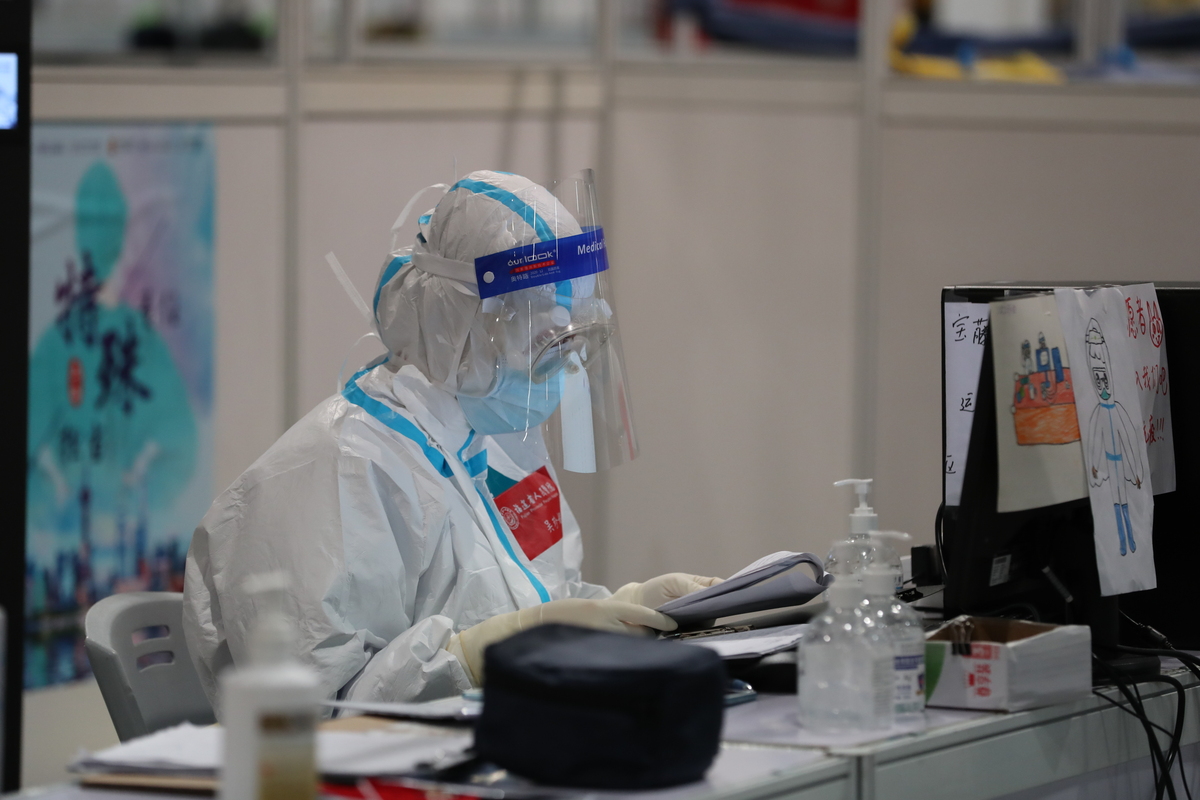
(Source: China Daily)
Reporter documents life in makeshift hospital
By HE QI in Shanghai | China Daily | Updated: 2022-04-20 10:35
From one aspect, Liu Xiaojing is just one COVID-19 case in Shanghai.
Liu's community in Minhang district, where he lives with his mother, wife and daughter, started closed-loop management on March 17. The family tested positive with COVID-19 on April 8. On April 10, three of them were transferred to a fangcang, or makeshift hospital, in the Shanghai World Expo Exhibition and Convention Center for centralized quarantine.
A journalist for 17 years and a photographer for local news portal Eastday, Liu decided to use his camera to record life in the fangcang even though his chief editor warned him to make his treatment the priority.
"Although I have experienced symptoms such as cough and fever as a patient, I am also a reporter," Liu said. "So I decided to record my experience in the form of a diary from the day of diagnosis.
"Defining myself as a patient, my diary angles will be more subjective. I set a boundary for myself to observe and experience as much as possible without interviewing other patients," he explained.
The fangcang where Liu is staying, one of the earliest established in Shanghai during the current outbreak, is mainly for mild and asymptomatic infections.
Since he arrived, the hospital has taken in more than 7,300 patients. It has been run by a medical team from Fujian province since April 9.
After settling down, Liu walked around with his camera late at night.
He saw most patients asleep, but each section had nurses on duty busy checking patient information and using computers. They have to check patients in who arrive in the early hours.
"I was impressed by the number of patients, beds and the medical staff," Liu said.
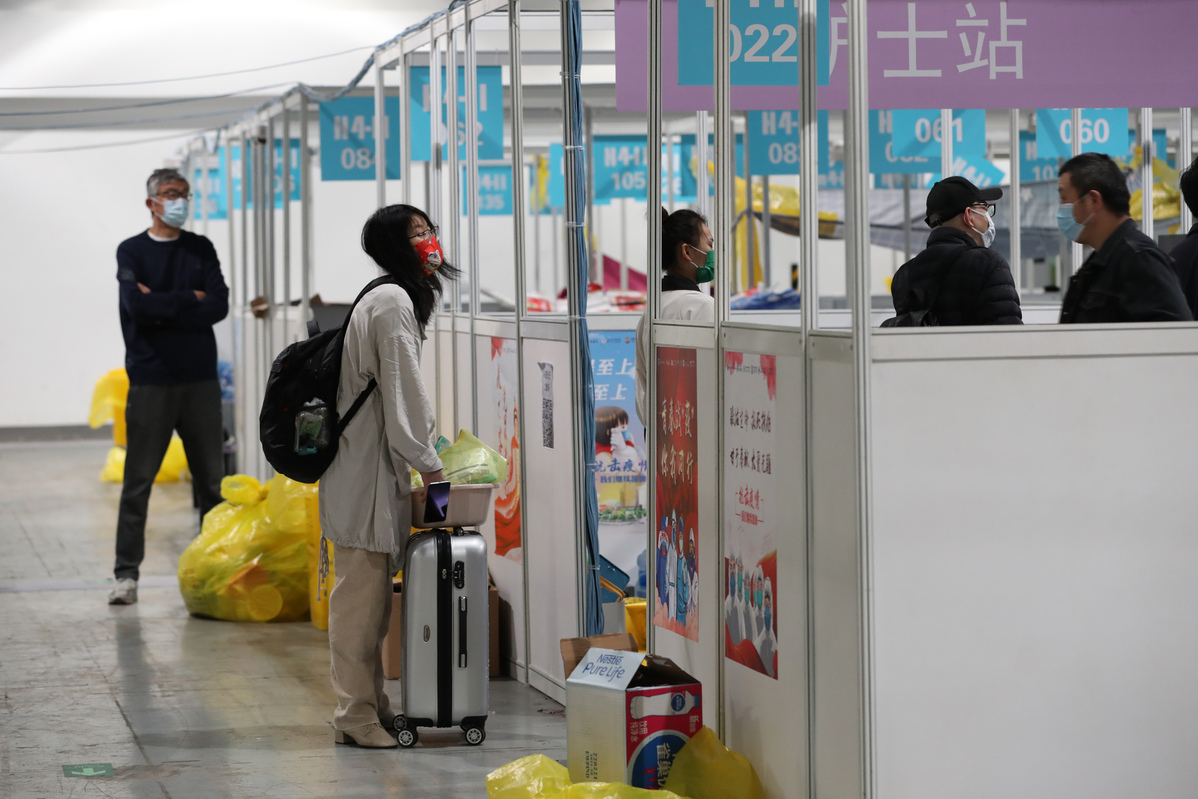
At 12:30 am, medical workers were dealing with the garbage. At 2:30 am, nurses were still busy on duty. At 4 am, new patients were lining up to enter the hospital. At 6 am, patients began to wake up and lined up for hot water. Some went to the nursing station to make inquiries. At 7 am, patient volunteers began to distribute breakfast and medical staff began to conduct nucleic aid testing.
The hospital became lively during the daytime.
Some patients work out in the public area, some tidy their living areas, some read on their beds and some elderly people chat in the sunshine.
One patient, Chen Chaosong, who was admitted to the hospital on March 29, came prepared with his scissors and is often busy cutting people's hair.
"I have cut hair for my colleagues for a long time. They can come to me at any time."
Chen, an employee of a local property management company, told Liu that he always carried his barber tools with him and now they are being put to good use.
One day, when he was cutting his own hair in the public wash area, a fellow patient asked if he could cut others' hair too. The part-time barber agreed and charges 20 yuan ($3.10) for a cut in the makeshift hospital.
"Before I came to the hospital, I thought it would be a scene of many weak and sick people. But when I came here, I found that I was the sickest one," Liu mocked himself in the diary. "I was the only one coughing when waiting in line for hot water and I was embarrassed.
"Most patients are calm and optimistic. This may be related to the low mortality rate caused by the virus so that we are not too nervous," Liu said.
"I feel like we're living in a dormitory. Apart from the imperfect public bathroom and bath equipment, the environment and other facilities are okay," he added.
Most people are calm and willing to cooperate with treatment and other management rules, although there are still small arguments.
On the fifth day, Liu described in his diary two patients arguing around midnight because one of them refused to wear a mask while sleeping. Another patient stood up and yelled at them to keep quiet because others needed to sleep, which finally calmed them down.
"Sometimes we may need to think more about other people. We all have complaints and difficulties more or less, but all of us continue to stay in the fight against the epidemic," he added.