(Source: China Daily)
Researcher reveals more details on human embryo gene editing
By Dara Wang, Chen Zimo and Li Bingcun in Hong Kong | chinadaily.com.cn | Updated: 2018-11-28 14:00
A Chinese scientist at the center of an ethical storm over what he claims are the world's first genetically edited babies said on Wednesday he is proud of his work and revealed that there has been another chemical pregnancy as part of the research.
Biological researcher He Jiankui also revealed more details of the controversial experiment in which he edited genes in human embryos that led to the birth of twin girls, Lulu and Nana.

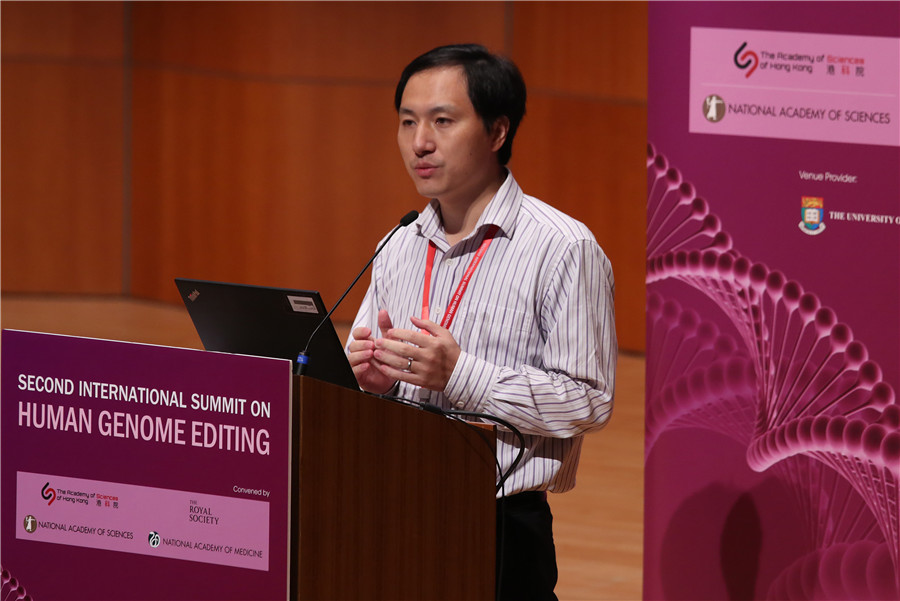
Speaking at a meeting on human embryo editing held in Hong Kong, the Chinese researcher, in his talk in English, said the purpose was to immunize the babies against the HIV virus through gene editing in the embryonic stage.
He told the audience that he had recruited eight couples through an AIDS support group. The requirements included the father being HIV-positive, and the mother HIV-negative. One of the participating couples later dropped out of his study, He said.
From the remaining seven couples, He said he got about 30 eggs, among which, 30 percent were gene-edited.

According to He, four experts reviewed the consent form that He later gave to the participating couples. He recalled that for each couple, he, in the presence of other expert observers, spent about 70 minutes explaining to them what the consent form meant, to convince them to sign the form.
The meeting He spoke at was part of the Second International Summit on Human Genome Editing, which began Tuesday and ends Thursday in Hong Kong. Since Monday, when he announced the news of the twin girls, he has been widely condemned by scientific communities in China and abroad for his disregard of ethics.
Professor David Baltimore, chair of the summit's organizing committee, said before He began taking questions, that it would be irresponsible to proceed with any clinical use of genome editing unless and until the safety issues have been dealt with and there is universal societal consensus.

Regarding He's research, Baltimore said it was not a transparent process. Baltimore said he believed that the diseases the summit participants had heard about in discussions earlier Wednesday morning were much more pressing than providing one person some protection against HIV infection.
In Baltimore's view, the occurrence of He's case has been a failure of self-regulation by the scientific community because of lack of transparency.
The summit's organizing committee will issue a statement on the matter on Thursday, Baltimore said.

Questions from experts and media after He's talk challenged him on various grounds, such as, what are the unmet medical needs that lead one to resort to gene-editing, when there are other proven alternatives to prevent HIV/AIDS?
They also asked what was the process to prepare the consent form for the parents and to get their consent, and whether He's team was competently trained to take consent in such experiments. He said that the parents are well educated and given two rounds of informed consent, which they understood.
He also was asked about what he thinks is his responsibility to Lulu and Nana as they grow up.
He did not answer the question with specifics, but in his speech he said that the informed consent document provided information about regular blood tests and other medical procedures.
Yang Zekun and Wang Feng in Hong Kong contributed to the story.