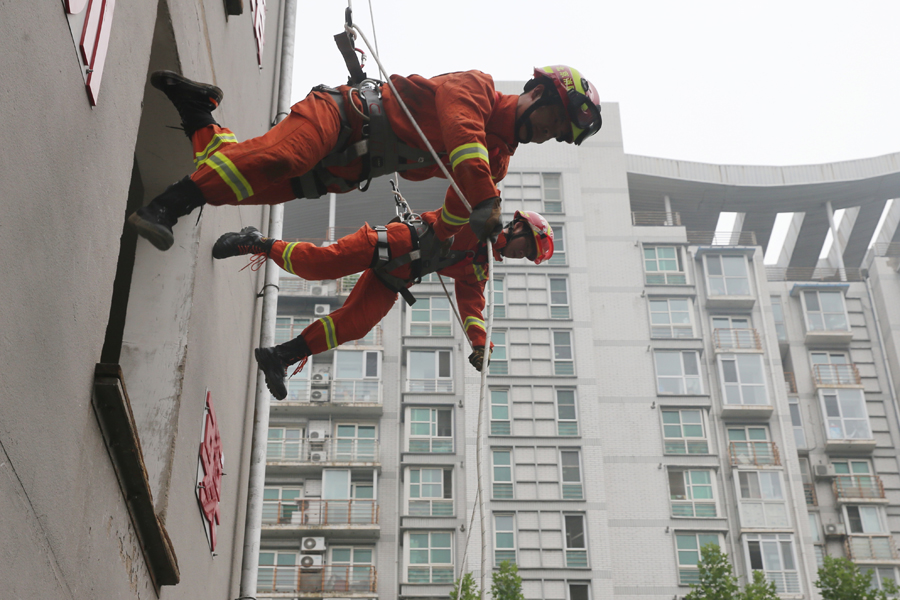
(Source: China Daily)
Many require psychological help to alleviate trauma triggered by scenes they witness in their working lives. Xin Wen reports.
Every time he returns to base after a mission, firefighter Wu Yadong throws away his used gloves and tries to forget what he has seen.
The 29-year-old, who is one of several deputy directors at the Wangjing Fire Bureau in Beijing's Chaoyang district, formed the habit after returning from a fire in which two seniors had been burned so badly that hardly any skin remained and their bones were clearly visible.
His training helped Wu remain rational and collected at the scene of the fire, but later he could not stop thinking about the fragility of life and the tragedy of accidental death.
Since then, when he returns to base after a mission, he refuses to think about the things he has just witnessed and discards his used gloves immediately so they will not remind him.
Many firefighters in China experience psychological trauma as a result of the scenes they witness during their work, and many admit to feeling more stressed than they had ever imagined before they started the job. Like Wu, most have developed their own coping mechanisms.
There are 170,000 firefighters in China, according to the Fire Department, which was part of the Ministry of Public Security until March when it became part of the Ministry of Emergency Management as part of an ongoing reshuffle.
In many Western countries, firefighters are provided with psychological counseling and assistance, but in China the mental trauma that can accompany their work is often ignored, which can result in long-term problems, especially as few firefighters are willing to seek help voluntarily.
A study of the psychological health of firefighters conducted nationwide by the Armed Police Academy of China in 2016 showed that 92.7 percent of those questioned had an anxiety-related disorder and 77.5 percent had depression.
According to the survey, most firefighters are ages 17 to 25, which means they are impressionable and can easily be affected by pressure of work or other people's behavior. Many admitted that they prefer escapism to facing up to reality in the long term.

Distress
In June, a 19-year-old woman surnamed Li jumped off a building in the downtown area of a city in the northwestern province of Gansu.
The heartless reactions of passers-by, who stopped to film the event on their smartphones, and a prolonged rescue attempt by firefighters, sparked heated discussion online.
A firefighter named Cheng Wei held the young woman's hands tightly for several hours as he tried to persuade her to abandon the suicide attempt. Eventually, however, she broke free from his grip and jumped to her death, causing another young firefighter at the scene to burst into tears.
Afterward, Cheng, a team leader at the local fire station, said the incident had caused him great distress and even led him to punch a wall several times. The young firefighter, who has just got married, is receiving psychological counseling for post-traumatic stress disorder, aka PTSD.
In 2015, Chen Fang, a psychologist in Beijing, founded a counseling center to provide mass psychological intervention after an explosion at a chemical warehouse in Tianjin claimed 165 lives, including 99 firefighters, and left eight people missing.
She said almost 20 percent of the people who attend the Herun Mental Health Service Center are firefighters, so she understands how the woman's suicide triggered Cheng's PTSD.
She believes that the nature of their work can cause extreme mental instability in firefighters.
"PTSD is a constantly growing problem," she said. "What's more serious is that a lot of firefighters don't realize that they have the disorder."
According to data released by the International Association of Fire Fighters, almost 20 percent of firefighters in the United States and Canada had PTSD in 2016, compared with 3.5 percent of the general population.
Chen said PTSD is now endemic among firefighters in China.
The symptoms may include flashbacks, feelings related to troubling events, avoiding incidents that can trigger trauma, and a rise in stress reaction that can last for more than a month.
Wei Hongchen, a 25-year-old team leader at the fire bureau in Wangjing, clearly remembers the first time he saw a dead body.
When Wei arrived at the scene of an explosion in the northeastern Beijing suburb of Zuojiazhuang that left two people dead and eight injured, an advance team of firefighters had almost cleared the scene, but one body remained.
Wei, who was a 21-year-old trainee at the time, had never seen a dead body, and he and his colleagues were curious. When a white sheet appeared in front of them, the firefighters couldn't resist opening it.
The acrid smell of burned flesh was overpowering, and the sight of the body shocked Wei. "It was a strong person who had been about 1.8 meters tall. He had been reduced to only about 1 meter in length," he recalled.
"At that moment, I realized how vulnerable we all are."
He also clearly recalls a failed attempt to save the lives of two men trapped in the cabin of a truck carrying about 70 metric tons of vegetables that collided with a car on the Jingcheng Expressway near the capital.
A lack of equipment meant Wei and his colleagues spent about 60 minutes using their bare hands to remove the spilled vegetables and get to the men.
The men were very weak, but one of them tried to talk with the firefighters.
"We spoke with him during the cleanup operation, but about 10 minutes before we managed to drag them out of the truck he stopped talking. They were dead when we got them out of the truck. We didn't see any injuries on their bodies, so they probably died from internal injuries," Wei said.
At home, he seldom talks about his work and daily experiences. "I don't want my parents to worry about me too much. I want to take care of things by myself, he said.

Traditional views
According to Chen, the psychologist, little psychological counseling is available to firefighters, despite a growing need for the service. Moreover, many firefighters hold a traditional view that it is better to work out one's problems alone.
"This is especially true if they have failed to save the life of someone they believe could have been saved. Then, they feel a sense of guilt and think it's their fault," she said. "If negative emotions are not dealt with correctly, a mental shadow can form."
For many firefighters, psychological counseling takes the form of talking with colleagues, mentors and senior officers.
"Chatting or drinking with comrades can reduce a lot of the pressure firefighters feel," said Zhao Yu, one of the deputy directors at the Wangjing Fire Bureau.
According to Zhao, a number of local psychological clinics often send counselors to speak with firefighters and relieve long-term pressures, and the bureau provides musical events to encourage team building and raise morale.
However, the lack of professional post-traumatic psychological support is a growing concern, despite efforts to improve the situation.
The problem partly stems from the fact that such support has a relatively short history in China.
The 2008 Wenchuan earthquake was a milestone in post-traumatic psychological support in China, according to Liu Zhengkui, an associate professor with the Institute of Psychology at the Chinese Academy of Sciences, who specializes in disaster psychology and trauma treatment.
Before the quake-which claimed more than 69,000 lives and left nearly 18,000 people missing in the southwestern province of Sichuan-no psychologists in China specialized in post-traumatic assistance, he said.
Liu added that inappropriate counseling provided by untrained volunteers exacerbated the problems experienced by survivors and also firefighters, who were on call 24 hours a day and needed extra counseling because of pressure of work.
"The situation resulted in firefighters from other parts of China, who had not experienced the quake but were working on rescue missions, also developing PTSD," Liu said.
National standard
In 2013, the Armed Police Academy of China formulated a national standard for psychologists who work with firefighters. The regulation sets the goals and principles of counseling and emphasizes the importance of establishing personal records for all firefighters.
Although applied nationally, the standard can be tailored to meet local requirements. For example, the fire authorities in Zhejiang province have invited psychologists to design a series of tests to assess the mental health of firefighters, and any deemed to be at risk have one-on-one counseling.
Liu said it is essential that a national system of psychological intervention is established to help firefighters cope with the stresses they encounter in their working lives and safeguard their mental health.
"Right now, I am not optimistic about their psychological equilibrium," he said.