(Source: China Daily)
A lack of care options means many will have no support when their elderly parents die, as Xin Wen reports.
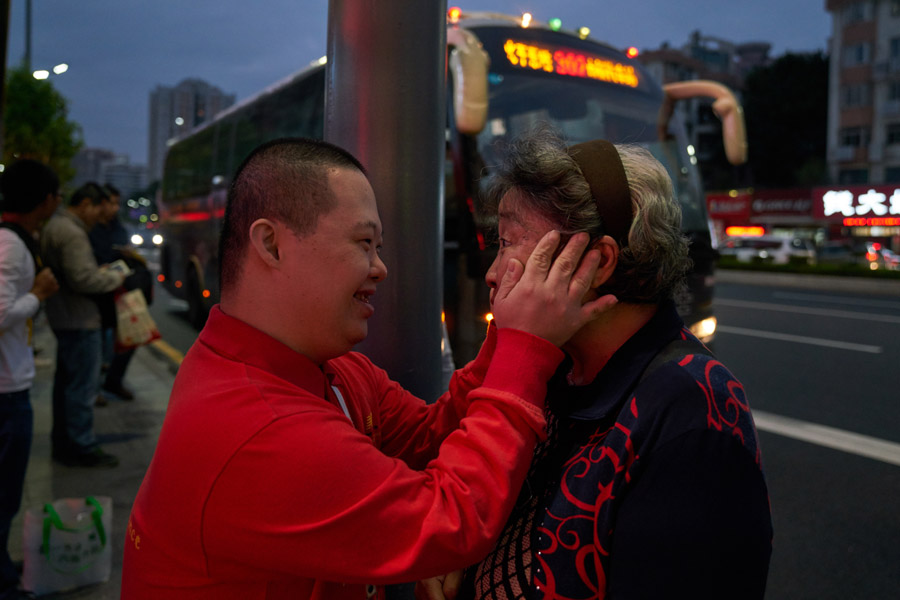
Meng Fanrong once considered jumping into the Pearl River in Guangzhou, Guangdong province, with her baby son in her arms because she was fearful of the future that awaited him.
Meng, now 70, quickly abandoned the idea, but her concerns over the future of her son, who has Down syndrome, persist nearly 40 years later.
Guo Feng, 39, is unable to speak, so he can't alert anyone if he is unwell or experiencing pain, and Meng can only discern his state of health through tiny changes in his expression. He is also unable to care for himself or perform basic tasks, and it took years to teach him basic skills, such as getting a newspaper from the newsstand or pouring water from the kettle.
Down syndrome, also called trisomy 21, is a genetic disorder that results when a person is born with three, rather than two, copies of chromosome 21.
The extra chromosome results in impaired mental capacity, delayed growth, flat facial features and lower immunity to a number of illnesses. The mental ability of an adult with Down syndrome is equal to that of a child age 8 or 9.
More than 2 million people in China have Down syndrome, according to the China Association of Persons with Intellectual Disability and their Relatives.
They have trouble communicating and controlling their emotions, and often rely on their parents for care into adulthood. As their parents age, though, the question of future care becomes an overriding concern.
People with Down syndrome generally take a long time to adapt to new environments, and some never adjust to new surroundings. Helping them to adapt requires knowledge of the syndrome, familiarity with the person's habits and endless patience.
As a result, many parents worry that without professional care, their children won't be able to adapt at all, and are concerned that caregivers will lose patience and mistreat their charges.
Desperate measures
In May last year, an 83-year-old woman surnamed Huang in Guangzhou drugged her 46-year-old son, who had Down syndrome, and strangled him. She then surrendered to police, saying her son was diagnosed with the condition when he was born and she constantly feared for him.
Huang was charged with homicide. "I was worried that I would die before him," she told the court, according to media reports. "I thought deeply for about a week and had the idea of giving him pills, allowing him to die peacefully without pain."
Meng, who followed the case closely, said she understood Huang's behavior because the same thoughts had occurred to her.
"I sometimes thought it would be better for my son to die. At least that would mean people could not treat him badly," she said. "He can't express himself and I need to pay close attention to him every day in case he falls ill."
She has become an expert on Down syndrome, and has developed ways of caring for Guo, but she cannot be with him all the time because she works part time to earn extra money to pay for his rehabilitation training.
At one point, Guo was sent to live at a school for students with mental disabilities, but he became upset and his health deteriorated. His unhappiness was obvious when he visited his mother for a week.
"He was such a cute boy, but when he came back from the school, he didn't speak a word and just sat motionless," Meng recalled.
The experience made her wary of sending Guo away again, so from the age of 18 until 30 he stayed home, and Meng prepared lunch for him before she left for work every day.
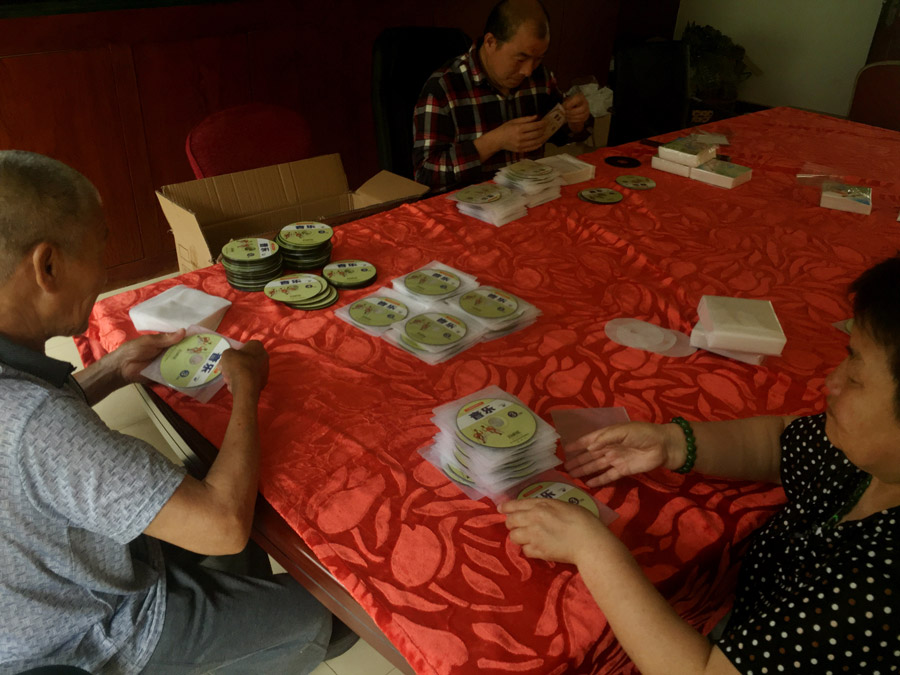
Now, Guo spends most days at a work therapy station, a day care center established by the Guangzhou government to provide mentally disabled people with opportunities to make handcrafted goods.
However, there aren't enough of these centers to meet demand, and one of the main reasons is a lack of government funding, according to Zhang Baolin, chairman of the China Association of Persons with Intellectual Disability and their Relatives.
"Most government funding for the mentally disabled targets the education and rehabilitation of teenagers, while in fact middle-aged people and seniors need more care and attention," he said.
Zhu Weisheng, who has Down syndrome, is also a frequent visitor to the work therapy station in Guangzhou. Ma Jieyun, his mother, has had to show the 35-year-old the short route from their home to the center many times.
"It takes him half an hour to walk a distance we would cover in about 10 minutes," she said.
Before Ma retired, Zhu was cared for by his grandmother. Although the elderly lady was his constant companion for about 20 years, Zhu showed no emotion when she died.
"As a child he seldom did any of the sweet things that kids normally do, but we grew used to it," Ma said.
Aging population
In addition to providing day care, many elderly parents are desperate to ensure their children will have a place to live when they are no longer around to help.
According to statistics from the National Down Syndrome Society in the United States advances in clinical treatment mean about 80 percent of adults with the condition reach the age of 60, and many live longer.
The rise in the number of older people with mental disabilities presents a growing problem, according to Zhang, who said most are cared for by their families, but only those with the most severe disabilities are eligible for State benefits.
However, benefits vary by region, so mentally disabled people in the country's eastern areas receive 800 yuan ($125) a month, while those in western areas get 300 yuan.
In most cases, these people will be left alone when their parents die.
Zhang, who has a 40-year-old mentally disabled daughter, believes "double fostering" - where elderly parents and their children are cared for in the same place - could provide a solution.
"But there are not enough institutions to meet the huge demand; a lot of areas don't even have one establishment for mentally disabled people," he said, adding that a lack of professional nursing staff members also poses problems for centers dealing with older patients.
"Parents carry the whole burden, but sooner or later they won't be able to carry on."
Incentives
In response, some local governments provide incentives to encourage private nursing homes to provide care for older people with mental disabilities. Even so, the few homes that offer such care are shunned by parents concerned about standards and conditions.
The Boai Disability Care and Rehabilitation Center in Beijing's Chaoyang district provides 200 beds for people with physical or mental disabilities, but only 45 percent are filled.
Nearly half of the mentally disabled people at the center are beneficiaries of the "One-year Breathing Policy", which is promoted by the Beijing Disabled Persons' Federation and provides low-income families with 12 months of free government-funded care in public institutions.
"Only a few parents know these institutions exist, and they are so concerned about the living conditions that it's hard for them to decide to send their children to us," said Du Lianli, the center's director. To make matters worse, many families that don't qualify for free care are unable to afford the high fees charged by care homes.
For example, the Boai center charges 1,800 yuan a month per bed, while nursing fees are extra and vary according to the treatment provided.
The average monthly fee is 2,700 yuan, equal to the average middle-class income.
The figure is prohibitively high for most families, but crucially it is too low to allow the center to hire qualified caregivers, meaning that many members of staff are untrained.
In 2014, the Beijing Disabled Persons' Federation established five centers to provide basic care for patients ages 16 to 59, making the capital a leader in the provision of facilities for people with mental disabilities, according to Zhou Hongfei, deputy director of the federation's education and employment department.
Despite the federation's efforts, more action needs to be taken. "We need to work with other bodies, including the health and civil affairs departments, to devise a more comprehensive policy," Zhou added.
Prevention, screening
Xu Jiacheng, deputy director of the China Disabled Persons Rehabilitation Association, said there is still a long way to go in the provision of care nationwide.
Every 20 minutes, a baby is born with Down syndrome in China - about 26,000 children every year. Xu urged women to undergo tests during pregnancy to detect abnormalities.
In 2014, the central government urged local health departments and institutions to develop a genetic screening test that could be used during pregnancy to detect problems, according to the National Health Commission.
However, the latest data from the Chinese Society of Perinatal Medicine show that only about half of the pregnant women in China undergo any form of screening.
Experts say that while there are no effective measures to prevent Down syndrome, screening can detect the condition at the earliest opportunity, allowing expectant mothers to decide whether to have the baby.
While an uncertain future awaits those who choose to have a child with Down syndrome, Meng Fanrong, who once thought of killing her son, is grateful for the joy Guo Feng has brought to her life, and she is determined to be optimistic.
"I really hope some nice person will adopt him after I die," she said.
Contact the writer at xinwen@chinadaily.com.cn
I once lost him for five days
Wu Miaoling, a 65-year-old retiree in Guangzhou, Guangdong province, whose son has Down syndrome.
Guo Yimin is 40 this year but I always treat him like a 6-year-old. He makes me laugh and cry. His life is so pitiful that I can't imagine what will happen to him when I am gone. It just adds to my pain.
Yimin was born with an extra chromosome, so he was fated to be different from other people.
Every morning I bring him to the work therapy station, which is sponsored by the Guangzhou government. He is paid about 12 yuan ($1.90) every day he goes there to make handcrafted items.
Life is a normal routine for him now, which is the best I can hope for. I force myself not to think about the time after I am gone, and I treat every day as the happiest it can be.
Guo can't express himself clearly and I am always worried that he will just disappear without anyone noticing.
One time I lost him for about five days. I felt as though I was going insane, and made frantic efforts to find him. It turned out that he took my metro card to ride the Guangzhou subway, but he got lost at Panyu Square, the last stop on Line No 3.
Fortunately I found him. I don't know what would happen if I lost him again but all I can do now is make sure he is close to me and always keep an eye on him.
He is a very stubborn person and must complete something if he feels he has figured it out. He is also a sweet guy. One day when he was age 5, he saw me washing clothes in the kitchen and handed me a small stool to sit on.
I hope the government will pay more attention to people with mental disabilities and extend the program so more people with Down syndrome will be eligible to claim benefits.
Wu Miaoling spoke with Xin Wen.