(Source: China Daily)
Senior care dilemma as cross-border option ends
By Zhou Mo | China Daily | Updated: 2018-01-05 08:55
Fewer older people from Hong Kong are moving to the mainland to take advantage of lower costs to fund their retirement, as Zhou Mo reports.
Living on the other side of the border used to be a popular option for retired seniors in Hong Kong, especially as they often had to wait years to be allocated a place at a local nursing home.
Larger homes, a lower cost of living and a better social environment were some of the factors that prompted seniors to spend the autumn of their lives in the Chinese mainland.
However, in recent years the number choosing to make the move has fallen.
The appreciation of the yuan against the Hong Kong dollar has resulted in a higher cost of living on the mainland, so it is no longer a cheap option for Hong Kong seniors, especially as they do not qualify for free use of the mainland's social welfare services and must use their savings to pay all expenses.
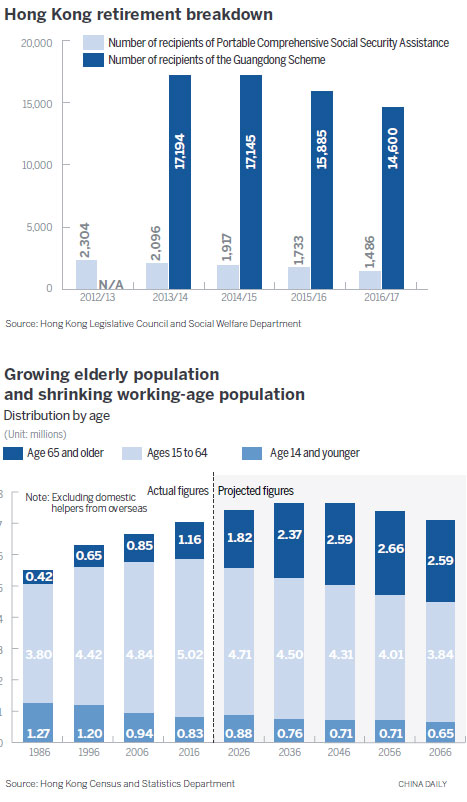
In October 2013, the Hong Kong government launched the Guangdong Scheme. It offers an allowance of HK$1,325 ($169) a month to eligible Hong Kong seniors age 65 or older who choose to reside in Guangdong province, but the number of people drawing the allowance is falling every year.
The Hong Kong Social Welfare Department said 14,600 people benefited from the policy in 2016-17, a fall of 15 percent from the 17,194 recorded in 2013-14.
The number of recipients of Portable Comprehensive Social Security Assistance has also declined.
The program is part of Comprehensive Social Security Assistance, a welfare measure that provides supplementary payments to Hong Kong residents whose income is too low to cover daily needs.
Portable Comprehensive Social Security Assistance extends the concept by ensuring that residents who choose to live in Guangdong or Fujian province still receive the monthly payment, boosted by an annual long-term supplement.
In 2015-16, 1,733 people claimed welfare benefits; a fall of about 25 percent from the 2,304 who claimed in 2012-13.

Cross-border care
The Hong Kong Jockey Club Shenzhen Society for Rehabilitation Yee Hong Heights is a residential nursing center in Shenzhen, Guangdong. The center is supported by the Hong Kong Society for Rehabilitation, a charitable organization.
It is one of just two facilities in Guangdong that implements the Pilot Residential Care Services Scheme. Launched in June 2014, the scheme offers places at nursing homes and residential care services to Hong Kong seniors on the city government's Central Waiting List for Subsidized Long Term Care Services.
The other facility is the Hong Kong Jockey Club Helping Hand Zhaoqing Home for the Elderly in Zhaoqing, part of an 11-city cluster in the Guangdong-Hong Kong-Macao Greater Bay Area.
As of Sept 21, 165 seniors from Hong Kong were living at Yee Hong Heights, 116 of them subsidized by the government. The remaining 49 pay the fees themselves.
A two-bed suite with comprehensive nursing care costs 7,350 yuan ($1,108) a month but the cost rises to 8,330 yuan if special nursing care is required.
"Nursing care in the mainland, especially in places such as Shenzhen and Guangzhou (capital of Guangdong), is becoming increasingly unaffordable for ordinary people," Wong Chi-keung said.
The 73-year-old, who lives in a nursing home in Dongguan, another city in the Greater Bay Area, pays 3,000 yuan per month.
"Compared with Hong Kong, the cost of living in Dongguan is lower. But that's only if you don't see a doctor. If you get ill and go to the hospital, the high medical fees will immediately raise your expenses to a high level."

Lost connections
A lack of connections with the mainland is also dissuading seniors from Hong Kong from heading north.
"Many Hong Kong residents came to the city from the mainland several decades ago, so they have close links with the mainland and are willing to return there when they retire," said Jackie Mok, head of Yee Hong Heights.
"However, those generations are gradually passing away. The new generations of seniors who were born and grew up in Hong Kong prefer to stay in the city rather than move to an unfamiliar place when they grow old."
Wendy Man, vice-chairman of the Clifford Group, which owns the Clifford Care Home for the elderly in Guangzhou, urged mainland nursing homes to raise their professional standards, in terms of care services, and work on positioning their operations.
The diminishing enthusiasm for cross-border elderly care among Hong Kong seniors could mean the city will face a heavier burden in dealing with its aging problem as the elderly population grows.
According to the Hong Kong Census and Statistics Department, people age 65 or older accounted for 16 percent of the population in 2016. The figure is projected to reach 36 percent by about 2057.
Helene Fung Hoi-lam, a professor at the Chinese University of Hong Kong who researches aging issues in the city, said her research suggests that some seniors are looking at low-cost housing in Taiwan or Southeast Asia when planning their retirement.
Noting the government's initiatives in the recent policy address, she said authorities have worked hard to make the senior care ladder easier to climb by providing community and household care.
Hong Kong is a society with low tax rates, which makes implementation of a fully fledged universal pension system untenable, Fung said.
Despite that reality, the policy address stated: "The government's policy direction should accord priority to the provision of home care and community care, supplemented by residential care."
Contact the writer at sally@chinadailyhk.com