(Source: China Daily)
Appreciating a Beijing staycation
By Bruce Connolly | chinadaily.com.cn | Updated: 2022-02-08 17:08
'Staycation', a phrase increasingly spoken of over the last two years. Due to the ongoing COVID-19 pandemic, this has become a norm for many people. Basically it refers to staying in one's home country or city while not traveling beyond the borders.
Over recent years there has been a steadily rising trend of Chinese people going overseas for vacations- a reflection of the growing affluence for many in today's China. Travel, a desire to experience and understand lands well away from our everyday lives. That is one reason I came overland to China in 1987. Many years later, I still remain passionate about my travels within this country.

Over the past two years outbound travel, for most of us, has been significantly curtailed. Various travel restrictions or advisories remaining in place, people have been changing their plans and aspirations. However, a carefully planned staycation can result in a very successful, indeed meaningful experience even in a familiar place. Many have seized this opportunity to discover more of the unique beauty and diversity of China. A boon, of course, to local economies, particularly in less-developed rural areas.
In Beijing there is the ongoing 2022 Winter Olympics at the same time as strict measures are needed to keep the pandemic from spreading. This all coinciding with the annual Spring Festival holiday. I saw this as a chance to simply concentrate on and appreciate what Beijing has to offer.

The area where I live, in Chaoyang district, is modern, increasingly international and can be very busy. It is significantly different from the city's historic heart. I felt a personal need, a desire to spend time closer to the heart of the city, to be within what I refer to affectionately as 'Old Beijing'.
For several of my earlier years I stayed in a hutong alley near Jiadaokou, a location whose history goes back to 13th century Yuan Dynasty. Often I would walk south from there to the area between Forbidden City and Wangfujing Street. So much of Beijing's early story was there for me.

To my delight, I found a comfortable hotel to spend some of the recent holiday, at the core of the city, west of Wangfujing. A short stroll would lead to where the walls of the former Imperial City once ran. Beijing historically was composed of several walled districts, or 'cities' with Forbidden City at its center. This proved a perfect location for several relaxing days while also photographing the city over the festival.
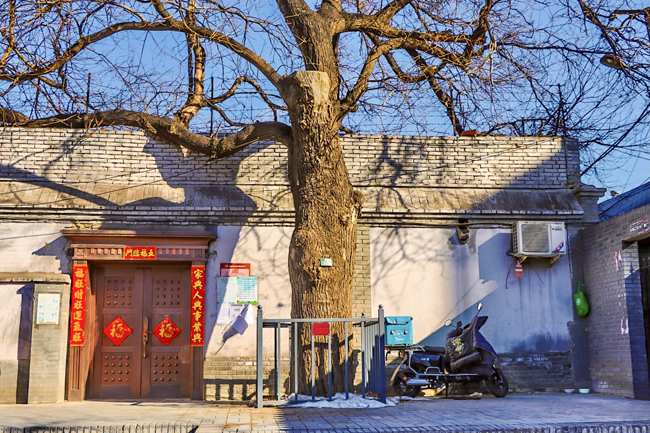
Initially I simply walked around the neighborhood revisiting streets that somehow had retained their earlier familiarity, others of course, significantly changed. It was a particular joy over breakfast to simply look out over the sloping rooftops, a feeling of gazing over part of Beijing's intrinsic heritage.
Directly west of where I was staying is a maze of alleys centered around Ming Dynasty Pudu Temple, formerly the Imperial City's East Garden. That area was renovated in the early 2000s, combining new courtyards in traditional style alongside upgraded residences of longtime local residents. Continuing through I reached Nanchizi street, once home to storage areas or warehouses for the palace. This included the former Imperial Archives (huangshicheng), constructed in 1534 and still standing within a large walled courtyard. Important documents from both the Ming and Qing dynasties were deposited there. Nanchizi was then prohibited for ordinary people to enter.

Within a few minutes, I was entering one of the grandeurs of historic Beijing. The Imperial Ancestor Temple ('taimiao'), constructed in 1420 during Emperor Yongle's reign. It represents an amazing complex of Ming-era architecture that has remained basically in its original design. My visit coincided with the first day of the Chinese Lunar New Year. Crowds were heading to the nearby Forbidden City, but as I stood amidst groves of ancient cypress trees, I was almost alone. I wandered slowly through gates in crimson-painted walls topped by yellow tiles. Regularly, within vast, silent courtyards, I would stop to photograph and consider the magnificence of the structures. A most sacred site, the main temple building sits on top of a three-tiered marble terrace. So often I have spent moments there simply sitting quietly while absorbing the incredible feel, the seemingly timeless legacy of Imperial Beijing. Although few visitors, I was receiving friendly seasonal greetings of "xin nian kuaile" (Happy New Year!) from any staff members who saw me.
Spring Festival, a time for families coming together. Indeed, over breakfast every morning I noticed how many of the guests were extended family groups. A tradition that has noticeably continued throughout my many years in China.

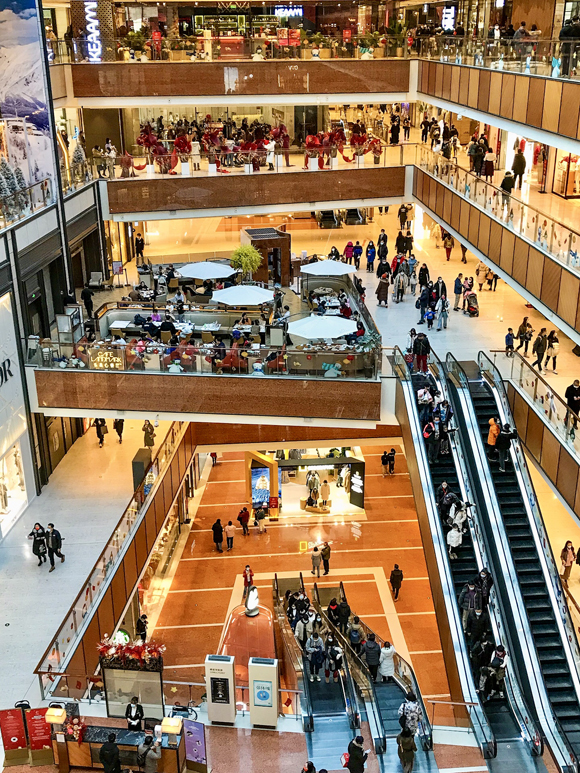
A few minutes north of the hotel, I came upon a small but very active outdoor skating rink. I was also thinking of the outdoor skating I first saw in 1995 at Shichahai, north of Forbidden City. Over the holiday, such areas continued to be busy along with the frozen lakes in many parks across the city. However, this smaller rink was in a garden attached to WF CENTRAL mall, opened in 2018. Inside that vast, modern complex I came upon a trend I have noticed recently in Beijing. With the ongoing 2022 Winter Olympics, many sports clothing companies promoting the latest in outdoor gear.
As I headed back onto Wangfujing Street I noticed the amazing blue skies we have been having recently. Perfect conditions I felt for outdoor events such as the skiing competitions underway at Yanqing and Chongli.
Wangfujing has a history going back over 700 years. It has long represented where newer and older come together, where east and west also interfaced. Close to the eastern gate of Forbidden City at Donghuamen, the locality became home to several aristocratic families and senior palace officials. This, reflected in its name with 'Wangfu' representing 'princely residence', while 'jing' refers to a natural well or spring that once provided water for the area. It was also a major market area, a tradition carried on to this day but now within modern malls.

As Beijing started expanding rapidly in the early 1990's, Wangfujing was losing some of its appeal to newer suburban shopping areas. In response, plans were launched to revitalise the area. In 1998, Beijing Sun Dong An Plaza opened, transforming customer experiences. The premier Oriental Plaza complex, facing onto Chang'an Avenue followed in 2001. Meanwhile the street was pedestrianised which certainly boosted its popularity. WF CENTRAL representing a splendid addition to Wangfujing's renewal and growing attraction.
Wangfujing was busy every day during the holiday, helped by the recent opening of new metro station entrances at both ends of the pedestrianized section of the street. It was a great time for people watching, whether it be children enjoying an ice cream or young adults queuing for coffee and pastries at an iconic French van now transformed into a small bistro. Meanwhile, the longer established malls have been transformed considerably since they first opened more than 20 years ago. Crowds were heading into them for shopping or seeking out the many dining experiences on offer. My feeling was most people I saw were Beijingers who, like me, were spending this period in the city. It was a time for me also to reflect on how people's lifestyles have changed since I first saw Wangfujing in 1994. Such malls, restaurants, fashions simply did not exist then - it was almost like looking at a very different world today!

As the holiday drew to a close, it was appropriate to have a traditional hotpot dinner, something I have a real passion for. This would be in a long established restaurant near the Donghuamen Gate of Forbidden City. It was fascinating how the establishment had changed to reflect modern times. Although refurbished and very comfortable, its interior design had managed to retain a sense of its original appearance. The copper hotpot was using gas instead of coal, while robots were delivering utensils and dishes to the table. Amazing! Behind me a couple had placed an iPad on their table to rewatch the Spring Festival gala while dining. Of course, payment was digital using the popular Weixin app. Leaving the restaurant I walked back down Nanheyan where once the walls of the Imperial City stretched. A feeling of the city's history gripped me.
Next day, back in my apartment near Sanlitun, it was time to watch the opening ceremony of the Beijing 2022 Winter Olympics, another great, indeed memorable, moment in my Beijing staycation.