(Source: China Daily)
Celebrating 60 years of Ghana-China diplomatic relations
By Edward Boateng | chinadaily.com.cn | Updated: 2020-07-05 20:08
Today, July 5, marks the anniversary of the 60 years since the establishment of diplomatic relations between Ghana and China. Sixty years of enduring and exemplary relations and cooperation between the two countries is worth cerebrating and pondering over.
Ghana established diplomatic relations with China shortly after becoming a republic in July 1960, one of the first African countries to do so. The personal friendship between President Kwame Nkrumah and Chairman Mao Zedong laid the deep foundation for relations between the two countries at the time. They were the thought leaders of their generation who stood shoulder-to-shoulder and became the mouthpieces for the oppressed. The first Chinese ambassador to Ghana, Huang Hua, presented his credentials on July 5, 1960, while the first Ghanaian ambassador to China, Kobina Kessie, assumed duty in Peking on March 26, 1961. On Aug 23, 1961, Ghana and China signed the Friendship Treaty, which affirmed the close bilateral ties between the two countries and established the foundation for practical cooperation, as well as the emergence of Afro-Asia solidarity that became strategic in the pursuit of decolonization and peace, and the development agenda of small developing countries at the time.
The Friendship Treaty was also aimed at creating a model for mutual economic, social and political development, as well as to contribute towards the stability of Ghana and, by extension, other newly-independent African countries.
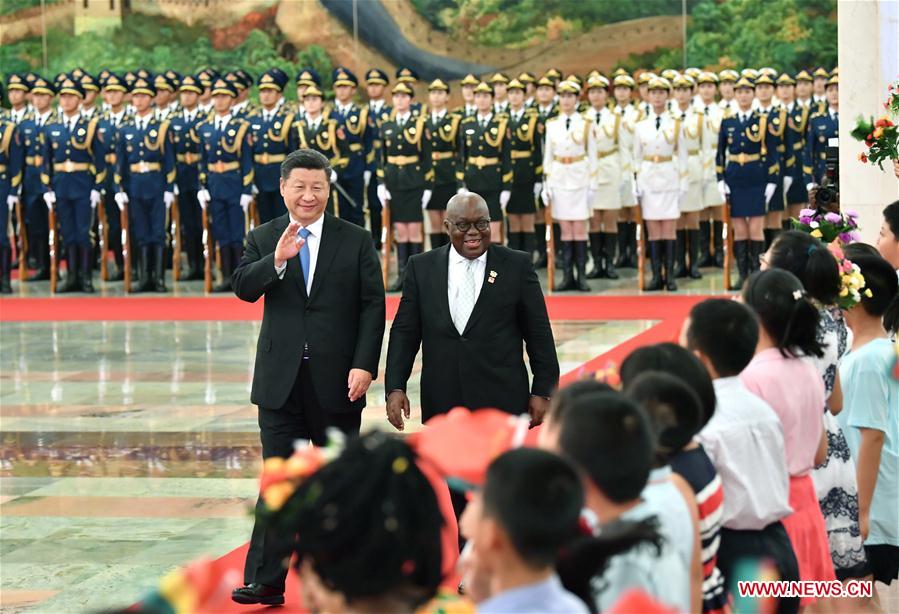
The 60th anniversary of our diplomatic relations with China presents an opportune moment for our two countries to take stock and deliberate on past developments and to formulate new agendas for greater successes in the coming years. Over the past six decades, our relations and cooperation have been tested but become more robust and diverse, touching practically all conceivable spheres of development, especially under the leadership of President Nana Addo Dankwa Akufo-Addo and President Xi Jinping, notably in trade and investment, culture, education, politics, economics, among others.
Our two countries have recorded significant achievements that deserve acknowledgment. Notably, Ghana was one of the earliest and consistent advocates and supporters of the admission of China into the United Nations organization and later a permanent member of the UN Security Council. It was Ghana, and indeed our ex-president J.A. Kufuor, at the time a deputy foreign minister, who cast the historic vote at the United Nations General Assembly for the admission of the People's Republic of China to the United Nations in 1971. The significance of this singular act should not be lost on us. It paved the way for acceptance of the People's Republic of China into the international comity of nations and restored its legitimacy as the only true representative of China to the United Nations. Since then, Ghana has continued to adhere to the One China Policy. China, on its part, has also been an ardent supporter of the Common African Position on the Proposed Reform of the United Nations, also known as the EZULWINI CONSENSUS, which was put forward by our current president, Nana Addo Dankwa Akufo-Addo, when he served as foreign minister. The two countries have continued to cooperate at the multilateral level as they work together to ensure a just, equitable and peaceful international order.
Sino-Ghanaian relations have been reinforced through the exchange of high-level visits between leaders of both countries. Over the past four years, the president of the Republic of Ghana, the vice-president, chief of staff, foreign minister, the first lady and a host of other ministers of State have all paid official visits to China. The Chinese side has reciprocated with visits to Ghana by the vice-premier, ministers of State and other high-ranking members of the Communist Party of China. The exchange of high-level visits has reinvigorated Sino-Ghanaian relations and given it a renewed sense of purpose.
On the economic, trade and investment front, the two countries have deepened their cooperation. In fact, China has provided Ghana with much-needed economic support in the areas of finance and infrastructure development. For the record, China is currently the largest investor in Ghana by number of registered projects. It is also Ghana's biggest trading partner, with a total value of trade reaching a record $7.46 billion in 2019 (Ghana Exports to China, $2.56 billion and Chinese Exports to Ghana $4.9 billion), thereby surpassing our traditional partners. The government of Ghana has further deepened its economic cooperation with China by joining the Asia Infrastructure Investment Bank and the Belt and Road Initiative. Funding from the AIIB and under the BRI initiative is important to support projects critical to Ghana's national development, particularly in roads, railways, and ports and harbor expansion, among others.
Strong cultural exchanges and people-to-people bonds have contributed in no small measure to bringing the people of Ghana and China closer, and have in turn, provided a powerful impetus for the development of the relationship of the two countries. Cooperation between the two countries in this area includes exchanges and interactions related to education, tourism, the media, visual art, design, theater, music, dance, film and sports, as well as exchanges between think tanks. Ghana leveraged its strong and rich cultural heritage in the above-mentioned fields to develop strong bonds of friendship and cooperative relations with China. Under the auspices of the Office of the First Lady, Rebecca Akufo-Addo, 20 Ghanaian children from all over Ghana participated in sports and education programs in China in 2018.
Educational exchanges between Ghana and China have also been strengthened and expanded. The number of Ghanaian students studying in Chinese academic institutions at various levels and in different fields has increased over the years. Presently Ghana is estimated to have the highest number of African students studying in China. These students will return home and make notable impacts on Ghana's socio-economic development in the coming years.
Consular relations between the two countries are on a positive trajectory as reflected in the increased number of people-to-people exchanges and contacts at all levels. According to the Ghana Immigration Service, an estimated 22,000 Ghanaians visited China as against an estimated 10,500 Chinese arrivals in Ghana in 2019. Under the auspices of the Ministries of Foreign Affairs of both countries, the first consular consultations between Ghana and China were held in Beijing from Aug 24-25, 2019. This long-awaited consultation will hopefully help define our consular and people-to-people relationships in the coming years.
The government of Nana Addo Dankwa Akufo-Addo established a Ghana Consulate-General in Guangzhou in April 2019 to better cater to its economic interests and the welfare of Ghanaians in that territory. Over 60 percent of resident Ghanaians in China live in Guangdong province. The consulate-general also provides consular and other services to many Ghanaian traders and businesspersons who visit the city. It is worth highlighting that the province is the pre-eminent economic powerhouse of China, with a GDP equivalent to $1.4 trillion, accounting for nearly 15 percent of the total GDP of China. In 2020, an honorary consul was also appointed in Hong Kong and an honorary consulate office opened in June 2020.
While we take stock of the achievements of Sino-Ghanaian relations over the years, it is important to explore new areas of cooperation that can spur the economic growth of Ghana. One such area is for Ghana to leverage its status as host of the Secretariat of African Continental Free Trade Area. The coming into force of the African Continental Free Trade Agreement would create a huge market of 1.2 billion people, an opportunity for Chinese investors to explore. Chinese investors are therefore urged to take advantage of this development and the conducive business environment in Ghana as a springboard to access the continental market. Ghana is going to become the major trade hub of the West African region in Africa, the "Singapore of the West" as some envisage.
The Belt and Road Initiative espoused by Chinese leader President Xi Jinping also presents new diplomatic and economic opportunities for Ghana and could completely transform our financial, manufacturing and technology sectors by connecting Ghana to new markets across the globe. We can learn from the Chinese models. In addition, China's emphasis on intensive infrastructure development, especially in the transport sector, would play a major role in supporting government transformational initiatives, such as the One-District-One-Factory, by opening up important transport routes for marketing our domestic products. Ghana-China relations can certainly be leveraged for mutual benefit across several areas. I believe that it need not be a one-way relationship.
With our world hit by the COVID-19 pandemic, a new normal is gradually being created. COVID-19 has reset the clock of engagement and the way things are going to work going forward. There is going to be a significant shift in the way that business, political conversations and engagements across the globe will be conducted. Ghana-China relations can ride on the back of the new normal and create viable political, economic, social and cultural partnerships that will define our future in the post-COVID-19 era. With the seeming death in leadership across the world, and with Ghana's growing leadership and voice on the African continent, and specifically in the West Africa sub-region, Ghana-China relations post-COVID-19 has the potential of becoming a blueprint for other bilateral and multilateral relations.
Forging ahead, we must continue to ensure that our relations and cooperation continue to be anchored in the time-honored principles of sincerity, equality, mutual benefit, solidarity and common development.
The author is Ghana's ambassador to China.
The opinions expressed here are those of the writers and do not necessarily represent the views of China Daily and China Daily website.