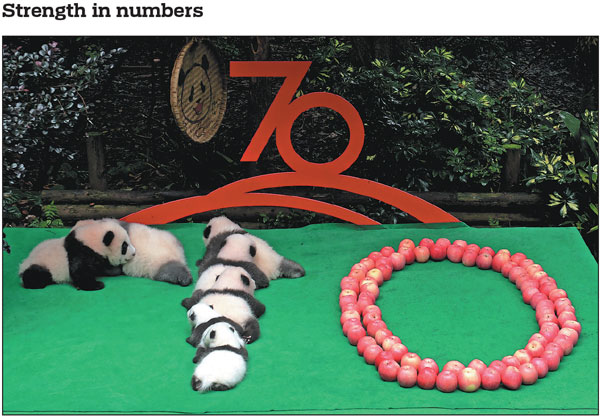
(Source: China Daily)
Decades of change: Let the past serve the present
By Laurence Brahm | chinadaily.com.cn | Updated: 2019-09-25 12:12
Courtyard reflections
The brown wrinkle of fallen leaves can be heard in the midnight breeze on the doorstep. This is the sound of Beijing in mid-autumn. For much of the past 25 years I have lived in a Qing-period courtyard house, which was the former home of Manchurian banner men. In the winter months, the Mongolian winds cut dry and sandy through the narrow hutong alleys outside, which form a labyrinth in the center of Beijing. This gives the courtyard a sense of solitude.
During the winter months, hutong life becomes silenced by the sound of wind.
The sharp shrill of Beijing's old dialect, heard amid cackling laughter in the summer months as elders play chess, drink tea and eat sticks of grilled lamb late into the evening, disappears in the winter months. It is replaced by the silence of a penetratingly blue sky that echoes clarity of mind. The haunting sound of pigeons flying in flocks with small cups tied to their feet – an old Beijing tradition for raising pigeons and tracking their movements – can be heard sweeping against the porcelain blue sky.
In the morning as I practice qigong on the back roof of our courtyard, I can see ultraviolet lights from high rising in the distance in a city that never sleeps, fading against the red sun rising in the morning east. The ancient inner city's complex of alleyways called hutongs (a Mongolian word that means water well) spreads as a labyrinth in all directions below.
These hutong were laid out during the reign of Yuan Dynasty Emperor Kublei Khan, who decided to make Beijing the site of his new capital, following the Mongol conquest of China in the 12th century. He hired Arab architects from North Africa to design the layout of this city, which has an almost Kasbah sense to its narrow-winding alleyways. Nepalese craftsmen came to build the white Buddhist stupas that stood as rising symbols of this new capital. Beijing was a crossroads of culture, an open center of diversity, learning and higher aspirations.
During the Ming Dynasty that witnessed the revival of Han rule over China during the 13th century, there were at least three Buddhist temples built on this hutong where I live. Craftsmen from Huai county in Shanxi province came to build the Forbidden City as it stands today, the parks and palaces that became Beijing as we know it. They brought with them their famous huai or scholar trees from Shanxi, planting them along the hutong for shade. A grand scholar tree rises from within my courtyard home today, cooling refuge from summer heat, somehow connecting shadows of the Ming Dynasty into our life today.
During the Qing Dynasty when Manchurians took power over the capital in the 15th century, this hutong became home of the White Banners, one of eight warrior castes of the Qing Dynasty. When the Qing were overthrown in the 1911 Revolution of Dr Sun Yatsen (who died only a few alleyways north of my home), this entire neighborhood was froth with intrigue as warlords scrambled for power and the Communist underground struggled against Japanese invasion and Kuomintang repression, during epic turmoil and civil war, that would lead to the founding of the People's Republic of China in 1949.
The gray brick walls and time-worn lion stones at the gates of these courtyard houses that line the hutong are the witness to the weight of a powerful history. My feelings about this city are best described with great sensitivity by the late author Han Suyin:
"Peking is home as no place else will ever be. We are exiled and disinherited until we may return. Beneath all tragedy there was an essential peace there, a deep substratum of unshakable harmony. There was beauty, the more poignant for its stately sadness. Our feet trod dust so rich in history, so weary with centuries of battle, so old with glory, that we were made wise and self-contained beyond our years."
In the autumn of 2019, in the silence of my courtyard home in the Eastern District of old Beijing's inner city, I reflected on the 70 years of change that transpired right here in the capital, in these very alleyways, an interlocking chain of events that mark the liberation, founding, opening, reform and modernization of China. This sequence of changes can only be appreciated in the context of a deep and complex history, the energy vortex of which lies right here in the center of Beijing.
Western perceptions
Western perceptions of China are bound by a series of misconceptions and prejudices that when combined, form the basic framework through which the events and changes occurring within China are misinterpreted. Chinese leaders have occasionally referred to this as "seeing the world through tinted glasses," an observation that is so accurate. Unfortunately, this Western framework is not easy to dismantle, as it stems from centuries of misleading information and an entrenched mindset formed by a self-righteous Christian religiosity and colonial supremacy.
Misperceptions of China began to be formed 800 years ago when the Mongolian hordes tore across the Siberian plains, through what is today Russia and Eastern Europe. This, historically, was the West's first real encounter with the East. The Mongolian invasion left in its wake wasted cities and populations—the hit-and-run strategy of conquest adopted by what was basically a nomadic people. The Mongolian conquest stunned Europe; the Mongolians seemed ruthless, unstoppable and undefeatable. Actually, they were strategically ingenious and open to absorbing the best of every culture that they conquered.
When the Mongolian threat subsided, Europe breathed, and feudalism continued. The dark ages, however, began to brighten when, in times of peace, Marco Polo visited Kublai Khan, and brought back with him the refinements of culture which had already become an accepted basis of life in China, but remained unheard of in Europe. With culture he brought new technology: gunpowder. It was the European exploitation of the potential of this single item – gunpowder -- which catapulted Europe out of its own self-imprisoning armor.
Four centuries later, the Europeans, having perfected the application of gunpowder, would venture to the gates of China. Their military technology would for the first time in history be superior to what the East had to offer. For the Europeans, this meant a new basis for confrontation -- the scales would be tipped in favor of the West. The memory and mystery of the Mongolian hordes, however, would remain unchanged.
By this time, the Manchurians, not the Mongolians, ruled China.
Like their predecessors, however, they absorbed Chinese culture, or rather, they were absorbed into it. The China that the West "discovered" was a world of refinement and culture consistent with the marvels that inspired Marco Polo. Coveted by the West, these refinements became a target for possession.
As their mindset remained unchanged, the Europeans justified their actions through religious dogma and feelings of superiority. The missionaries saw a vast population of "heathens" to convert; the politicians encouraged and gave full support to this view as it suited perfectly their objectives of economic colonization of the East. With the growth of Western industrialization, the West was looking for new markets into which it could expand and eventually control.
Whether its philosophy was based on religious dogma and the alleged mission of religious conversion, or on a new political dogma and a mission of political conversion, or both, the West consistently rationalized its actions in China throughout the 1800s and into the 1900s. Although the veneer might change, the mindset stays the same. The perpetuation of old myths from a Mongolian China served to provide a basis for Western governments to justify their attempts to manipulate and control China politically with the objective of extracting from China as much as possible economically.
It is China's objective to develop its economy and raise the standard of living of its own people. With 40 years of experience, mistakes and successes drawn from experience, China also wishes to share its knowledge with other developing countries and offer the infrastructure needed to achieve development. This is something that should be in line with Western values. However, policymakers in Washington reject China's rise with an almost autistic knee-jerk reaction.
When covering China, the focus of the Western media is on the odd situation, the extreme occurrence, and mainstream thought or activity is not reported on. There is nothing new about blinkered reporting on China. Author Sterling Seagrave in his biography of the Empress Dowager Ci Xi described the tenor of China's reporting at the end of the Qing Dynasty as follows:
Little historical background was understood by Westerners in China, who were dependent upon what they could learn from Treaty Port compradors or hired interpreters, who were themselves ill-informed and far from disinterested. Such people filled in the gaps in their knowledge with colorful inventions, because it was important to seem to know what was going on. Over drinks at the Long Bar in Shanghai or gossiping at the new racetrack, they mingled misinformation and supposition and passed it on by letter, diary, memoir, travelogue, diplomatic report and journalism to the far concerns of the earth, where it was accepted as fact.
While there is nothing wrong with reporting negative events in China, to simply focus exclusively on them does not help Westerners coming to China, or their governments, to usefully comprehend those events and to place the economic, social and political transitions occurring there today in their correct context. One observation which has been repeatedly made by Singapore's late senior minister Lee Kuan Yew cannot be ignored in this regard. It is that the developed countries have a mutual vested interest in retarding China's economic growth for fear that China will become the next economic superpower, a new economy of 1.3 billion people.
If one chooses to adopt Lee Kuan Yew's analysis, then it would seem (or at least the conclusion could be drawn) that the kind of statements which have become a predominant media trend have the effect of serving the political ends of countries wishing to contain China's economic growth and eventual coming of age as a world power.
Western motivations
The Yuan Ming Yuan, the architectural wonder built by the Kang Xi and Qian Long emperors, once stood as the epitome of Qing imperial splendor and refinement. It was a vast sequence of interlocking palaces with gardens and fairylike pavilions, radiating outwards along crystal lakes covered with delicate bridges. The very existence of the Yuan Ming Yuan must have irritated European minds. Its splendor confirmed to the West that Europe had not attained the advanced level of culture that China had enjoyed for tens of centuries.
Today, when you stroll through the public park that was once Yuan Ming Yuan, in the suburbs of modern Beijing, you see nothing of this splendor --virtually everything that was Yuan Ming Yuan has been obliterated. The delicate palaces which once housed imperial treasures dating from every period of China's history are gone; only the stone foundations, which could not burn, remain to mark the pillar supports of the once-classic vermilion palaces and pavilions. The treasures once held within are today on display in the museums of those European countries whose forces sacked Yuan Ming Yuan.
Today, when you walk through the shattered remains, you can only ask yourself what kind of hatred could fuel such destruction.
In 1860, the British and French allied forces united in a single purpose: to cripple China politically and force it to open to the West -- on Western terms -- economically. The Emperor Hsien Feng had already fled to Chengde in the north, the old hunting lodge palace complex of the Qings. His dynamic brother, Prince Kung, became diplomat of the day. He kept the foreign forces at bay and refused to open the gates of Beijing to them.
Unable to attack the political nerve center of China, the allied forces attacked the cultural. Discovering the vast wealth outside Beijing's city walls, enshrined in the Yuan Ming Yuan and the Summer Palace, they broke into the palaces, stealing every conceivable item of value and destroying what they could not take with them. Pearls, jade, rubies and gold of immeasurable quantity and value were removed. Century-old vases were shattered, paintings of priceless value were indiscriminately burned, the precious Peking dogs -- specially bred by the imperial household -- were hurled head first into wells, and gold-embroidered dragon robes were heaped up and burned.
The entire complex of Yuan Ming Yuan and the Summer Palace was put to the torch. For weeks, the sky over Beijing was black with smoke. The destruction was vast, and intended to be complete. The statement was clear: Precious items of immediate commercial value to China were to be taken by the foreign powers; precious items of cultural importance and value were to be destroyed completely.
In the weeks that followed, Prince Kung negotiated. The foreign powers wanted access to Beijing; they wanted the gates opened. Eventually, he was forced to acquiesce and the gates were opened. The foreigners entered; another treaty was signed. Trading ports which included Tianjin, Beijing, Nanjing and Guangzhou were opened, and foreign-occupied territories in China were put under foreign administration. Chinese law was not enforceable against foreign interests on Chinese soil in these foreign-administered enclaves.
The backdrop of these events cannot be forgotten or lost in understanding the dynamics of Chinese-Western relations today. It is not a question of old unsettled grievances, but the historical context upon which such relations have been established.
It is clear that the foreign powers did not have as their intention the toppling of the Qing imperial system. They chose not to attack the basis of the political nervous system of dynastic China. Rather, it was clearly their intention to have access and, moreover, control of China's resources. Leaving a weak political system in place was only to their advantage.
The elements of Western policy towards China during the late Qing Dynasty were to obtain unlimited access to China's market, that is, the selling of Western-manufactured finished goods to the vast Chinese population without restrictions or import duties; to have unlimited access to China's vast natural and/or crafted products at cheap labor costs; and to control trade. Foreign powers knew that a weak political system would have to tolerate their interests and commercial domination. In addition, foreign rights in China could not be touched by Chinese laws, foreign laws and administration were carried out within foreign enclaves, and complete diplomatic immunity was accorded to all foreign interests.
These elements have remained part of the collective unconscious underlying both the Western diplomatic initiatives today and the approaches of Western business interests in opening the China market. To a great extent, Western diplomatic relations with China are today driven by corporate interests seeking access to China's massive market potential as the most heavily populated country in the world (the fact that China accounts for nearly one-quarter of the world's entire population is an awesome marketing statistic).
China's own regulations on foreign investment prohibit the creation of any kind of "dependency" relationship. Foreign multinationals wishing to market their products in China must manufacture them in China, which requires investing there. This avoids a pure trade dependency relationship similar to that developed earlier between the developed West and Latin America or Africa. In a dependency relationship, finished goods from the industrialized counties are exported to underdeveloped countries in return for raw materials to be processed for export back to these developing markets. This has the spiral effect of keeping the underdeveloped world underdeveloped and concentrating capital in the developed world which grows ever richer through manufacturing finished products which the underdeveloped world becomes dependent on.
Being aware of the risks of dependency, China, like any other developing nation, views the promotion of "American values" as an attempt to create dependency on American products. Should China become capable of producing its own products with its own technology at prices below those in America, then maybe Americans will find themselves dependant on Chinese-made goods. It is not totally unrealistic to foresee the day such an ironic situation actually happens.
China is driving forward on a policy of market economics, which has created what is in fact becoming one of the most laissez-faire economies in the world today. The incredible materialistic drive of the Chinese people -- a pent-up energy released by 15 years of reform -- is gaining momentum of its own. China has come of age: This is a fact of our times. It cannot be denied by negative journalism, historic misunderstandings, misdirected animosities and emotions, or policies of "containment". The century beginning in the year 2000 will be China's.
Motivations today
In 1996, the patterns and trends of opening were clearly observable to people like myself living and working in China. I was a lawyer at that time advising multinational corporations entering the China market. At the same time, I had served as central bank advisor to regional governments such as Vietnam, Laos and Cambodia making the transition from planning to market. I also served as advisor to China on financial reforms and in particular the blueprinting of what would become the State-owned enterprise reform, a keystone of China's own managed transition to a socialist market economy.
That year I wrote a book called China as No 1 (a play on the title Japan as No 1 written by Harvard professor Ezra Vogel more than a decade earlier that explained Japan's own economic rise). China as No 1 predicted China's rise as an economic powerhouse. There was no magic in my prediction, viewed as both radical and unrealistic by Western media and policymakers.
Working with officials in China's government on a daily basis – either in seeking approvals and policy guidance for the foreign investors who were my clients, or in advising them on comparative approaches of other countries to both economic development and industrialization -- I had access to the plans and programs that would be instituted in the five-year plan ahead, and in the next five-year plan underway. The vision of the leadership was clear, as was their determination to implement it.
The book China as No 1 reflected this vision and the aspirations of China's people to pull themselves out from underdevelopment and get ahead. Not surprisingly, Western media and political elites considered my book as "pro-China". Like Edgar Snow before me, I was quickly labeled a Marxist and Communist.
In 2001, I wrote another book China's Century. The premise was straightforward: The 19th century belonged to Britain; the 20th century belonged to America; the 21st century would belong to China. At the time another American named Gordon Chang, who was unhappy about his experiences in China, wrote a competing book called The Coming Collapse of China. His premise was that China's economy would collapse within five years if it did not adopt an American model of democracy.
These two books gave rise to competing views on China. My view represented the "China Century Theory" while Chang's represented the "China Collapse Theory." At the time, the political counselor of the American embassy in Beijing (effectively the second-highest ranking officer after the ambassador himself), spoke to me sternly and said that the American State Department considered the "China Collapse Theory" to be the correct view. "Regardless of whether it is five years or a little more, China will collapse economically if it is not an American-style democracy," he proclaimed to me, effectively warning that I should change my view.
Of course some 17 years later China's economy has not collapsed but only grown stronger and more vibrant. In stark comparison, productivity in America has gone down consecutively each year reaching negative figures. With the rise of Donald Trump's fascist agenda for America, there is now a vibrant anti-fascist movement organically rising against Washington politics. We see American democracy, as it has evolved today, being severely questioned by the American people themselves. Many Europeans are questioning whether American values should be the binding force of universal values, or whether a new set of values are needed.
In 2018, reflecting on 40 years of dramatic change, the comparison between Washington's vision of our future and Beijing's are starkly different. The administration of President Donald Trump has refused to believe in climate change as a scientific fact, has torn up the UNFCC Paris climate accord, openly revitalizes fossil fuels while condemning renewables, has withdrawn America from UNESCO, disregards UN processes and multilateral trade agreements, and threatens and antagonizes other nations insisting on only "America first".
Meanwhile, China is entering a new era, proving the global leader on renewable energy solutions and having adopted Ecological Civilization as a national policy. China's leadership under President Xi Jinping is determined to work through the United Nations processes for global peace and development, is promoting globalization through multilateral trade and technology exchanges, and is seeking to end antagonism through rational dialogue and economic empowerment. After 40 years of reform and opening-up, China is looking outward globally and adopting the shared vision of "a common destiny of mankind".
The author is the founding director of the Himalayan Consensus and a senior international fellow at the Center for China and Globalization.
The views expressed here don't necessarily represent those of China Daily.