
(Source: China Daily)
Travel to follow a dream
By Bruce Connolly | chinadaily.com.cn | Updated: 2019-06-20 14:07
In life I have always been a dreamer, following that dream wherever it may take me.
Travel inspirations start with a dream, at times what may have seemed an impossible dream. But if we persevere, dreams can come true.
Why do people travel, away from the comfort zones of our everyday life and into the uncertainties of undertaking long road trips in unfamiliar lands? Through most of my schooldays, the travels we can achieve today were just such dreams, or so I was told after writing essays on where I wished to someday go. The world then was not as open as it is now. Many destinations were so remote that I could only read eagerly through geographical magazines. I would follow the exploits of travelers who endured months of hardship trekking into remote areas returning with often monochrome images of far-flung places. Indeed such was my passion for travel that I went on to become a geographer, sharing personal experiences with audiences across my Scottish homeland.
In 1987 China was not on most people's must-visit list, for the practicalities even then of visiting were fraught with many difficulties such as time, distance and expense. There were very few international flights into the country. After undertaking a long train ride from Scotland, eventually reaching Hong Kong, I named my resultant lecture series The Ultimate Dream - A Railway Journey to China. Many were enthused by such a concept and would sigh at the sight of the train passing the Great Wall at Badaling or scenes of traditional farming in Hunan.

However, for me looking out from train windows as we headed for two days, two nights south from Beijing to Guangzhou, I increasingly realized the vastness of China. I could feel within me that much more travel awaited me beyond such a corridor, the route we followed through Hebei, Henan, Hubei and Guangdong. How could I ever achieve that more elaborate dream rapidly developing within my mind? Back in Scotland I knew I wanted to somehow explore, to discover so much more of China. It became a passion impossible to shake as I read extensively any travel books I could find on the country.

That opportunity transpired in 1992 as I headed off for a year to live in Guangzhou. It proved no ordinary travel experience for I would be staying and working among ordinary Chinese people, not cocooned within the few comfortable or luxury hotels then available to foreigners. It was an opportunity to travel alone on river journeys -- of visiting families in their village homes, reaching the stunning Li River landscape of Guangxi -- and to head along railway lines by steam-hauled trains that helped drive this inspiration. It is something I still have, to keep discovering so much more of China's unique geographical and human diversity. China, a country I have found so vastly different from contemporary images of Shanghai's magnificent waterfront or Beijing's spectacular imperial heritage.

Shortly after returning to Scotland in 1993, I watched a beautifully filmed documentary series Beyond the Clouds about the lives of the Naxi people living in the then remote town of Lijiang, located within a spectacular northwestern Yunnan valley. This was a China that even in my wildest dreams I had never before appreciated. It seemed incredible that such ethnic groups could continue to exist within what felt like a time warp compared to the rapid transformation then underway in the major cities. However, knowing how China was changing, I could feel that the country's remoter areas would also change in some ways then unknown. A burning passion was developing about reaching such areas. Yunnan then increasingly dominated my China dream!

It seemed that parts of China, isolated by difficult physical geography, had continued with seemingly traditional life passed down through the centuries. A lack of infrastructure in airports, railways and modern highways had left such communities relatively cut off. Indeed I remember on reaching Lijiang that even Kunming, Yunnan's provincial capital, seemed so far away. How things have changed today!

In 1994, on a brief visit to Kunming I saw that city's railway station, the very one featured in Beyond the Clouds. Kunming then really was the end of the line. A railway connected it through Guizhou to the then main hubs of China. A narrow-gauge line also ran down to the border with Vietnam. Access to the northwestern parts of the province by road was then the only option. In July 1995 I arrived back in Kunming after around 45 hours by train from Beijing.

Northwestern Yunnan became an experience morphing into a personal road to Shangri-La, an inspiration gained from reading James Hilton's 1933 novel Lost Horizon. Desire can develop within one's heart to return to somewhere special, to go back to a place or region that evoked a personal passion. I found this as I traveled through Yunnan while again as a geographer I was more and more taken with its sheer beauty. Such was my passion for the area that I delivered several public lectures, talked on radio travel programs, and held exhibitions of photographs and artifacts. I was leading study tours from the UK into this stunning locale, with members quickly appreciating how it could hold such a sway on travelers like myself. Of course it need not be only northwestern Yunnan that has a pull for I have often spoke of the personal satisfaction I can feel in cities such as Tianjin, one that has really caught my passion for creative photography.

Often with travel, I would go on my own, for I like to be alone, away from crowds, whether in a temple within a busy city or in a remote, isolated part of the countryside. Being alone allows one to think and to absorb the surroundings while also composing shots for photography. Talking with others can be a distraction but also at times an important element in travel.
Sitting in a vegetarian restaurant within the grounds of Kunming's Yuantong Temple, people in ethnic costumes from different areas around the province would come and sit next to me. In conversation, surprisingly at times in English, they would tell me of their distant homes, whetting my appetite to visit. Of course backpacker cafes along the routes I would follow were great sources of updated information in those pre-internet days. Friendships were made over cups of thick, strong Yunnan coffee or long glasses of cold Dali beer. Although I often wanted solitude, strangely I never really felt alone. There was a special feeling at that time.

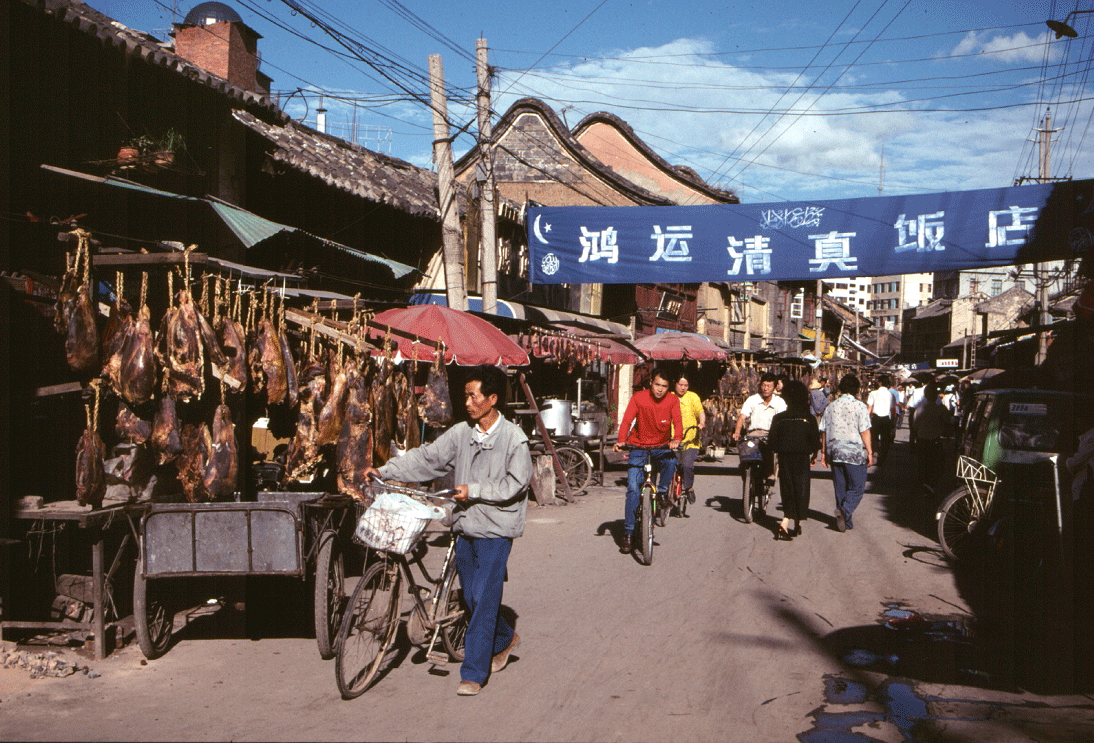
Kunming was amazing in the mid-90s. The narrow alleys, lined with open-fronted shops and two-floor partly wooden buildings were frequently crowded with a real mix of ethnicities. I could spend hours there immersing myself within the ongoing scenes. However Kunming was just a starting point.
My travel onward was by road on a bus. The journey was slow and not very comfortable, particularly in the sleeper buses which were so different to the norms of coach travel I was used to. However such journeying was also rewarding, for there were many opportunities to chat with fellow passengers and to look out on often incredible scenery, both physical and human. Today's travelers flying between cities such as from Kunming to Lijiang miss out on so much. Think of what I would have lost, had I flown direct from the UK to Hong Kong in 1987 instead of going by rail? My passion for China would never have been born and I would probably still be living in my beautiful Scottish homeland. Travel leads us in many unexpected ways.

Going northwards from Kunming and nearing Dali I remember my first views of extensive Erhai Lake with snow-capped Cangshan Mountain rising above its western shores. Stunning, a word I would use often during such travel experiences.
I rapidly fell in love with Dali. In fact had I not to returned to my working life back in Scotland, given the chance I could easily have settled there, becoming a writer based within one of its enchanting cafes. I did return to Dali at the end of 1999 for as 2000 approached I wanted to be there, in a place I would describe as my personal heaven on Earth.

It was with reluctance I pulled myself away from Dali, as my time in 1995 was limited and I wanted to reach Lijiang. Another enthralling journey passing ethnic villages, roadside markets and packhorse trains headed off to remote, isolated settlements. And as we moved further north, views of the snow mountains were increasingly breathtaking. I was reaching the edges of Himalayan China and as a geographer I simply could not get enough.
Walking through the Old Town of Lijiang, along stone-paved alleys parallel to fast-flowing water channels I was reliving many scenes from Beyond the Clouds. Indeed I could find myself torn between there and Dali for I had found some great cafes where I could happily spend all day writing, talking or just dreaming. My personal romance with northwestern Yunnan was becoming deeper. Certainly cycling way beyond the town into quiet countryside, I increasingly felt I was discovering another area that could fit my dream of Shangri-La. I was again in a personal heaven to sit beside meadows where horses grazed, to look up toward forested slopes eventually giving way to the sheer rocky and icy slopes of Jade Dragon Snow Mountain. I was looking out across classic landscapes I had studied as a geographer back in Scotland.

The scene increased both in scale and breathtaking magnitude as I continued north from Lijiang. I initially traveled onwards to Zhongdian, today referred to as Shangri-La. But as we approached Qiaotou and I saw the sheer scale of the Tiger Leaping Gorge through which the waters of the Yangtze River would crash. I jumped off the bus, as my passion was to photograph that amazing scene. Three days living there quite basically in a simple guesthouse rates highly among my travel moments. Walking alone along a narrow footpath into the gorge above that river's violent, cascading waters was the reward.

To continue higher by bus with a maroon-robed Buddhist monk as my fellow passenger shared his food was another memorable experience. Zhongdian felt literally on the roof of Yunnan surrounded by a backdrop of distant snow-capped peaks. The area had a strong Tibetan feel, particularly around the market where many locals congregated. I went through lots of film in those pre-digital days. Again the great experiences were cycling out to nearby lakes where villagers looked over herds of sheep and yaks before heading along what was then a country lane to Songzanlin. How could I ever describe there at its historic temple, the experience of monks inviting me into their dormitory to share cups of butter tea while snacking on traditional tsampa? The amazing world of travel allows us to reach into situations so different from our everyday comfort zones.

Five years later, in June 2000, I was able to travel up from Beijing to Lhasa. I remember so clearly looking at the sheer magnificence of the Potala Palace and thinking "dream fulfilled". Decades earlier as a schoolchild in Scotland I wrote of what was then seemingly an impossible dream, to reach Lhasa. For those who wait and persevere dreams can come true, as my China travel adventures have proved to me.

It is for me a personal pleasure and honor to now share some of my China travel experiences discovered along the road to Shangri-La. Images taken mostly in 1995 between Kunming and Zhongdian with later shots from Lhasa will be on exhibition at Tianjin's Shangri-La Hotel from June 21 throughout the summer months.

