(Source: China Daily)
Pingyao: A walk through historic China
By Bruce Connolly | chinadaily.com.cn | Updated: 2019-05-14 15:16
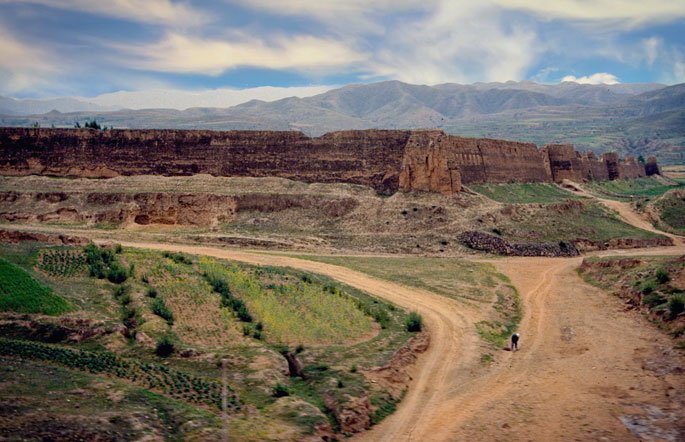
During my initial China experience in July 1987, I was fascinated with the scenes beyond the windows of my train from Mongolia to Beijing as we headed through a mostly dry Shanxi landscape, broken by stretches of an earthen Great Wall. It was there I first saw the remains of walled towns, which instantly fascinated me because we did not have them back in my native Scotland.
Years later I would discover they were fortress settlements set up over 1,000 years ago to help protect China's northern borders. Throughout China's extensive and turbulent history, military defense was an important factor in city design and structure. My travels would show me that walled towns were in fact very common throughout much of the country, with the Ming and Qing periods seeing prolific wall building in China.
I simply loved visiting walled towns, marveling at the construction of the walls before climbing up their often broad tops to peer over the battlements at the ancient streets below. Some such as Xi'an still have grand walls enclosing an historic core, while others may have surviving gate towers as reminders of former glories. More often the clue to long-gone walls would be names including a suffix such as "-men". Qianmen, for example, was the Front Gate on Beijing's Ming Dynasty Inner City walls.

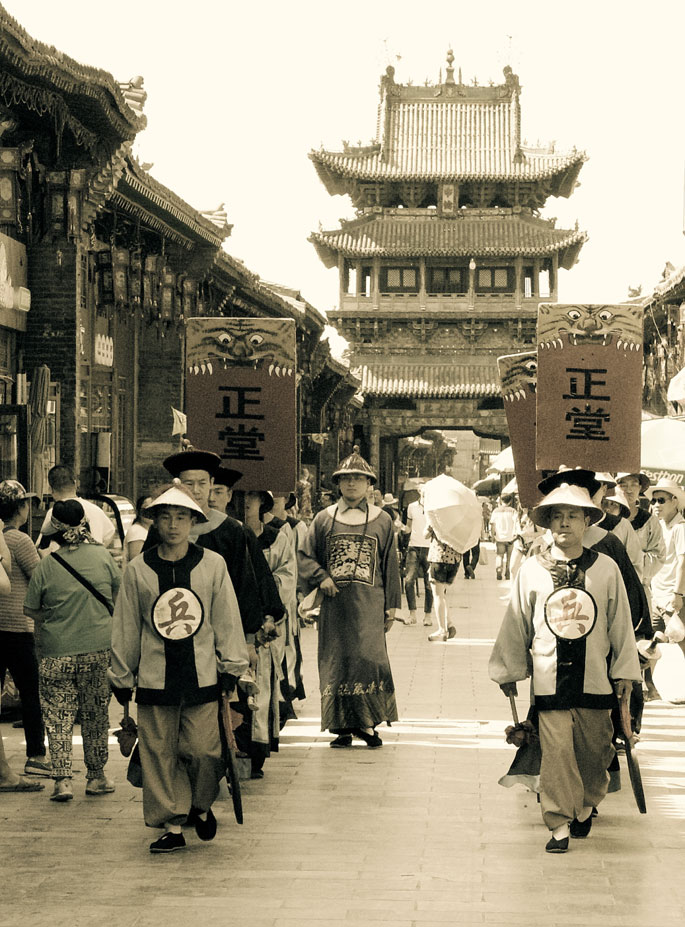
Then there's Pingyao, one of China's classic and best-preserved walled towns that I was fortunate to visit in 2016. Located in Shanxi province just 715 kilometers southwest of Beijing, the city is famed for its importance in Chinese economic history and its well-preserved Ming and Qing layout. Amazing experiences straight out of a classic film production await travelers. Its UNESCO World Heritage old town with a history of 1,000 years serves as a surviving example of several dynastic periods, a feeling enhanced when a "police patrol" would march along in their 19th century garb, banners held high while "maintaining order" among the bustling crowds.
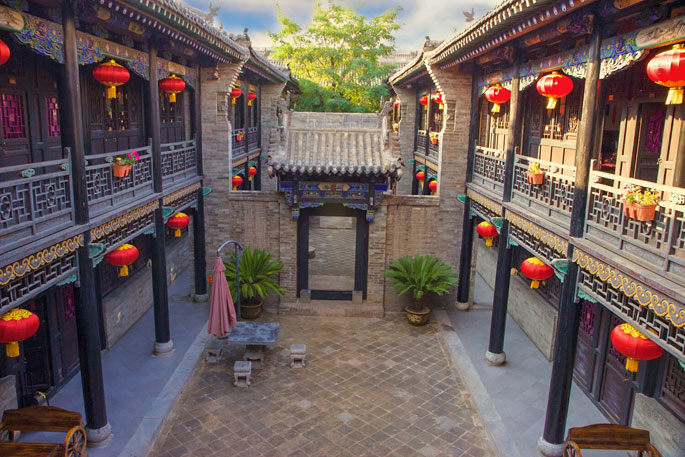
Tourists will find it easy to wander around Pingyao, thanks to its relatively small area, measuring roughly 1.6 km in length and breadth. It also delivers endless possibilities to discover history and indulge in photography, as Pingyao has over 100 streets and lanes in this city's Ming and Qing urban layout with close to 4,000 17th- to 19th-century shops and residences. Pingyao remains a thriving community with many continuing to live in the old town's courtyard homes, going about their daily lives alongside and often indifferent to the tourism boom so noticeable today along its main streets.
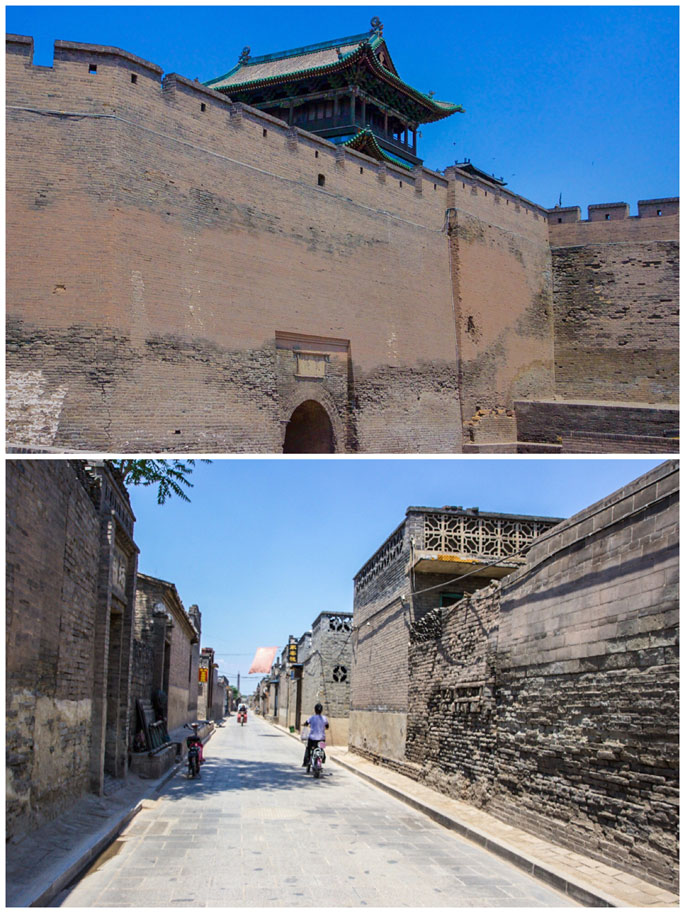
Walking and cycling in the city are both perfect ways to quickly absorb its historic vibes. Six gates allow access through Pingyao's massive walls, beyond which motorized vehicles are not allowed. Away from the busy touristy streets, it is easy to feel transported back to an earlier era.
Pingyao was first established over 2,000 years ago during the reign of King Xuan (827-782 BC). The earliest walls, which were earthen, stood mainly northeast of the present location. The massive and strong walls seen today, about 12 meters high with a perimeter enclosing 2.25 square kilometers, were constructed starting from 1370 in the third year of the Ming Emperor Hongwu. However, some sections still show signs of earlier construction.

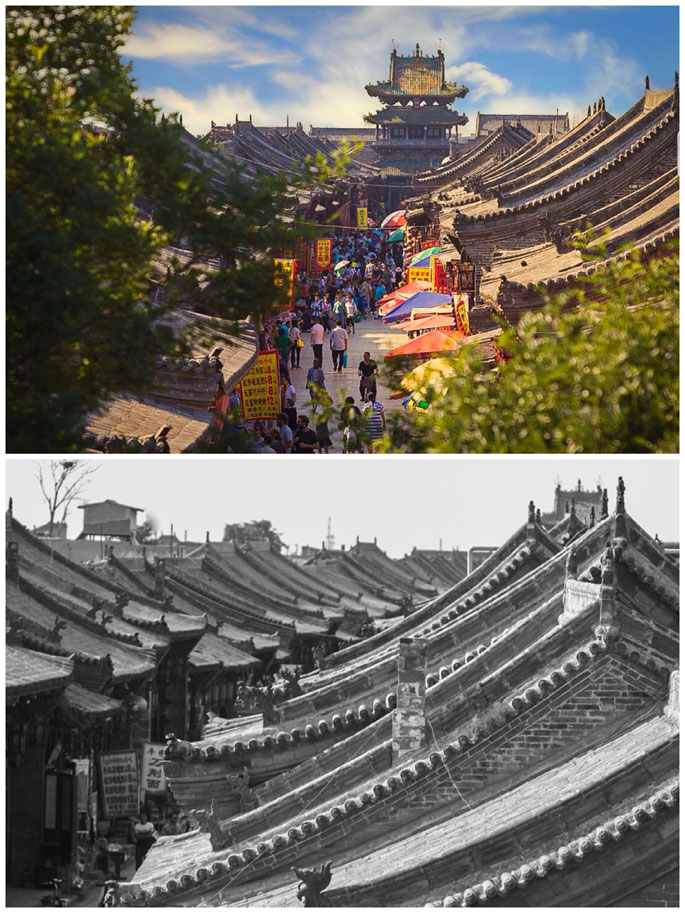
Walking sections of the walls allows excellent views across the city's many tiled rooftops and down into domestic courtyards, as most buildings within historic Pingyao are mainly low-rise. Grander buildings such as the Confucian Weimao Temple rise distinctly above most domestic and commercial buildings packed tightly together across this amazing testimony to earlier periods from northern China's history.
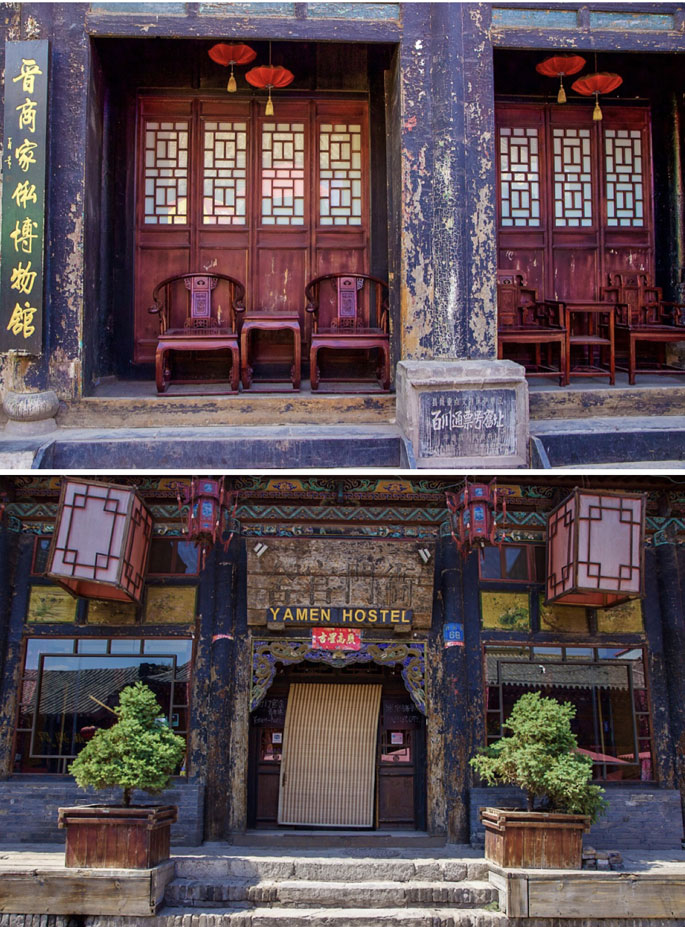
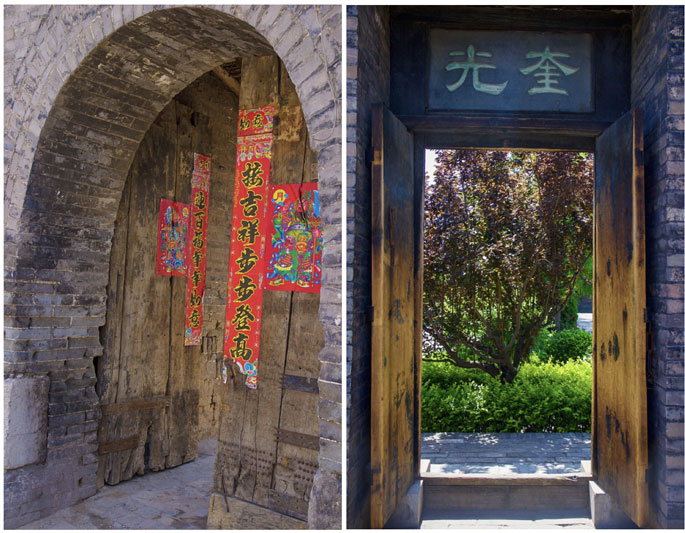
It felt so easy to feel the grandeur of Pingyao's early days as a major regional trading center while wandering along its Ming and Qing dynasty streets, where I passed the gates of many impressive residences. Red lanterns hung along lanes, outside heavy wooden courtyard doorways. This came with an impressive backdrop or silhouette of the town walls rising above, of several magnificent temples and classical buildings.
Pingyao has been a county seat since the Qin Dynasty, resulting in a large well-preserved yamen. A country government office was known as a yamen and that in Pingyao dates from1346 during the Yuan Dynasty, with its present buildings going back to the Ming era. They formerly housed the office and home of the magistrate sent to act as mayor, judge and senior official for Pingyao. Entered through a ceremonial gate, this yamen had over 300 rooms including not only offices but also a court, meeting rooms, residential areas, a garden and even a prison. It proved to be a fascinating compound to explore and to appreciate more of the grandeur of Pingyao.
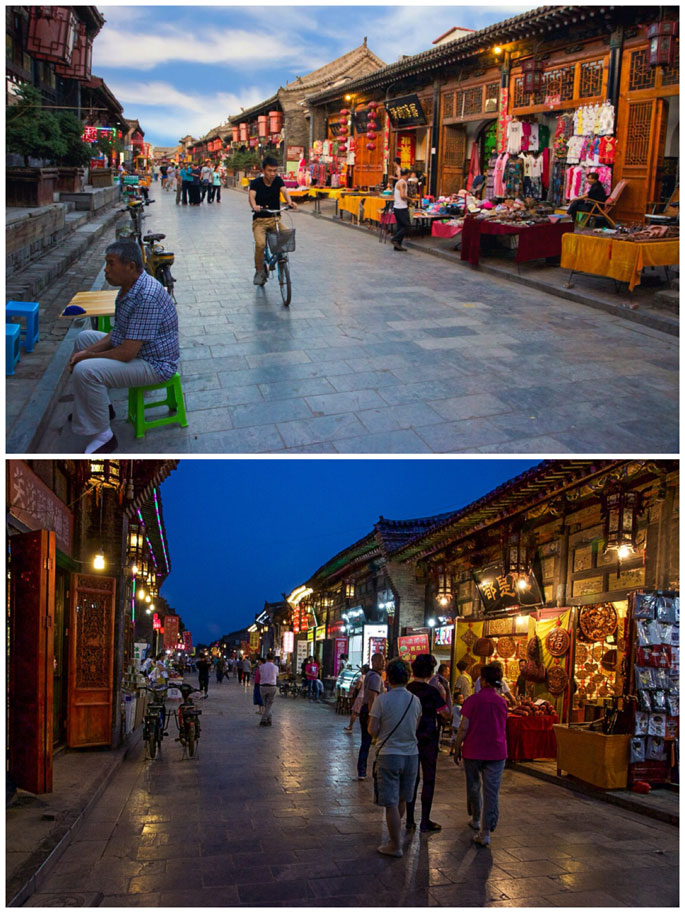
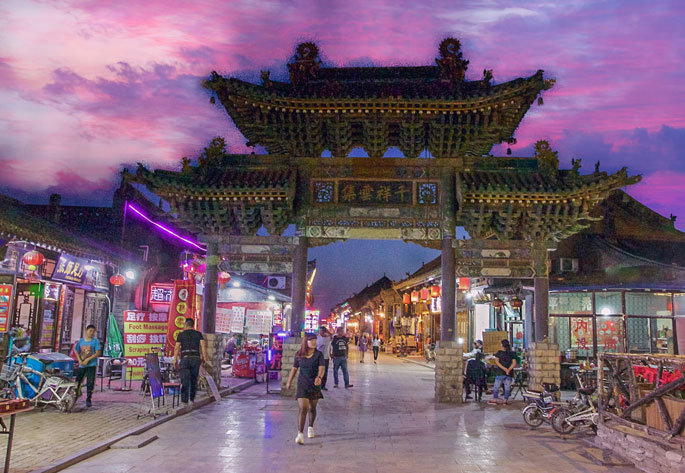
South Street (Nanda), also known as "Ming-Qing Street", is 450 meters long and forms the central axis of Pingyao. Today it has transformed into a traffic-free commercial and tourism street, one that is a sheer joy to walk down at night, with buildings often illuminated.

For cnturies South Street was also the main commercial avenue in Pingyao, and some of its businesses still occupy buildings going back hundreds of years. A whole variety of trading goes on along its course with outlets selling snacks as well as paintings, wooden furniture, calligraphy and more. On busy days it can feel like being back in some older crowded bazaar.
Historically Pingyao was at the center of trade links created by its merchants extensively across China and even venturing overseas, making it the heart of Shanxi's prosperity and even of China's banking industry. In 1832 the first piaohao, or exchange house, opened in Pingyao, providing remittance services, accepting deposits and offering loans. It was named Rishengchang, or Sunrise Prosperity, and known as the "Father of the Bank in China". It continued operations until finally closing in 1932. Located within a former private courtyard, it can be visited and indeed provides a fascinating learning experience. Rishengchang went on to establish 43 branches across China with others opening overseas including Japan, Singapore and Russia. Ultimately over 50 percent of China's piaohao had their headquarters in Pingyao.
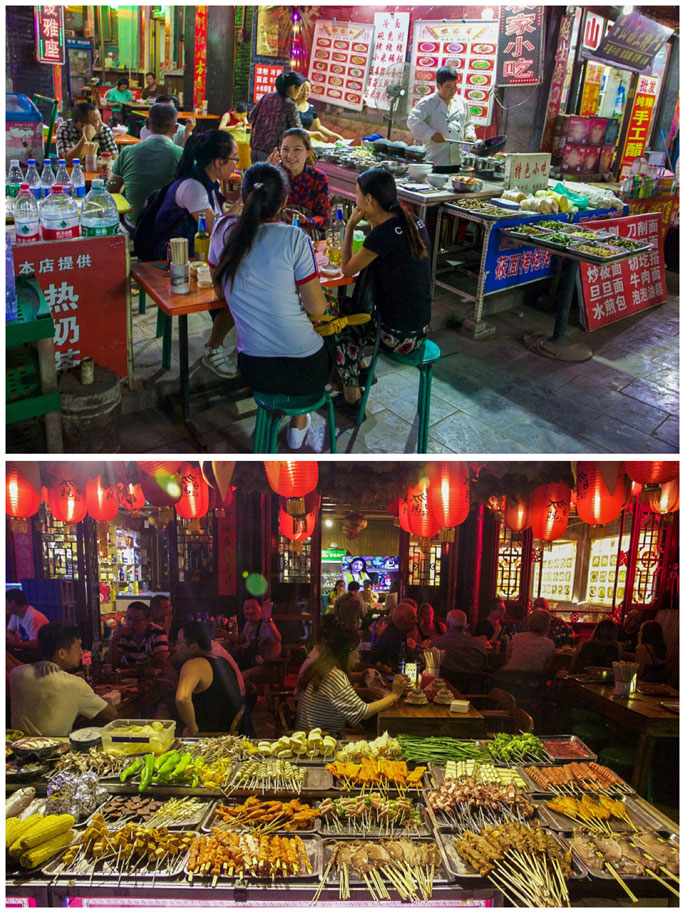
Pingyao can offer some unique dining experiences, particularly in warmer months, with many restaurants providing outdoor seating that allows you to watch the constant flow of people. The city has its own specialties, with wheat forming the basis of many staple foods and used for different varieties of noodles and local snacks such as wantuo and kao laolao. Pingyao beef served in cold slices with soy sauce is a local specialty and once a favorite of late Empress Dowager Cixi.
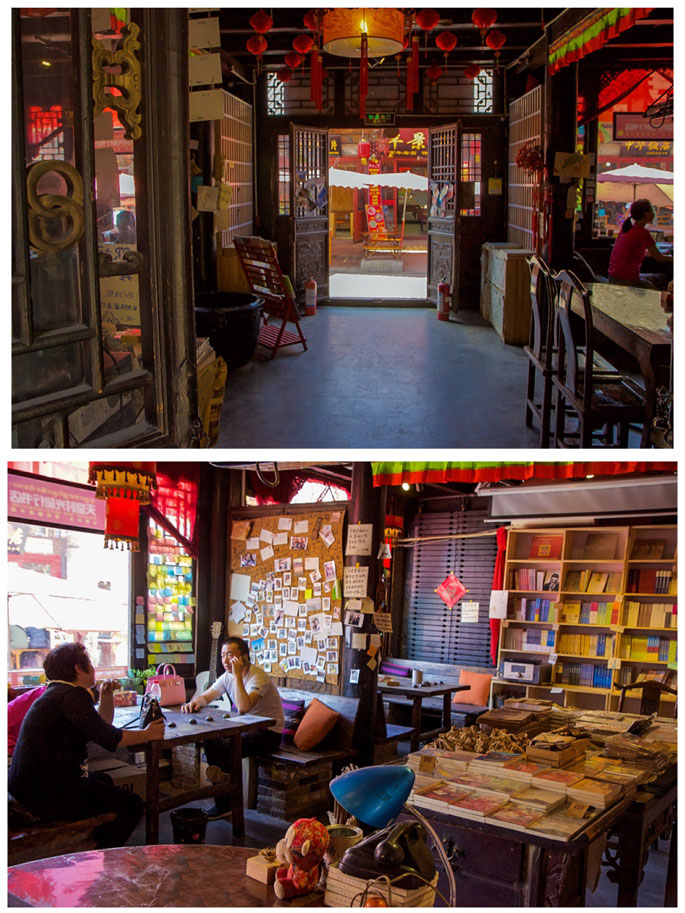
My hotel stay in Pingyao proved particularly enjoyable, for like many in the older town it tried to recreate a Ming feel in both architectural style and historic luxury. My room featured a kang-style bed traditionally heated from underneath. The hotel occupied a great location close to the Confucius Temple. With an area of 8,361 square meters, it is one of the best preserved such temples in China. It was traditionally a school where scholars wishing to become government officials took the grueling imperial examination. Walking for breakfast, I would pass its courtyards where people engaged in morning exercise and tai chi.
I have long believed that it is important to go beyond the "comfort zones" offered by China's increasingly 21st-century cities. With more connectivity through high-speed rail, destinations such as Pingyao are increasingly seen as a must visit. I could see why Pingyao is increasingly popular. It is exciting to find a city where a walk simply feels like a journey back into a past era.