(Source: China Daily)
Old Beijing - a personal journey of discovery
By Bruce Connolly | chinadaily.com.cn | Updated: 2019-01-23 07:27
On a hot, humid morning in July 1994, my taxi, after 50 minutes drive from Beijing Capital Airport, reached Beixinqiao Santiao, a long, narrow and tree-covered alley. The driver stopped at a four-story building incorporating elements of Chinese roof design. He showed me the handwritten note I had brought from Scotland and pointed to the "Huaqiao Fandian" (Overseas Chinese Hotel).
I was in a China very different to the southern city of Guangzhou where I had lived from 1992. It was also poles apart from the Beijing I first saw in 1987. I had then stayed out in the northern suburbs at the Friendship Hotel only visiting grand locations such as the Summer Palace. Hutongs, Beijing's traditional, historic alleys, were not on the schedule or even mentioned! It was at the insistence of a Scotland-based Chinese friend, passionate about older Beijing, that I had come to the capital before heading southwest to Sichuan. "Bruce, you will love the old city and its hutongs!" She was right! Over many subsequent visits I stayed at that hotel, for it was in the midst of a traditional hutong district, a neighborhood I easily developed feelings for.

The first time I flew to Beijing was in 1994, before that I always took trains. As the aircraft descended over the northern mountains, looking down at the Great Wall snaking over the peaks was like an iconic welcome to China! At that time only one small terminal served the airport as traffic, particularly international, was relatively quiet.
I remember heading downtown along the Airport Expressway which then terminated just beyond Sanyuanqiao Bridge. Passing Zuojiazhuang Park, people were performing morning exercise beside bird cages suspended from tree branches. Many little restaurants, providing outdoor breakfast, operated close to a local transport station. Cream and maroon two coach public buses were departing, carrying office workers toward the city centre. Commuting was relatively new as many people still lived at or close to their place of work. Roads were thronged with cyclists as we approached No 2 Ring Road and Dongzhimen, once a major eastern gate along the city's former Ming Dynasty walls. My taxi carried me westwards towards Beixinqiao.
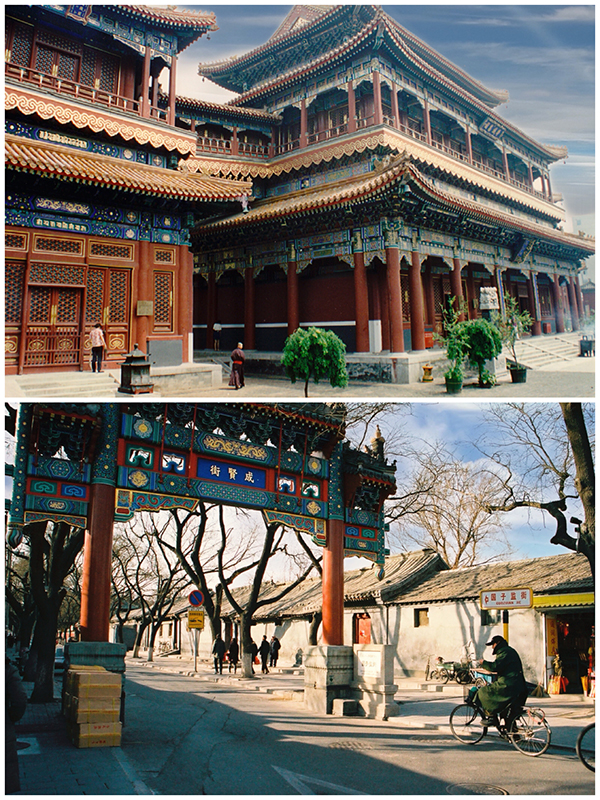
Long before the Airport Metro opened, I would often alight from airport transit coaches at Dongzhimen. Wanting to quickly re-engage myself with the older city and having become increasingly familiar with the area's many alleys I would walk the last 30 minutes to my hotel. Along Dongyanguan Hutong, for example, a small kindergarten opened onto a courtyard. However, locals seeing a Westerner carrying luggage would automatically assume where I wanted to go and would point to which hutong to follow!
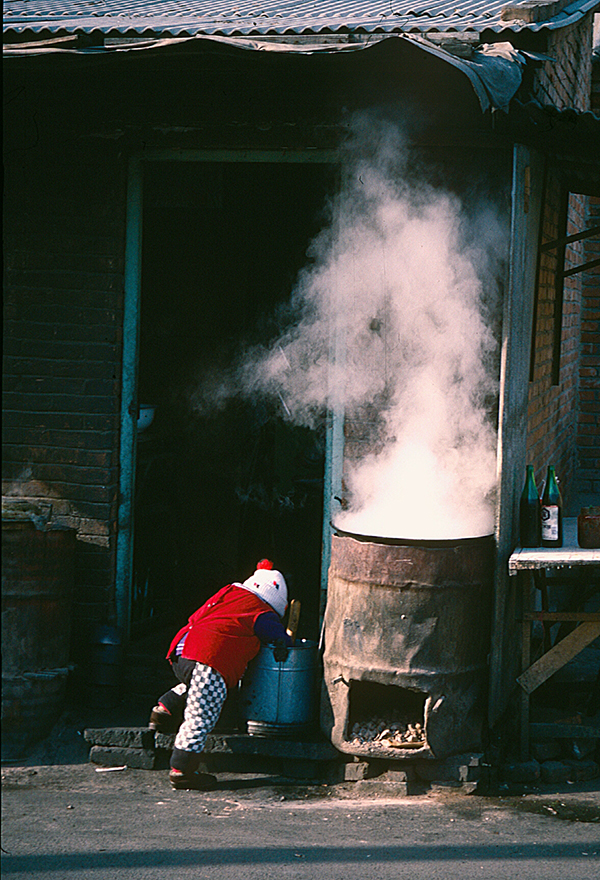
I was residing in an excellent location to explore the city. Yonghegong Metro Station was within convenient walking distance of the hotel. It could have been simple to just go west along to Yonghegong Dajie before turning north toward the metro. However I preferred to wander, at times losing myself, through the narrow lanes such as Houyangkang Hutong that led past a myriad of local scenes, sights and aromas toward the crimson walls of Bailin Temple. Westwards from its gates ran Xilou Hutong where compact food markets looked out on small units preparing noodles and fresh breads. Spicy lamb chunks skewered on wooden sticks were a favorite local snack. Circular coal blocks, used at times with "cookers" created from discarded oil drums were piled along the grey walls of the alley. Children headed to and from school passing older people sitting outside wooden entrances into hidden courtyards. This was set amid a background of incessant calls from hawkers and vendors on bicycle carts either looking to buy discarded household items or sell produce. Such scenes could easily go back to the late Qing Dynasty when few markets or shops, if any, existed in the alleys and most commerce was by direct trading from the carts. This still continues today with, for example, knife sharpeners or recyclers looking for custom although a distinctive sound still heard is of carts filled with crates of glass beer bottles rattling along the alleys to the accompanying cry of pijou (beer). Indeed many folk songs still recall earlier hutong life including the distinctive call of the "haws" seller. In winter I was fascinated by large piles of cabbages and leeks, ingredients within staple diets, distributed at very cheap prices to the ordinary people. In summer, great mounds of melons were thrust quenchers during the searing Beijing heat. Sometimes horses would pull carts laden with fruit or vegetables but their presence was becoming increasingly restricted. Shops had many domestic essentials such as warm winter quilts, long aluminum smoke pipes for the coal stoves and thermos flasks. Every restaurant, every hotel room, every train carriage had its ubiquitous hot water flask.

Then there were the men who sat by the alleys and who seemed able to fix almost anything. Pride of place were the bicycle repairers for cycling remained a popular way of local travel.
It was always surprising to wander through alleys and scenes that seemed so caught in a time warp but to suddenly emerge into what even in the mid 1990s was starting to become a modern city.
Canjiquan Hutong led north from the market area and being more residential lacked the earlier bustle. It ran behind the Lama Temple emerging just east of the metro station out on Andingmen East Street and elevated No 2 Ring Road. Previously strong defensive walls from the Ming Dynasty (1368-1644) demarcated this as the northern edge of Beijing's inner city. However, during the Yuan Dynasty (1279-1368) the city, or "Dadu", had extended much farther north. I soon realized that many of the hutongs I was walking through could trace their origins back to that period. It took me quite a while, however, to work out the meaning of many local names, for example Beixinqiao or "North New Bridge". Alleys were closer to daily life, referring to rice, tea, salt or even gold fish (jinyu).

From high points such as the Zhonggulou's Drum Tower I could look across the older city's spread. Major streets were generally straight whereas crisscrossing lanes were smaller and narrow. Directly around the Drum and Bell towers there stretched a myriad of single floor courtyard dwellings, many being traditional Beijing "siheyuan". Looking farther north could be seen high-rise developments that had grown close to the 1990 Asian Games Village while eastwards lay the international areas near Chaoyang's Liangmaqiao where many embassies located. What was also interesting was how beyond the former walls domestic buildings changed in style. Post 1949, Beijing had been transformed partly into an industrial city, but the factories were located mostly outside the walls. Today most have closed while the homes of former workers remain, including six-story brick apartment blocks, some going back to the 1950s. Beyond rose taller 18 floor towers dating from the 1980s.
At every opportunity I would climb the hill at Jingshan Park to try and appreciate Beijing's layout. Looking north, Dianmen Outer and Inner Streets ran south from the towers of Zhonggulou following what was the historic axis line along which Old Beijing had been spread out. The city was an example of a strict geometric layout that centered on the massive Forbidden City directly south of the hill. The Axis Line continued not just through the Imperial Palace but went several kilometers down to the Yongdigmen Gate. The Palace being home to the succession of emperors, no dwellings or commercial buildings within Old Beijing could be higher than its walls. In contrast, the alleys, being residential neighborhoods, tended to reflect more the city's grassroots culture. This was particularly true south of Qianmen Gate although for the northern hutongs around the Shichahai Lakes there I would think of imperial officials walking around wearing their elaborate costumes.

With maps and books I could find at the Foreign Languages Bookstore on Wangfujing Street I would try to make sense of Old Beijing The city was much more complex than I had initially appreciated. Early rules related to domestic building style, size, colour. Then there were many former internal walls and gates such as Dianmen, the "Earth Gate", but what did it all mean and signify?
The metro from Yonghegong was a convenient way to reach historic sites such as the Ancient Observatory at Jianguomen or the Ming-era "Victory Gate" at Deshengmen. At Qianmen a petite French-style cafe served coffee and crosissants for breakfast. There I looked toward the great Zhengyangmen and Jianlou Towers, imagining imperial processions as the emperors were carried south from the Forbidden City toward the Temple of Heaven. Then I would immerse myself in the alleys of Dashilar and Liulichang before heading back on the metro towards Dongzhimen, spending early evening in delightful Nanguan Park near the Russian Embassy.
I would slowly meander back along the alleys during both summer and winter trying to absorb so much of the local character. Nightly, in simple small restaurants, locals dined around steaming copper hotpots. Most days there was often was a quietness broken at times by the sound of bicycle bells, hawkers on their three-wheeled carts and something else, pigeons! Domesticated pigeons flew with whistles attached, creating sounds like jet aircraft!

Staying at the hotel on Beixinqiao Santiao, I was becoming so immersed with the city's history that I would sit for hours at the window of a local restaurant looking out on the adjoining alley. This area had none of the international bar scene developing around Sanlitun, for example. Everything was local, providing an opportunity to develop language skills. Staff, increasingly knowing me would show patience and help in my usual linguistic struggles but the food, both inexpensive and plentiful was always good, particularly when washed down with local beers! Indeed my first call, returning to Beijing and after checking in, was to go across to a little Sichaun restaurant, have a cold drink and think, "I am back!" With many people eating out every night, such little diners were good places to meet some of the "laobaixing" or local long term residents.
In July 1994 I only had a few days in Beijing before heading southwest to Sichuan, but those precious days showed me that there was so much still to discover in this vast city. So much untold. I resolved that at every opportunity I would try to explore its many, intriguing corners. For, in my mind I also realized that what I had found would inevitably change as the development momentum gathering pace in southern China would surely spread northwards towards the capital. But when? Older Beijing inevitably became a place increasingly special to me to the point where I became known and still am as 'Bruce in Beijing'!