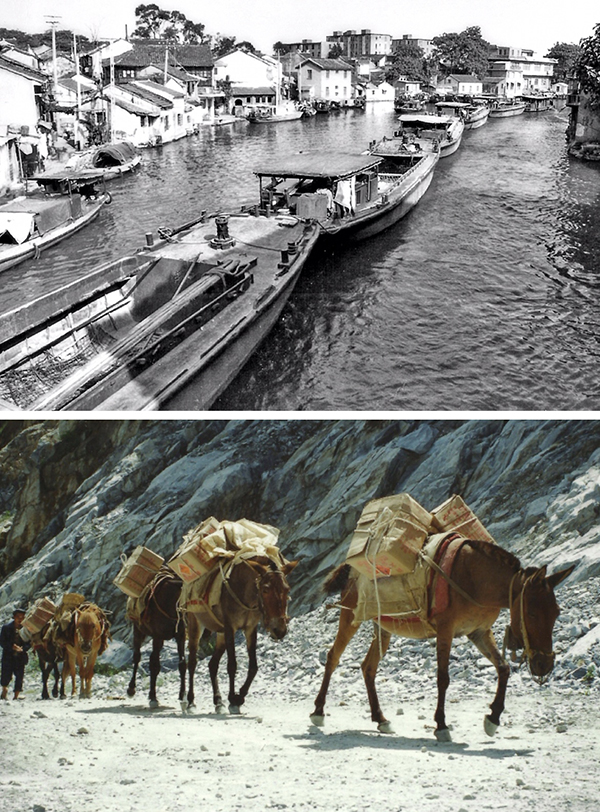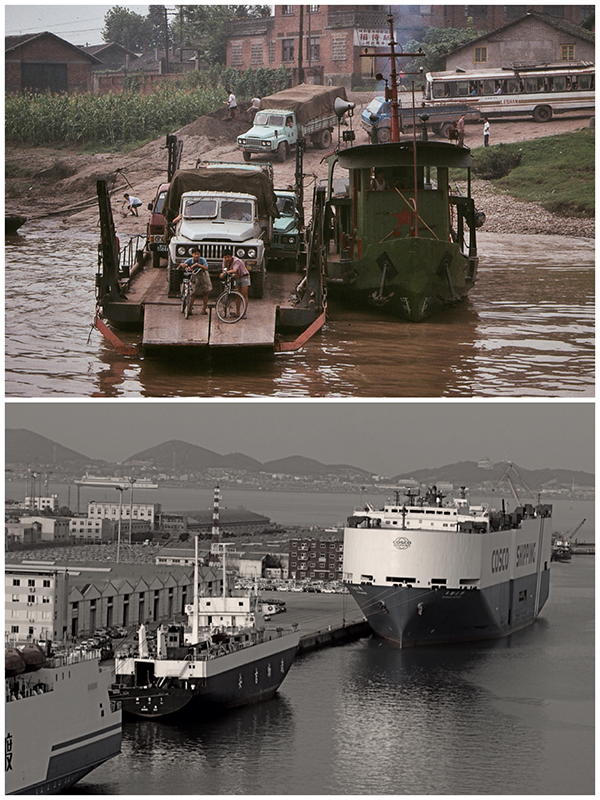
(Source: China Daily)
Three decades of documenting China
By Bruce Connolly | chinadaily.com.cn | Updated: 2019-01-08 07:48
December 2018 marked 40 years since China embarked on its transformative policies of reform and opening-up. For me, 2019 marks 32 years since I first journeyed eastwards to this country which then bore little resemblance, except in geography, to what I see today. At that time, like many of my fellow countrymen, I had very little idea, very few preconceptions of what to expect. Indeed, I really came here to complete a journey, a train journey but one that, as I have said many times before, was an "eye-opener".
January 3 this year saw China's Chang'e 4 successful mission to the Moon. However, go back 50 years to 1968 when the US Apollo 8 first successfully orbited the moon. Then it would have seemed unimaginable for China to have risen to the fore in space exploration - yet, there was Chang'e 4, the first vehicle from Earth to land on what we used to call the "dark side of the moon". But that in some ways reflects the story of China and what I have been and keep discovering over almost one third of a century. I must keep reminding myself that I have lived through so much of the country's transformation, at times even being part of it.
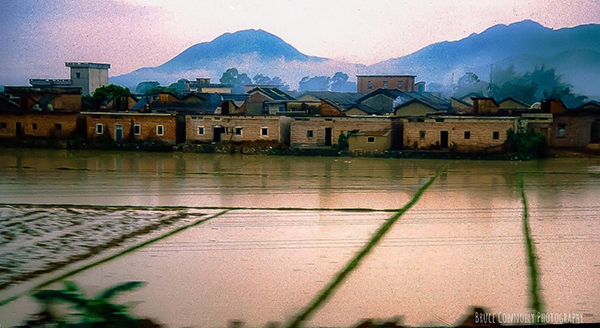
Thirty-two years ago, my knowledge of this country was very limited, indeed sketchy at best. However, China quickly fascinated me for I knew I was in a quite different land. I was intrigued! How did it all function and despite often negative feelings I would hear toward rural life I found the countryside I passed through to be beautiful, indeed at times resembling traditional paintings.
Railways have been a lifelong passion, particularly enjoying long train journeys. On my initial north to south adventure I noticed steam power still working although my trains were mainly hauled by diesel or occasionally electric locomotives. Over the years, travelling that way around China I would learn much simply looking from the train window or walking around a city. It was increasingly obvious, from those early days that change was spreading both to many areas and often in different ways.

I admit also to knowing little about the reform programs underway so seeing Shenzhen for the first time in 1987 was quite a shock. It proved so different to what I had observed over the previous days of travel within China. It was then I started to realize the significance of what was underway, about what had been launched at the end of 1978 and how the initial experiments at reform and opening-up were mostly happening around the border areas with Hong Kong. This was partly through easier access to hard currency, business expertise and worldwide connections via a major international container port.
Returning to Scotland in August 1987 China was firmly in my mind, I just wanted to learn more, to discover what was really going on for as I said, there was at that time little awareness of the foundations of change then being laid down in coastal Guangdong. I desperately wanted to return but for reasons such as finance and available time it felt then almost impossible.

Within me I knew the China I saw, indeed the vast areas of the country I never had the opportunity to visit would also change. My desire was to visit and indeed photograph much before the inevitable modernization I briefly saw at Shenzhen would spread nationwide. However, it was fortuitous that my then local government, Strathclyde Region, had entered into a relationship with Guangdong Province. Partly having been, although briefly, to Guangzhou and having a growing obvious passion and interest in the country I was invited to participate in the newly set up exchange program.
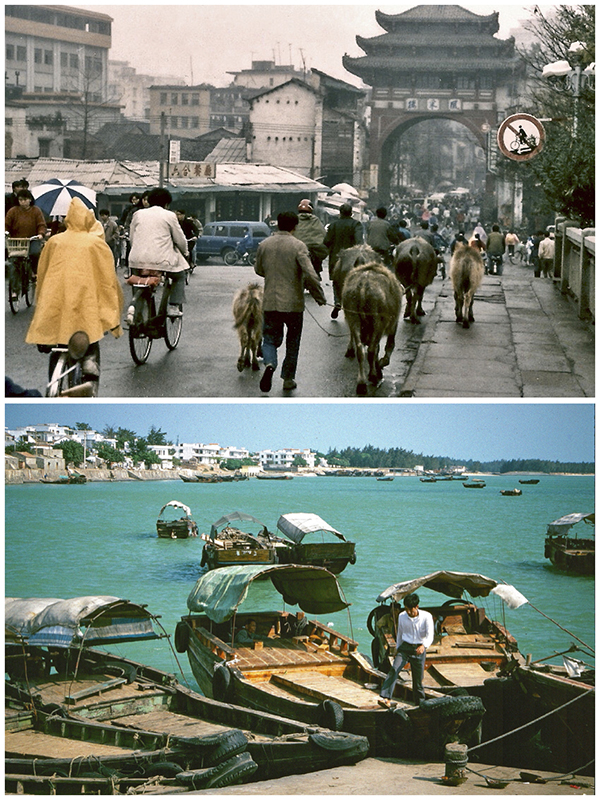
By August 1992 I was starting out on a year both living and working in Guangzhou. From trying to learn about China from books, suddenly I would be thrust into one of the world's fastest changing areas, the Pearl River Delta. No longer a traveler looking from the windows of hotels or trains, I would live within an actual "work unit" (danwei) located in an attractive suburban part of northern Guangzhou. I was being introduced to life within small Delta cities; visiting modern factories at the heart of the area's industrialization; I was watching first hand an entire new transport and urban infrastructure literally being laid down under my feet; I was also immersed within the educational drives underway to produce English teachers - a language vitally important for developing international trade. It was there I saw the determination amongst the students of that period to really create a modern China. Opportunities arose for me get close to some exciting railway developments; to visit farming villages and learn about rural life's challenges while also exploring many other parts of Guangdong, Guangxi and Hainan, even meeting some of the area's ethnic nationalities. Of course, regular visits were also made to Shenzhen, a city rapidly transforming since my initial sighting in 1987.

Although I had to return to Scotland in 1993, China had become my life and frequently being asked to talk about my experiences again to people who had little previous knowledge but were keen to learn and find out what was happening. Personally I retained a desire to discover more, particularly away from the developing southern coasts.
To discover a country, to witness daily life and routine, a river journey can be an answer. Not by luxury tourist vessels but by local boats serving riverside communities. In 1994 it was still possible to follow the Yangtze River from mountainous Sichuan all the way to Shanghai. I went as far as Wuhan, but although much remained traditional changes were happening with high-level bridge construction and early works on the Three Gorges Dam. Returning to Chongqing in 2017, apart from the river's physical geography much felt unrecognizable with so many new bridges and an advanced monorail system.

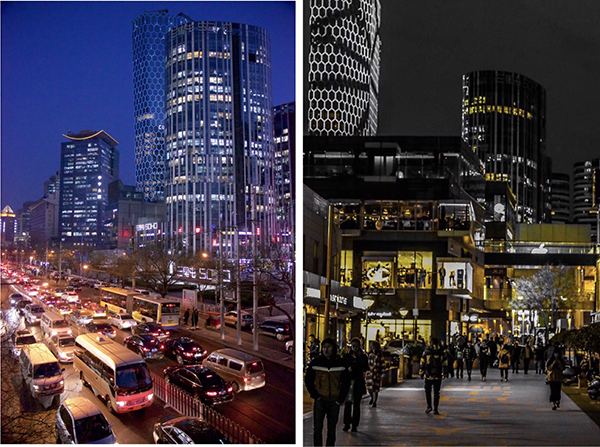
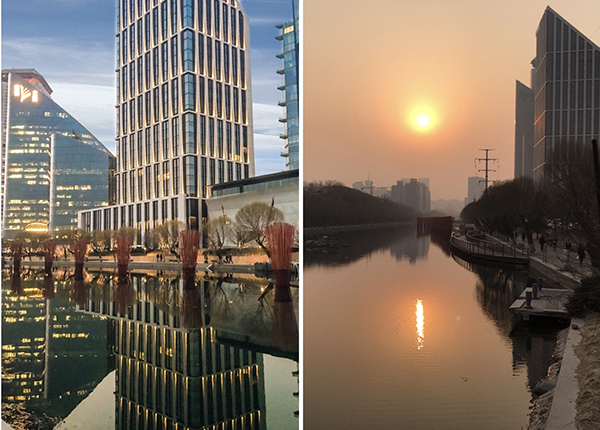
By 1994 I was increasingly spending time in Beijing, living then in older hutong neighborhoods while daily exploring and recording the city before its major facelift in the run-up to the 2008 Olympics. The city felt as though it ran on a daily routine where much was simple and indeed content, an image helped by the flow of bicycles. The traditional, grey walled alleys I found so unusual to come upon within the midst of a growing city. I could detect a rhythm to the hours and seasons, even a closeness to nature. I truly loved living there and often felt isolated to the modernization appearing particularly around the city's edges. All so different to the city's skyline seen today, for example as we look east from the Forbidden City to Beijing's high-rise CBD.
However, China was not only about cities and rapid change. Much of the country's remoter borderlands were home to many ethnic nationalities, living in ways so different then to the increasing modern urban norms. 1995 marked the start of many visits to Yunnan with Lijiang an obvious destination. Thankfully my earliest memories of what then was still a remote town came before the destructive 1996 earthquake. Today, of course with the increasing growth of air, rail and highway infrastructure such areas have been opened up, attracting increasing numbers of tourists annually.
Shenzhen and the Special Economic Zones had helped launch much of China's opening up but by the mid 1990s change was happening for example around Shanghai. Historically a port and international trading centre it lay close to the mouth of the Yangtze River. Today it is a world leading city enhanced by its dramatic, high-rise skyline. Shanghai's stimulus came in1993 with the Pudong New Area being established directly across the Huangpu River from the classic early 20th century Bund. In 1996 fortuitously I visited the city, photographing some of the early stages in Pudong's development. Returning most recently in 2017 the contrasts were indeed staggering.
It always intrigued me that China with several of the world's largest cities could actually encompass vast areas of uninhabited land, mostly within its northwestern provinces and regions. In 1997 I set off on a journey, mostly by rail following effectively the former Silk Road to the far west, to Xinjiang. There, a story of stunning landscapes, remote deserts and mountains where survival depended on availability of water. All so different to areas such as Guangdong, my early China home.

After the far northwest, Tibet became a dream fulfilled, something I had longed for since my early schooldays. In 1997 unfortunately I could only go as far as Golmud in Qinghai by train but had I travelled after July 1, 2006, the rail lines would then have carried me onwards to Lhasa. Completion of the Tibet Railway was another amazing infrastructure project I followed avidly.
Living in Beijing through much of the 2000s, I was increasingly exploring much of the city writing many photo articles and while producing countless radio features introducing the city. This proved an advantageous way of keeping abreast of Beijing, a city that today has changed considerably since my first footfall in 1987.

Although living in Beijing for many years opportunities still arise to discover more of China including Dongbei, Shanxi, Anhui, Guizhou, Jiangsu, Shandong, Chongqing, Chengdu and Xi'an with each place worthy of lengthy features! Indeed Shandong's Yantai proved so delightful I went there three times in 2017! Tianjin, only 30 minutes from Beijing by train but with fascinating historic and contemporary diversity, has increasingly attracted my attention, leading to several photographic exhibitions on the city.
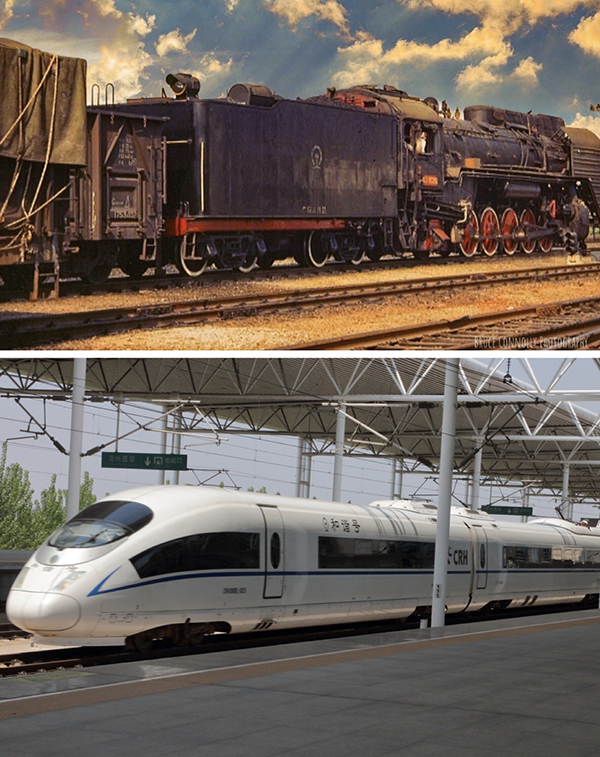
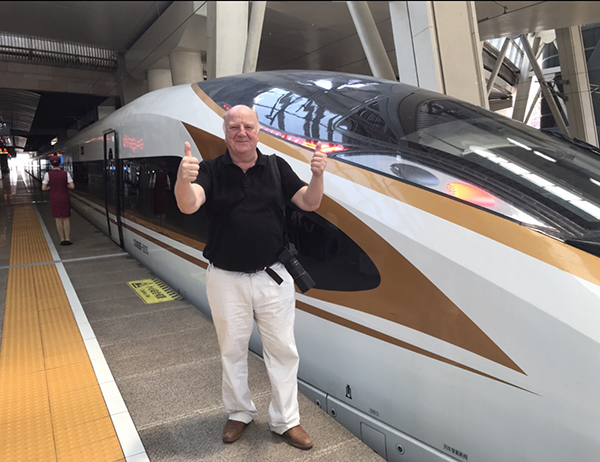
My preferred way to travel has always been by train, an excellent vantage point to view a country. China's railways from the earlier days of steam have not only transported me across this vast land but let me observe how railway engineering has greatly helped open up geographically difficult regions. I experienced through the late 1990s/early 2000s as conventional trains were speeded up, shortening intercity travel times. However the most fundamental changes were from 2008 following the initial launch of the high-speed services between Beijing and Tianjin. Back in the early 2000s then travelling around 160 km/hr the concept of 350 km/hr was simply unimaginable, but it has happened! While the network has extended nationwide, China's modern stations are also unrecognizable compared to even a few years ago. So much has gone digital, of course, helped by the advent of smartphone technology.
I look forward over the coming year to sharing many more personal features on China, Yesterday, Today and Tomorrow. It has been an incredible journey!