(Source: China Daily)
Yantai: A wide angle
By Bruce Connolly | chinadaily.com.cn | Updated: 2019-03-18 14:00
There are places in China I want to return again and again. Just for the personal joy of immersing myself, of once more being there. I first visited Yantai, on the northern coast of Shandong province, in 2017, surprisingly late during my journeys of discovery throughout China.
I wondered why visiting it not earlier turned out to be much better than expected. Maybe it was simply waking up on my first morning at the delightful Golden Gulf Hotel, nestled at the base of Yantaishan Hill. The sun was rising over a totally calm, indeed tranquil, Bohai Gulf. As I watched, absolutely transfixed, hilly Kongtong Island emerged as dawn mist dispersed across the bay. Below my window people were already exercising or walking along the broad seafront promenade. The previous evening, after arriving by train from Beijing, I had sat there by the sea listening to the waves lapping gently on the shore. Soon I started to feel a sense of relaxation Yantai seems to induce in people.

That first morning, after breakfast, I walked up traffic-free lanes on Yantaishan under a warm, cloudless sky. Passing often elegant former international consulate buildings it felt such a contrast to my normal living in a bustling part of Beijing. Abundant flower beds scented the air alongside lush blends of coniferous and deciduous trees combined with the cool gentle sea breeze.

Over a week I explored, a bit like a tourist, historic buildings; the fishing harbor; rocky and sandy coastlines and of course sampled its fine wines! The city, I later learned, had been occupied by Anglo-French force in 1860, opening to international commerce as a treaty port in 1861. This accounted for the areas of European-influenced architecture I came upon while wandering around the neighborhoods of pedestrian-only Chaoyang Street within older Zhifu District. This included fascinating residential and commercial areas, once associated with fishing and maritime commerce, that had grown up around Yantai's early port just southwest of Yantaishan. Within time I was sure redevelopment would lead to some disappearance or maybe gentrification for fewer people continued to live there leading to building disrepair and sadly even abandonment. Photography allows a recording of such testimonies in stone to preserve the memories allowing later comparisons as I have been able to do in other parts of China.

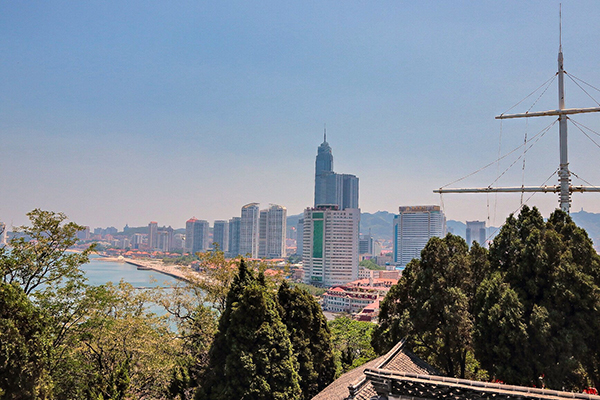
There was a realization that Yantai had more to offer than I had experienced in one visit. It was fascinating to return during different seasons from pleasant spring, through hot humid summer and into autumn with its encroaching storms. The latter proved quite spectacular as I walked from the hotel, watching waves crash up and onto the promenade. By next morning, calm had returned. That afternoon I climbed up to a vantage point overlooking the older harbor area and fishing town dominated by the historic lighthouse on Yantaishan. The hill and adjoining land formed natural protection for the early docks. Today most commerce revolves around the many large vessels berthing at newer facilities farther west, some located almost below where I stood.

Close to the ocean, seafood is plentiful in Yantai as walks around the markets adjoining the old port would reveal. Restaurants, often bustling with customers, had boxes of freshly caught fish including many shells displayed outside. Indeed Yantai is famed for its marine cuisine.

My walks would take me, always with my camera, to historic temples, former commercial guild and trade halls and even hilltop forts. At either end of the early city the latter structures defended against attack and seaborne invasion. Indeed throughout history much of coastal Shandong had witnessed incursions and wartime engagements as I would learn by visiting the large Yantai Museum.

However, it proved to be the older areas that kept me enthralled as a photographer. There I would walk alone, at times the only light coming from inside quiet households or an occasional solitary bar. One similar such area I came upon was well inland from the harbor, indeed almost on the lower slopes of the hills rising steeply on the urban periphery. Locals were fascinated by my keen interest in old buildings, often lacking in modern facilities.

Yantai is mainly a contemporary city with many of the facilities and cafes I would find anywhere across China today. However, I have noticed how over the vastness of the country there are many local variants in architecture with Yantai being no exception. I was looking for original design not influenced by 19th century European styles. This I came upon by chance as I walked down from Nanshan Park. I entered a narrow alley leading to a maze of lanes centered around Suochengli Street. A compact small area, it was crisscrossed with byways often too tight for vehicle access, suited only for walking or possible horse transportation. The narrowness often reflected the need historically for internal defense within such settlements along with protection from exposure to winter storms. However, with its stone built buildings, whose walls and doors were often brightly painted, it was in a way picturesque despite lacking many modern facilities.

I spent days exploring or simply sat down and watched everyday life. Many residents were old as most younger families had moved out to newer apartments rising up not far beyond. I thought about the future, if any, for such neighborhoods while recalling examples of where I have seen successful restoration of older districts and towns across the country.

A feature of such long-standing localities has been the food markets where countryside almost spreads into urban zones. I come from a large Scottish metropolis, Glasgow, where most of my daily or weekly shopping was conducted at large supermarkets. Yes, I would push a trolley laden with microwaveable meals! However, I have found in China that the market can be so colorful. Walking through vegetable sections there is an aroma of freshness from daily delivered harvests. At times I was unfamiliar with the varieties and again a certain amusement from stallholders as I would try to photograph the crops. There was bustle, particularly early morning, but not the pushing through aisles found in today's large supermarkets.

Increasingly I could appreciate Yantai as a "living city" where people came out to mingle on the streets and pavements. I was advised to explore around Nanhong Street. I was not disappointed! Many outdoor stalls were crammed with everything from clothes, to spectacles, to mobile phone accessories and so much more. Snack stalls were in abundance with the constant sizzling sounds of grilled meats. This was not a touristy area, but an integral part of local life. Some alleys were partly covered but everywhere it was commerce, tailor booths, food, snacks, people. It also proved to be very friendly with smiles and even handshakes when I wanted to capture the moments with my camera.

Indeed, as I said, I saw Yantai as a people's city, a place offering a pleasant, often relaxed lifestyle attracting many retirees. Yes, I felt tempted myself! There, for example when visiting the remains of historic Xipaotai Fort groups of elderly residents exercised. Meanwhile, in contrast, within contemporary shopping malls young families relaxed and played in recreational areas so typical of scenes from today's China. Such generational contrasts were there again with younger people congregating around and examining displays of the latest smartphone technology. However, in contrast, older residents would come together in the older alleys playing chess or cards.

My daily exercise of course would be morning walks on Yantaishan. Regardless of weather or season it was always beautiful. Below the cliffs groups of people sitting on rocks would cast long fishing rods over the sea waters. Meanwhile, others walked along the coastal trail or crossed narrow suspension bridges between rocky outcrops. Again, there were always excuses for me to stop and sit, maybe in a clifftop pavilion to watch roll-on roll-off vehicle ferries head to and from Dalian, six hours across the Gulf.

There I would also observe in fascination and always with my camera, the regular procession of couples having their wedding photography taken within a quite beautiful coastal location. The waters around this part of Yantai were often amazingly clear. Couples would stand or perch on rocky headlands alongside which wooden boats carried fishermen on their daily quest to land abundant catches of seafood.

For photography, I found in and around Yantai many colorful locations. With mostly clear skies and considerable sunshine so image reproduction would usually be strong. However, I also went out at night, along often darker alleys and streets capturing images of workers at food stalls or sometimes simply the contrasts of brightly illuminated offices or hotels rising above the compact maze of seemingly little frequented surrounds that I had stumbled upon.

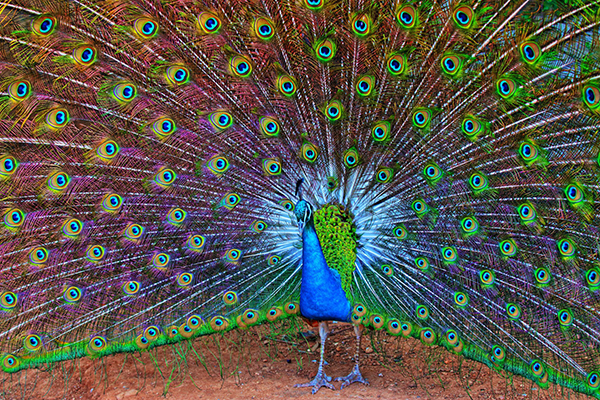
Hills encroached much of the city resulting today in more of a spread along the coastline but not reaching very far inland. On the slopes spread considerable areas of forest. Within one area on Nanshan Hill, there was located the city's zoo. As I wandered through on a hot midsummer day in front of my camera a peacock spread its plumage out. Just so beautiful I then tried creating an artistic image of the birds.

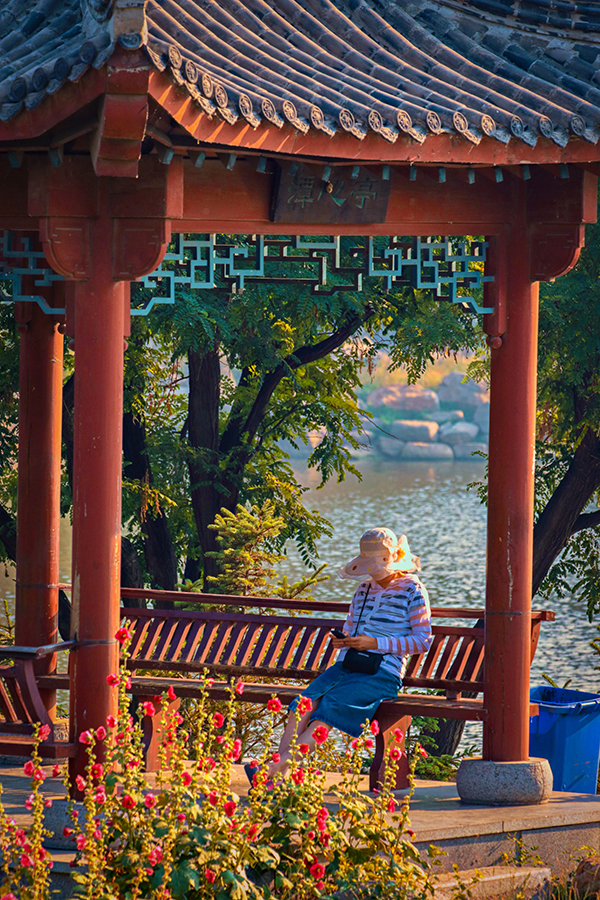
Looking from Nanshan the city spread below with its increasingly modern skyline along with expanding port and a growth of maritime related industries. I could in the distance discern the lighthouse tower on Yantaishan and decided to walk back. First it was down forest trails to a lake nestling within wooded slopes. A pavilion or "ting" providing a peaceful rest before continuing past Yantai Brewery. Eventually I reached Suochengli Street where there was a delightful cafe created from an older courtyard building. Crossing busy Beima Road it was back along Chaoyang and Hai'an Streets to reach the sea. I sat there, in front of my hotel for about an hour, with the refreshing sea air gently blowing over me. Next day I would be heading back to Beijing but Yantai was on my mind. How much would it change before I returned? There were also areas I had not yet explored. When would I be able to return?

Unfortunately I did not manage to visit it last year but this year it is on my calendar. I hope that dream can be fulfilled. To be once again with my camera recording and documenting the many fascinations of this lovely city with its excellent location near where the Bohai Gulf merges into the Yellow Sea.
Yantai!