(Source: China Daily)
Fulfilling a Beijing courtyard dream
By Bruce Connolly | chinadaily.com.cn | Updated: 2019-01-29 14:56
I had always had a personal dream of staying in a traditional courtyard house in Beijing, which had served as my base during 1999-2000, a time when I was traveling extensively around China. Indeed, people had told me that I could not understand old Beijing until I had lived in such a dwelling. The traditional courtyard, or siheyuan, represents the epitome of Beijing's historic domestic courtyards: four-sided, laid around a yard, with only one door, usually on the southeastern side, providing access to an adjoining hutong. Directly inside the entrance rose a protective screen wall. Several generations would often live within the compound. The finest examples were mostly found in the north of the older city. This was where many senior officials had previously lived, serving both the daily needs of the emperors residing within the Forbidden City and also the country's general administration. This had also been a more affluent part of the city where much commerce centered around Jishuitan and Zhonggulou.
I moved into a small room overlooking a beautiful garden courtyard surrounded by buildings in traditional architectural style. It faced south, receiving plenty of warming winter sunshine. There were no windows on its northern walls, for from that direction came the cold, freezing winds. Although this was not one of the city's ancient courtyards, it had been created in keeping with traditional design.
Over a two-year period, this room became an idyllic and peaceful place for me. It felt like a dream fulfilled most mornings when I would have tea and listen to traditional guzheng stringed music while sitting on the green wooden frames of a long corridor enclosing the garden. Harmony was enhanced by the songs of birds in the overhanging trees with no mechanical sounds coming over the wall separating the garden from the nearby alley. My cozy little room had a window desk where, when cold or raining, I could sit there to write, dream or look out into the garden. We had no Wi-Fi then, adding to the tranquility.

Winter, when it snowed, became a particularly beautiful time, as in January 2001. I loved to awaken and discover the garden covered in white under the blue Beijing sky. Somehow it reminded me of traditional paintings I had come upon of Beijing in earlier days. Then, I would quickly head off with my camera trying to capture the scenes in the hutong, for the snow would surely soon disappear. It seemed to dampen any sounds, creating a feeling of walking almost in silence, broken occasionally by a passing bicycle cart.
My courtyard experience proved an ideal base to immerse myself within the hutong culture of the early city and to contemplate and study the various influences on design, layout and, indeed, even the hierarchical structure, where there were strict criteria regarding size, location and more. Doors were fascinating for they came in different sizes, but all were constructed to rules. It is best to visit somewhere such as today's extensive Beijing Capital Museum to understand the complexities and the significance of the exterior stone piers, or mudun, and much more.

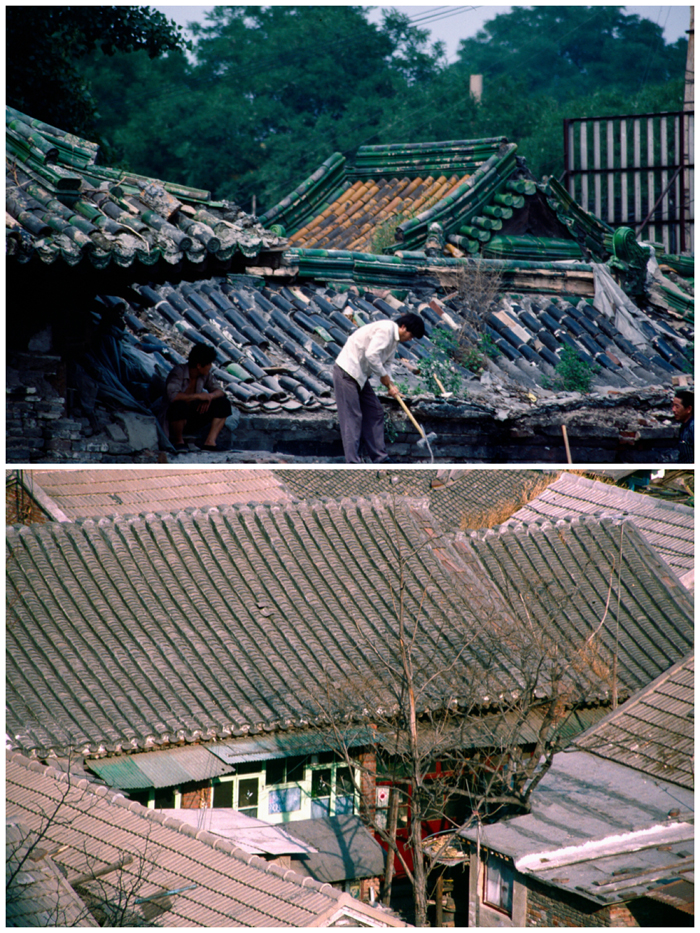
I discovered Beijing by walking slowly and observing. However this did show me that, unfortunately, not all courtyard life in Beijing had retained its earlier charms or comforts. After the fall of the Qing Dynasty, many of the siheyuan fell into disrepair, as the original owners or families had disappeared. Often, less affluent families had moved in, particularly after the 1976 Tangshan earthquake, creating multioccupancy conditions with temporary buildings erected within the actual courtyard space. Facilities, often communal, were fairly basic, resulting sadly in the clearance of swathes of those older areas during the 2000s. Today, many surviving courtyards have been renovated into highly desirable properties, particularly around areas such as the Shichahai lakes.
The area close to the courtyard where I stayed centered on a busy north-south commercial alley, Nanluoguxiang, which today stands out as a very popular destination, particularly for visitors to Beijing. In 2000, it was then a local lane crowded with people from surrounding alleys who would come to shop in the little markets or have a simple meal in one of its many small restaurants.
However, there was one small venue on the western side of Nanluoguxiang alley where I almost instantly felt like I was back in Guangxi's Yangshuo or Yunnan's Dali. This was the original Pass By Bar, which felt very much like a travelers' cafe with its many books and photographs. In 2000 it was a very quiet place to go at night, do some reading, write up notes or simply look out on the winter snow falling across the alley. Since then, as the area developed, Pass By moved into a larger and more traditional courtyard, where again I kept myself immersed in the old city culture. This was particularly true sitting on the upstairs outdoor terrace. There I could look over the sloping gray tiled rooftops, watching flocks of pigeons circle overhead while in the far northwest rose the Drum and Bell Tower.

It would be very easy to stay permanently within that world of old Beijing, its courtyards and alleys, and simply forget what was going on outside. After all, I had everything I wanted. It was a content feeling just walking every day and learning more of the local area and of the lives of its inhabitants. However, go out I did, for Beijing was changing, particularly in preparation for its forthcoming bid for the 2008 Olympics. The city was engaged in a major renovation and modernization drive.
A regular walk of mine headed south, passing the National Art Museum of China, to reach Wangfujing Street. Although my interest was the Foreign Languages Bookstore, the street was changing. Its southern section had become a pedestrian street, with two of Beijing's early international malls opening. The shopping and dining experiences offered something a world apart from the almost timeless existence I pursued within my quiet hutong alleys. It nearly became the best of both worlds, particularly on a cold, wet winter's day.
To really appreciate what was happening to Beijing beyond the historic alleys, I traveled out west on a beautiful July day in 2000 to the Central Television Tower close to Yuyuantan Park. From the viewing platform the panoramas were stunning, revealing incredible vistas of the city. I could look out as far as the Western Hills where urban Beijing ended, and then do a visual sweep of the city's expansion outward and upward. Below me stretched the wide carriageways of the Third Ring Road heading toward the cavernous Beijing West Railway Station, which was a regular departure and arrival point for my China travels. From the television tower it proved difficult to locate the older areas where I lived and spent most of my time, reflecting the scale of the city's growth from its pre-1949 core.

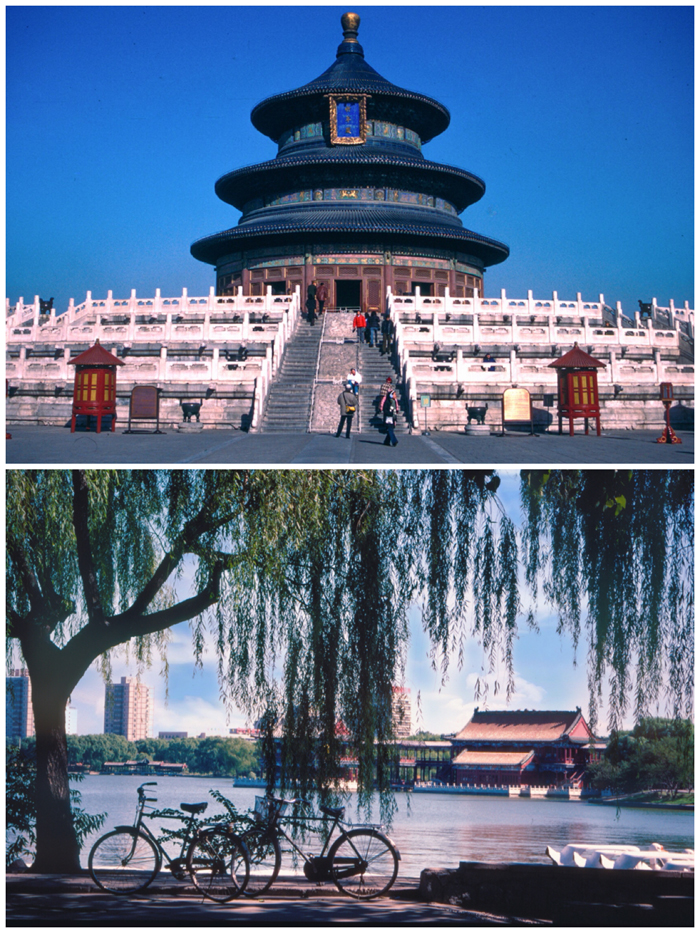
I would take a long morning walk as my regular exercise. From my courtyard near Jiaodaokou, I would head out, passing the former residence of Mao Dun. In the morning, people were heading to the markets while children, often wearing yellow caps, were going to school. West along Heizhima Hutong and Fangzhuanchang Hutong, I would reach Dianmen Outer Street. In the north rose the massive Drum Tower, while ahead the former Fire God Temple was being restored. My walk would also encompass the three lakes of Beijing's greater Shichahai Lake District. Along the way, I passed local markets, temples, pavilions, courtyards, the former residences of Soong Ching Ling, and much more. I was fascinated with people swimming, even in the icy winter cold.
It was surprising to discover the lakes were mostly manmade, going back to the 13th century Yuan Dynasty. Waterways connected with the Grand Canal at Tongzhou, allowing barges to carry grain and foodstuffs from the lower Yangtze region to Beijing and in particular to the Forbidden City. This waterborne traffic led to much commercial development around the lake shores and the western Gulou area, becoming the most commercially vibrant area of Beijing for a while. Later I would go on to walk and discover more of Beijing's intricate canal and water management systems.
Yindingqiao, or "Silver Ingot Bridge", became my favorite location where a small, narrow canal connected the back and front lakes. When I first discovered it in 1995, it was a quiet local area where small restaurants steamed dumplings close to the bridge. Later a few small cafes and bars opened, creating pleasant locations to spend summer evenings watching boats on the water or pedicabs carrying the few visitors who then had sought out this enchanting part of old Beijing.

A twisting alley, Yandaixijie or "Lane of Long Stem Pipe Makers", led up from the bridge toward the Drum Tower. This alley, a quiet local place in 1995, has become the heart of the local tourist industry today.
As always, in Beijing so much changes. Sadly, by the summer of 2002 I had left the courtyard to reside in a small guesthouse within a residential community near Dongzhimen, where I looked forward to more changes in the city in the run-up to 2008 and the Olympic Games.