(Source: China Daily)
Kunming, China's 'City of Eternal Spring'
By Bruce Connolly | chinadaily.com.cn | Updated: 2018-12-22 09:41
During the early 1990s in the UK, a television documentary series beautifully portrayed the life of the Naxi people living in and around Yunnan's Lijiang. It really inspired my travel aspirations. Having lived and worked in rapidly developing Guangzhou around that time, this seemed a world so different to the modern, fast moving cities I was familiar with. That series, "Beyond the Clouds", was a play on Yunnan's name translating literally as "South of the Clouds". What came over was the then isolation of many ethnic groups living either among the rugged mountainous terrain of Yunnan's northwest or dense tropical forests of its southern border lands. What also came over was the geographical importance of the provincial capital, Kunming. Isolation due to southwestern China's difficult physical geography produced many accessibility issues but ironically earlier 20th century wartime struggles against Japan actually worked toward its development, as I will explain later.
Until the late 1990s Kunming was a railhead, the only mainline connection out from Yunnan to the rest of China. To go anywhere, people had first to reach Kunming, often by lengthy bus journeys followed by equally long rail travel, as was shown in "Beyond the Clouds" where people travelled from Lijiang to Shanghai.

As I was to discover, the railways of southwestern China remain as some of post-1949 China's great engineering achievements. Indeed the story continues today with the opening in December 2016 of a high-speed line connecting Shanghai via Guiyang in around 10 hours compared to over 40 hours by conventional train. As a rail enthusiast I was gripped by the story of Yunnan, of Kunming and of its opening up. However, my first short two-day visit to Kunming, in 1994, was by air from Xian followed by an onward flight to Guangzhou. But that excursion inspired me to return in July 1995, for the first of what would be several lengthy explorations of Yunnan.
Through much of history, Yunnan really was seen as a remote borderland reached only by long, difficult journeys, for example from Beijing. Caravan trade routes tended to focus on movement between southeastern Asia and Tibet, following the famed "Tea Horse" trails. Early Kunming sat at a junction of two major routes — one west to Burma via Dali with connections up to Tibet, the other south via Mengzi County to the Red River and today's Vietnam. Another, extremely difficult route allowed mule trains to cross the mountains north to Guiyang and on to Hunan. It was not until the 1930s that the first real highways were laid, connecting Kunming with Chongqing and also to Guiyang.
In the mid 13th century Kunming came under Yuan Dynasty control but by the 14th century it was retaken by the Ming Dynasty. City walls were built and its position as a regional market and transport centre developed. However, it remained isolated from much of the country.

In 1910, a French initiated narrow gauge railway connected Kunming with Vietnam's Hanoi and Haiphong. However, it was the World War II that really saw Kunming and other parts of southwestern China develop. With Japanese advancements across eastern parts of China industrial plants, administration and even universities were relocated to the area, hopefully out with the range of enemy bombers. Many educated, skilled people settled, for example, in Kunming. It also became a strategic supply base both with the overland Burma Road via Dali and the air corridor created "over the hump" from India. Between 1941 and 1942 the heroic "Flying Tigers" were based in Kunming.
Postwar, the city benefitted from such relocated academic and technical expertise to develop rapidly as an industrial centre. That period also saw the opening up of southwestern China by what can only be described as incredible railway engineering achievements. 1,134-kilometer-long Chengdu-Kunming (Chengkun) Railway was constructed between 1958 and 1970. Traversing extreme terrain via hundreds of tunnels and bridges it remains today as a recognized monument to outstanding railway achievement. Another key project was opening of the "Nankun" line in 1997 connecting Kunming with Nanning in Guangxi. It considerably shortened freight and passenger time to/from Guangdong and even Hong Kong.
In July 1995, I travelled from Beijing to Kunming on a 47-hour train ride that took in part of the Hunan-Shanghai-Kunming (Hukun) Railway. Although easy to have flown from Beijing to Kunming, I wanted to see the landscape and to experience a railway penetrating through some of China's more difficult terrain. It would also take me through parts of Guizhou and hopefully see something of the ethnic groups inhabiting that remote upland plateau.

Initially, following the main Beijing-Guangzhou Railway, the train at Changsha switched onto the Hukun Railway and started heading southwest. Looking out, I knew this was why I chose to travel by train. The scenery was both beautiful and indeed from a human point of view, fascinating. Mostly rural, with villages grouped alongside fish ponds, the landscape becoming increasingly mountainous. Rivers, long tributaries of the Yangtze catchment area, provided essential transportation corridors for both freight and people.
Our journey was slow, the line mostly single track but work was underway on double tracking, electrification and extensive tunneling. We passed through areas of small, local coal mines then lacking the urban facilities and lifestyles I had left behind in Beijing. While those rural-urban contrasts were stark, the landscape was certainly beautiful.
I spent time in the dining car, chatting with fellow passengers, enjoying simple food while regularly looking out at the passing countryside. Villages were composed of two floor wooden homes with balconies. Beyond, mist clung to high, forested mountain slopes.

As we entered Guizhou, "Butterfly Lovers" played over the carriage loudspeakers. However, night had fallen, a pity because I was sure we were going through stunning scenery. Next morning the train pulled into Guiyang, a city so different to the one I visited last year, 2017. Ahead lay a smooth journey toward Anshun along a dry, high plateau with many egg-shaped limestone hills. Villages were scattered with ducks and geese waddling between small ponds.
The route was increasingly spectacular; at times following narrow ledges cut above deep valleys as we seemingly crawled towards the clouds. Piercing the hills, tunnels, mostly constructed between 1965 and 1966, were connected by short viaducts. At each gap I could look down on parts of the railway we had been following.
Liupanshui is a border city between Guizhou and Yunnan. There, people often in ethnic costume, crowded the platform. Continuing beyond, railway engineering appeared even more impressive as we followed one side of a deep valley before going through what seemed spiral tunnels to emerge on the other side before gradually climbing onto a more level plateau. Villages now more numerous, rice fields dotted the land along with a growing number of small industrial towns. More and more the scene became busier until finally the train pulled into Kunming. What a journey that only rail travel could provide!

Walking out from Kunming Station at south end of Beijing Lu I noticed the July temperatures was mild, indeed very pleasant. A few minutes later I had booked into a small hotel overlooking this main thoroughfare, it was already late afternoon. Nearby I found a cafe with an outdoor terrace. I was in no rush. Just spend a few days relaxing while discovering Kunming before heading up country toward Dali.
Not wanting to do too much on my first day, I wandered through some older streets to Green Lake Park. Street life always fascinates me such as popcorn being roasted in large cylinders rotated by hand over coal fires. Also the many people who congregated on pavements repairing shoes or household items. The park I would return to many times. On the waters, wooden boats resembling small teahouses were polled gently through the waters. In pavilions people performed traditional songs while children rode on miniature "bumping cars". Older people, often in blue cotton jackets, played cards, board games or just chatted while relaxing in the warm sunshine. The aroma of freshly prepared snacks enticed me to have some grilled chicken on sticks.
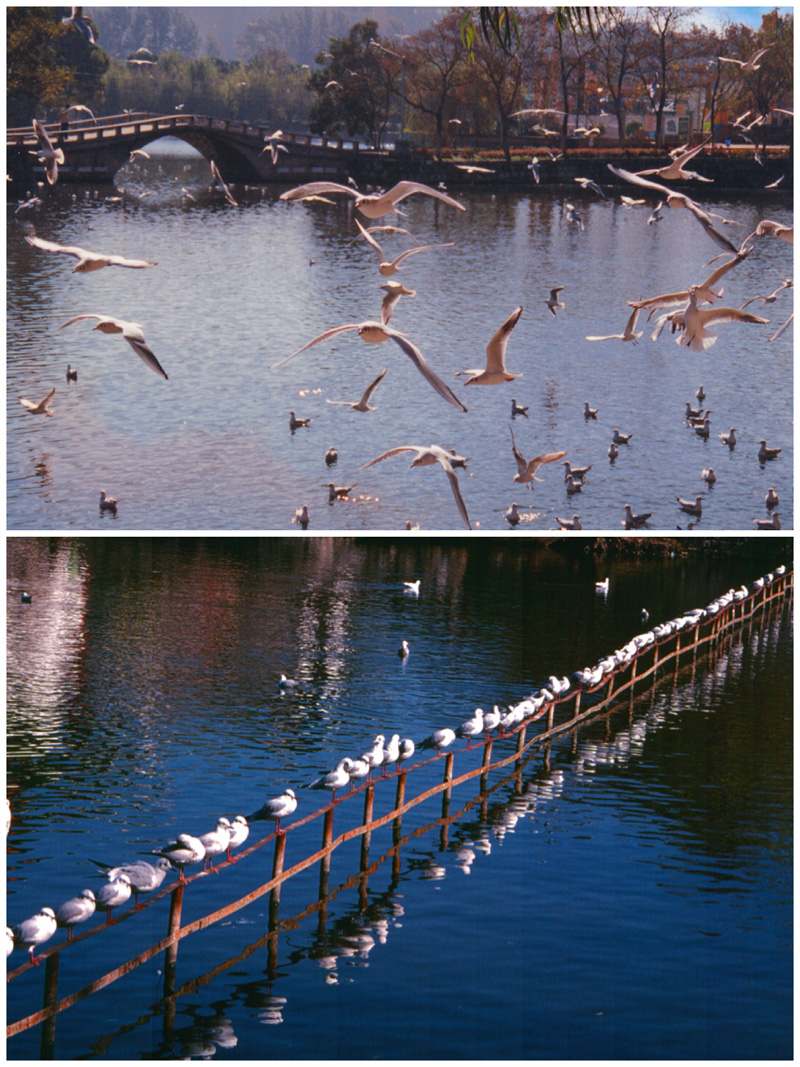
In winter months the park was renowned for the many thousands of Siberian seagulls that descend on the city. Driven south by the extreme cold gripping Russia they migrated across northern Asia to the relative warmth of this sublime city. While hibernating around the shores of nearby Dianchi Lake they would head daily toward the park where locals and visitors fed them with miniature loafs of bread!

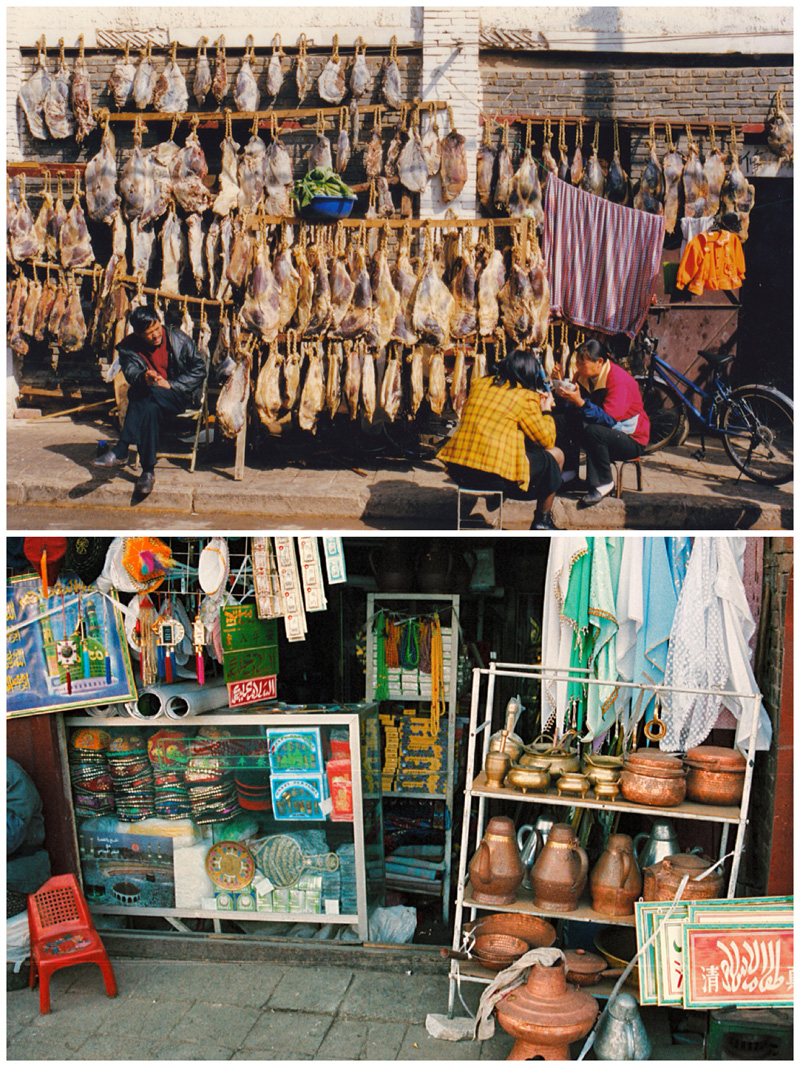
Kunming I was starting to enjoy, but I also wanted to discover what remained of the historic city, a search for older Kunming. Soon I was slowly wandering around the Muslim area which apparently could trace its roots back to the 13th century. Buildings traditionally were two floors with red wooden facades. Open-fronted shops displayed household copper goods spilling out onto the pavements. People sat chatting, while others cycled along the bustling alleys. Dried meats, a Yunnan specialty, hung outside from bamboo poles. Yet as I walked so I saw modern Kunming increasingly rising.
The city's Yuantong Temple, over a thousand years old, was somewhere I would visit regularly. A delightful place, the aroma of incense accompanied by sporadic chanting created a relaxing, soporific atmosphere. Overlooking its main pond crowded with golden fish, I discovered a vegetarian restaurant. I sat there endlessly sampling several authentic culinary creations, sipping tea while just letting time drift past. There, alongside Buddhist monks, I increasingly noticed people in ethnic costume. Yes, Yunnan was revealing some of its fascinations.

During the 1990s, from my first visit in 1994, Kunming was steadily undergoing transformation. A major stimulus for this was the 1999 World Horticultural Exposition. With its mild climate, Kunming feels "in bloom" with flowers all year including its iconic Camellia. In response, the city underwent a considerable makeover leading toward the modern Kunming we see today. Tourists started flocking to Yunnan, helped by this greatly improved infrastructure initiated by the Expo.
Annually, Kunming became my staging post for onward Yunnan travel adventures including heading to the border with Vietnam by the historic narrow gauge railway. However, every visit to the city led to increasing discoveries in and around its surroundings.