(Source: China Daily)
Lhasa - a travel dream fulfilled
By Bruce Connolly | chinadaily.com.cn | Updated: 2018-11-20 09:37
Throughout my Scottish schooldays exotic travel seemed just a dream. Inspiration, mainly derived from monochrome photography, was mostly gleaned from pages of geographical magazines. Some really inspiring images were of a small city, so different, then seemingly in a time-warp literally on the "Roof of the World". Maybe because they were monochrome, I kept looking again and again at its amazing Potala Palace rising on a rocky hill above Lhasa, capital of Tibet. Inspiring yes, but it felt impossible for in my childhood such travel ambitions were out-of-reach both financially and through practicalities. Too often there were simply no feasible transport options. Infrastructure was not there to facilitate ease of access for all but the most adventurous of travelers. Those days are now long gone. Cities such as Lhasa are today conveniently accessible by air and rail although road journeys, even on the much improved highways, remain lengthy.
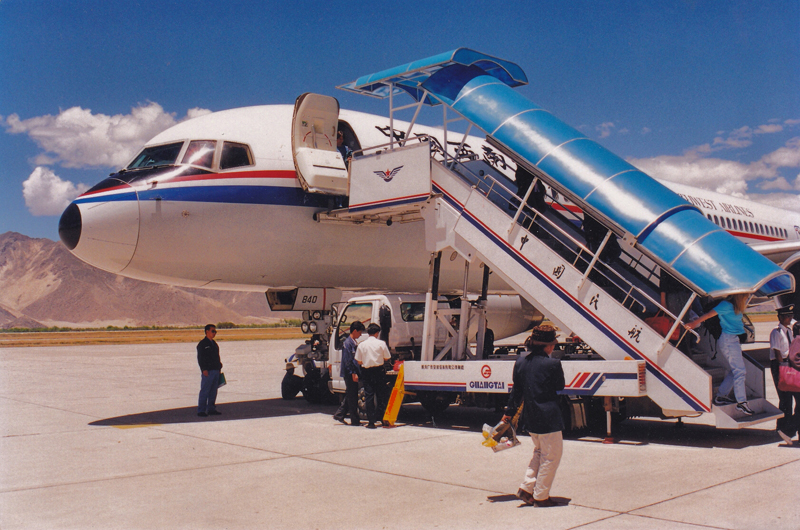
In 1997 I travelled along the then "Tibet Railway" to its railhead at Golmud in Qinghai. Walking to the edge of that high-plateau city, standing on what was the highway to Lhasa, I wondered if my schoolboy dreams would ever be accomplished? Three years later, in June 2000, it had materialized! I was in Xining, Qinghai's capital, about to board a Boeing 757 that would follow one of the world's highest air routes, to Lhasa.
Transfixed, for several hours, I looked down on an almost uninhabited scene of high-altitude deserts, salt beds and snow mountains. This was a landscape pushed up to such altitudes by the massive tectonic forces that had created the Himalayan mountain ranges. Indeed a week later, approaching the world's highest peak, Mount Everest (Qomolangma), I was presented with fossilized remains of sea creatures widely found in that area which in ancient times had formed the sea bed.

Descending, the aircraft aligned its final approach toward Lhasa's Gonggar Airport above multi-braided channels of the Yarlung Tsangpo River. I looked across the waters toward Samye Monastery before we gently touched down. Alighting, both clarity of the air and an intense blueness of the sky were striking. In the distance rose snow mountains. I had arrived in Tibet.
Lhasa was then a 95 kilometer drive initially alongside the river, passing many chortens and bundles of prayer flags. Eventually a bridge carried the highway across the main channel toward the valley of the Lhasa River. Passing farming villages with fields of maturing barley we stopped at a small lake where a brightly colored Buddha image had been carved from a cliff face.
Beyond, a sign proclaimed "Welcome to Lhasa" and there in the distance, rising on the 130 meter high Red Hill (Marpo Ri), was the Potala Palace. Its golden roof structures glittered in the afternoon sunshine. It was later that day that I finally set foot at Potala Square. Looking toward the Palace I quietly smiled while saying to myself, 'Dream Fulfilled'! The view, then in bright afternoon colors, reflected those previous monochrome images of such a majestic edifice overlooking Lhasa. During my stay in the city I frequently returned to that mesmerizing viewpoint, each time thinking "Am I really here?"
Although Lhasa sits at 3,650 meters, I had no altitude problems except a slowness walking uphill or climbing steps. Maybe it was the excitement of being there that kept me going? Naturally on my first full day in the city, the desire was to visit, to actually be inside and onto the roof of the Potala Palace. One of the world's great architectural wonders it symbolizes both an iconic image of Lhasa and Tibet. From many vantage points around the city I would notice how it so often it featured across the skyline. Initial construction, between 1645 and 1693, was during the time of the Fifth Dalai Lama. Considerably expanded since then, it became the winter palace before completion of suburban and summer residence, the Norbulingka, in 1755.
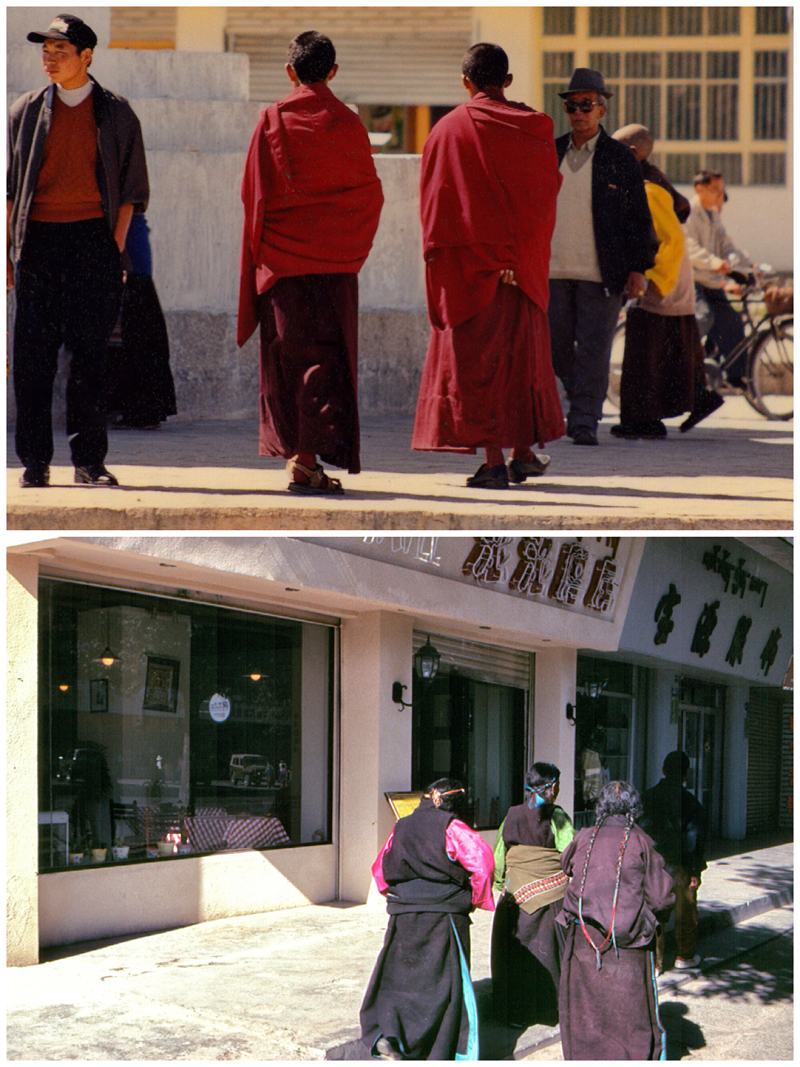
In 2000, Lhasa was still very much a compact, low-rise city something increasingly revealed as I ascended upwards toward the main buildings of the Palace. While the structure itself was simply awe-inspiring, I discovered there are actually several sections making up its facade. The earlier White Palace (Potrang Karpo) and the later Red Palace (Potrang Marpo), while in between sat smaller yellow colored segments.
Awe-inspiring, there felt too much to take in on one visit with so many rooms, meeting halls, libraries, and prayer halls through which crowds of quietly chanting locals and visitors slowly moved. Many spun hand held prayer wheels while also fingering long chains of wooden beads. I noticed how women, wearing heavy long dress, often had thick, braided hair. Frequently I was greeted by "Tashidele" or "Hello". Incredible would probably sum up my feelings of that morning.
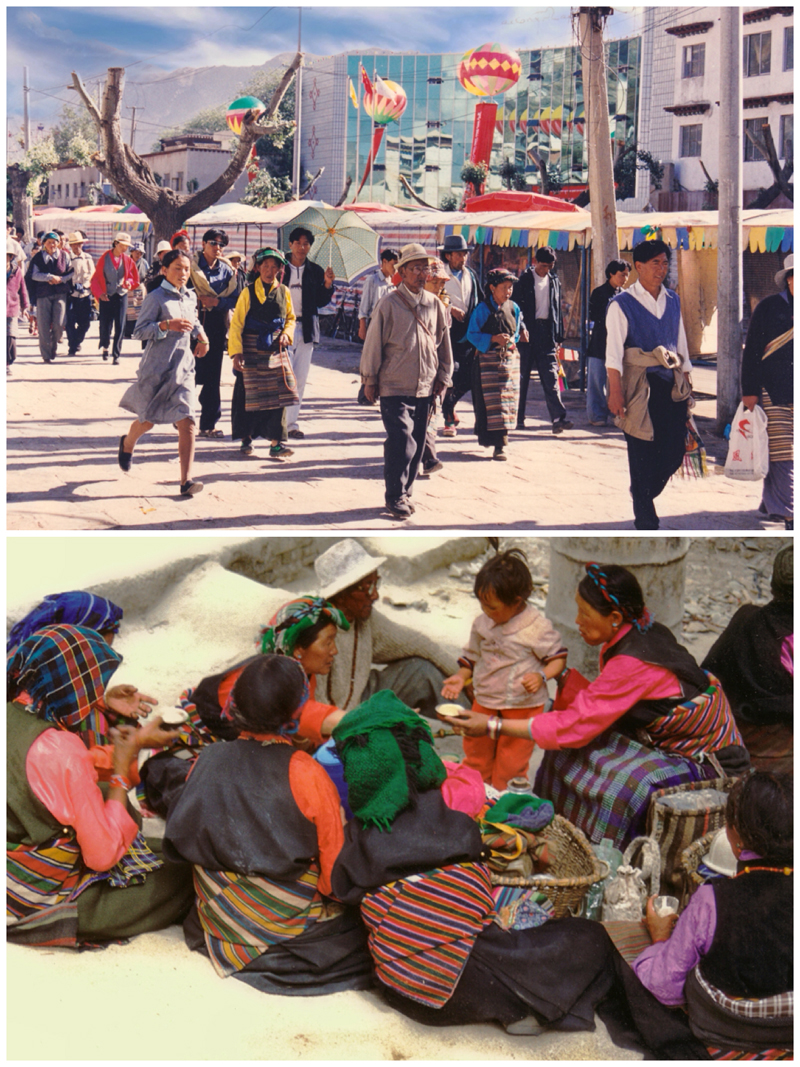
Reaching the rooftop space, extensive views took in much of a developing, expanding city, across to Lhasa River and the mountains beyond. Descending from the Palace, via a long series of walkways and steps, eventually exited through an encompassing wall. There I watched many people following the Potala Kora, a sacred walk clockwise around the base of the Palace. Walking or moving slowly, most quietly spun handheld metallic prayer wheels. Some would enter small structures enclosing shrines before continuing with their circuits.
I crossed the main road and headed toward a white chorten where an earlier western gateway into Lhasa once stood. Climbing Chagpo Ri, a nearby rocky hill, the views back toward the Potala were stunning. Later that day I would visit equally fascinating areas around Barkhor Square and the Jokhang Temple. The latter, regarded as the most revered religious structure in Tibet, dates back to the 7th century although little remains of the original construction. There was so much history to absorb of how Buddhism first arrived in Tibet.

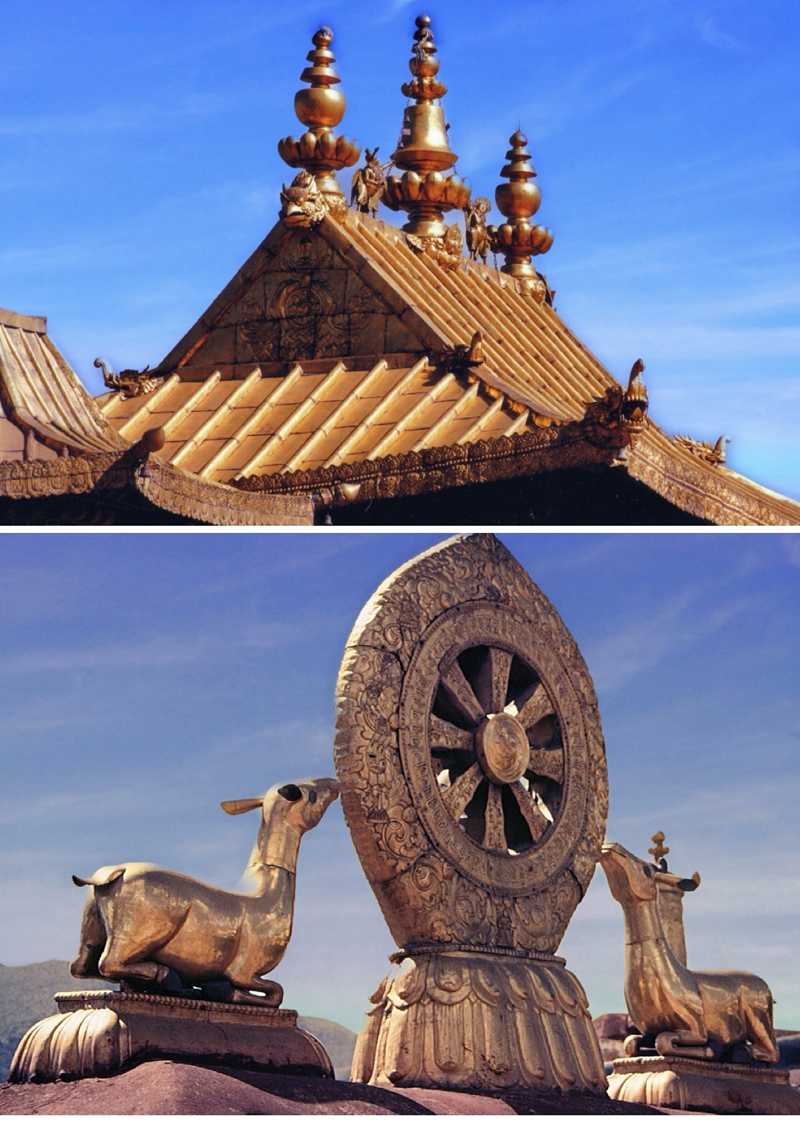
I was fascinated at the scenes all around. Groups of monks walking past crowds of people thronging the forecourt and entrance to the Jokhang, some prostrating themselves on paving stones worn smooth over many years. Going inside it was like stepping back in time as I was led by a young monk through halls and narrow corridors lit by flickering butter lamps. The air heady with aroma of incense. Within a holy sanctum sat the historic statue of Sakyamuni, brought from Chang'an (Xi'an) over 1,300 years previously by Princess Wen Cheng. There was so much, indeed almost too much to take in before I was guided up onto the roof. It was adorned with many golden symbols including the "Wheel of Dharma" that recalled the Buddha's first sermon in a deer park. The view toward the Potala, stunning, it was a perfect location to be photographed alongside my guide. Moments that I have always cherished.
Back outside I walked clockwise along part of the Barkhor Circuit where many stalls offered traditional clothes, hats, butter lanterns, decorative thangkas depicting the Potala Palace. I returned, as was my custom, to an outdoor cafe at the square below the Potala to update my diary. Writing complete, I would simply sit there trying to take in all that had happened during such a highly memorable day. The weather, beautiful, added to the experiences.
To the west of the city sits the former Summer Palace of the Dalai Lamas. Today Nobulingka or "Jewel Park" is a public garden. The original palace was created in 1755 by the seventh Dalai Lama who decided to transform this pleasant woodland area into a summer administration base. Every year saw a great procession of palace officials moving in spring from the Potala to the Norbolingka, returning back in the autumn. Over subsequent periods there was both new building and extensions to the site. A fascinating place to explore while taking in the beauty of the forested gardens appearing popular with families coming out for picnicking or simply relaxation.
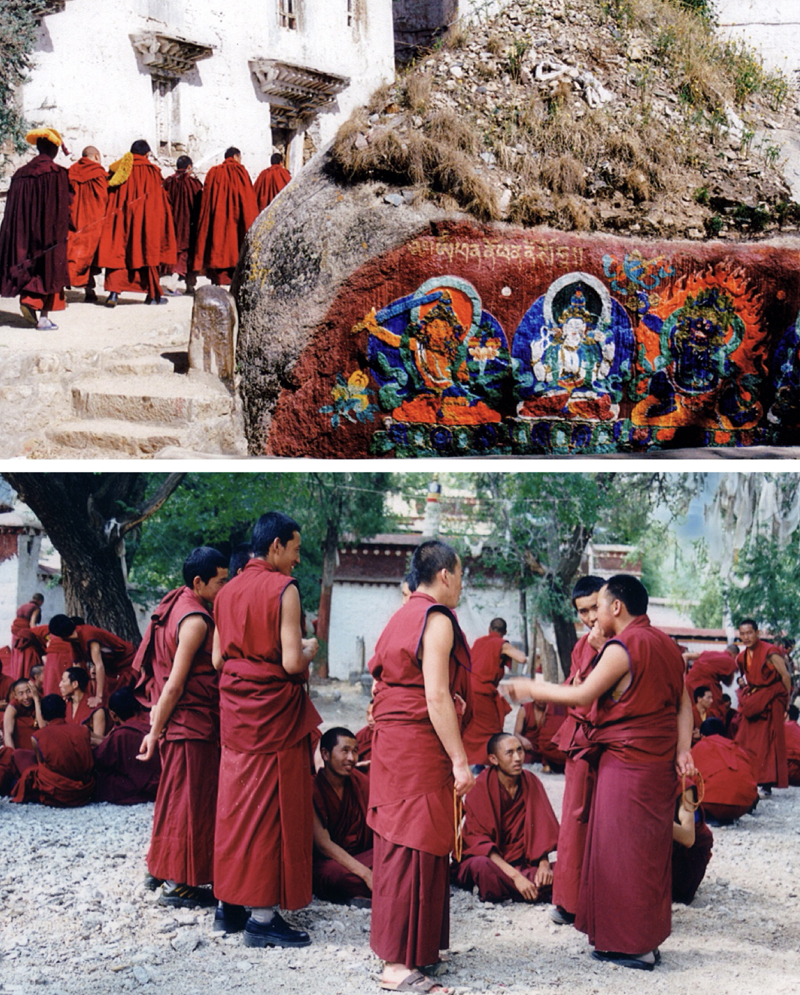
Lhasa in 2000 was not a large city and most journeys quickly took me beyond the urban areas. One, into nearby hilly terrain was to the Sera Monastery. Along with the Drepung, this was one of Lhasa's two great Gelugpa monasteries. Founded in 1419 it remains an important centre for Buddhist study. In a tree-shaded courtyard I came upon a noisy scene of many monks debating, chatting and indeed laughing. Some were fingering long strands of prayer beads while snapping their fingers or slapping their hands to emphasize points. Some stood while others sat in groups, again I was welcomed and invited to take some photographs.

Walking higher through the monastery's grounds, considerable renovation work appeared underway. Again I went into some halls, with their mostly white exterior walls, black framed square windows and rooftops adorned with glittering gilded features such as the "Wheel of Life". Within the halls, the now familiar yak butter lamps, sandalwood aroma and quiet chanting. However I wanted to walk and soon headed up a path, passing murals painted onto rocks with bundles of prayer flags nearby. I reached the Sera Kora where many people continued to walk clockwise around the monastery. A tall white wall rose in front of me, used for "Sunning the Buddha" ceremonies with a giant thangka during the Tibetan New Year Festival. High above, more prayer flags adorned hillsides.
I was in Lhasa at the start of an incredible journey that would take me both to the Base Camp of Mount Everest (Qomolangma) while also traversing some relatively little visited parts of Tibet. At that time much of Tibet was still developing. Travel was both adventurous and indeed, hard! It was good spending a couple of days simply relaxing in Lhasa at the culmination of my Tibet experience. Naturally I had been spellbound by the city's classic iconic reminders of my youthful dreams. However I also discovered a pleasant small but modern city to walk around. This was something I did at every opportunity including sitting at outdoor cold drink stalls or evenings relaxing in smart coffee shops. In Lhasa I had also experienced a diverse range of cuisine from Tibetan, including local yoghurts, to spicy Sichuan and a fascinating range of international dishes from popular traveler cafes. I appreciated finding places where I could relax on an outdoor terrace to look across the city as evening fell while literally "letting time drift by". There I thought of my early ambition, then seemingly unachievable, to reach Lhasa. But from Lhasa an onward journey lay ahead that would take me through some of the world's most dramatic scenery, often a far cry from the comforts that Lhasa had provided.