(Source: China Daily)
A Geographer in the desert - Experiencing Dunhuang in the mid-1990's
By Bruce Connolly | chinadaily.com.cn | Updated: 2018-11-06 14:52
Lanzhou, rising alongside the Yellow River in Northwest China's Gansu Province, must have appeared as a relief to travellers following the Silk Road east along the Hexi Corridor. I thought of that scenario as I headed one late afternoon in 1996 towards the city's airport. Beyond its urban terrain a transformation rapidly unfolded towards a more gravelly, dry landscape. My destination, via a two hour flight, lay westwards to the oasis of Dunhuang. Historically camel caravans opting to traverse, via Wuwei for example, faced an arduous journey across difficult, challenging and often stark landscapes.
An evening flight, it revealed an area of low population density. Although the sky was clear, I detected few if any lights on the ground below. Indeed Dunhuang's airport seemed to appear suddenly out of the desert darkness. Disembarking I looked upwards to an amazing canopy of stars. I also noticed it was cold, although only mid-October. Winter temperatures can drop to -26 degrees while summers may reach 40 centigrade!

Soon I was wandering through the older alleys of this oasis whose survival historically has been dependent on water supplies being locally available. Passing through an arched gateway I came to a square where a daytime market would bustle but by evening was filled with food stalls offering round flat breads and spicy lamb kebabs. Sitting there, enjoying the sounds of local music, I read up on the history and strategic importance of Dunhuang.
During the Tang Dynasty, the area was known as Shazhou or 'sand district', referring to its gravelly, stony expanses bordered by a sea of dunes. At the mouth of the Hexi Corridor, it formed a meeting point of trade routes circulating around the north and south of the Taklamakan desert wastes of southeastern Xinjiang. Dunhuang was where provisions were acquired before traders set off on those long-haul camel caravan treks or gained respite before journeying eastwards towards Lanzhou. Merchandise being shipped in both directions was traded in the town's markets. In the surrounding area early traces of settlement go back to a Han garrison town founded in 121 BC.

Today Dunhuang continues as a major route centre with highways connecting via Golmud in Qinghai to Tibet; west to Xinjiang and east to Lanzhou. Ongoing railway construction will continue to enhance this role.
Then in 1996, my first experience of northwestern China, it was still dark outside while I had breakfast for the entire country keeps to Beijing time. However the sky soon lightened to reveal an intense blue that would remain as a memory of travels across such a vast region. That initial foray into the mostly waterless gobi lands around Dunhuang was for only a couple of days but later I would return for a lengthier period of exploration by foot or bicycle throughout both the town and its surrounds.

The mid and late 1990's was a time before the large mainly tourist crowds of today. It was much quieter although it had already by then attracted several travellers' cafes. They proved to be good sources of practical advice along with cycle hiring. Usually I would discover a pleasant venue, use it as a base while appreciating the often spicy range of vegetable-based meals served up within.

Walking to the outskirts of the town, I scrambled up parts of its former earthen defensive walls. The urban area appeared compact with mostly low-rise, flat roofed dwellings. It was remarkable how near the desert encroached, how quickly green turned to colours of aridity. Noticeable were the great sand hills of Mingshashan, a range 40 kilometres long. Local roads, lined by tall poplar trees, led between intensively cultivated fields. Water gushed along irrigation channels so allowing production of vegetables, fruit and cotton. Following a country road I passed through a compact village where farmers tended goats or toiled in the fields alongside some crops grown under plastic sheeting.

Part of Dunhuang centered around busy cotton markets. Tractors hauled carts loaded with great bales and loads of cotton to accumulation zones for onward distribution to eastern China or overseas. Such areas again provided fascinating viewpoints to watch local life. People would shop or eat at small local markets set amidst cotton storage warehouses. Children played on the red tractors while older generations warmed themselves in the afternoon sun.

Having been educated as a geographer, desert landscapes were an integral part of my studies. Dunhuang offered some of the finest such topography across the northwest. Several times I would head out walking or cycling, stopping to look, for example, at local courtyard homes entered through decorated, tiled doorways.

On the edge of town, towards Mingshashan or the 'Singing Sand Mountains' I heard chanting from a small temple. Investigating, I came upon a lively scene where local, mostly elderly residents, walked in a line led by monks and nuns. As I sat watching, I was given fruit and bread. A communal vegetarian meal was prepared for everyone in attendance including me!

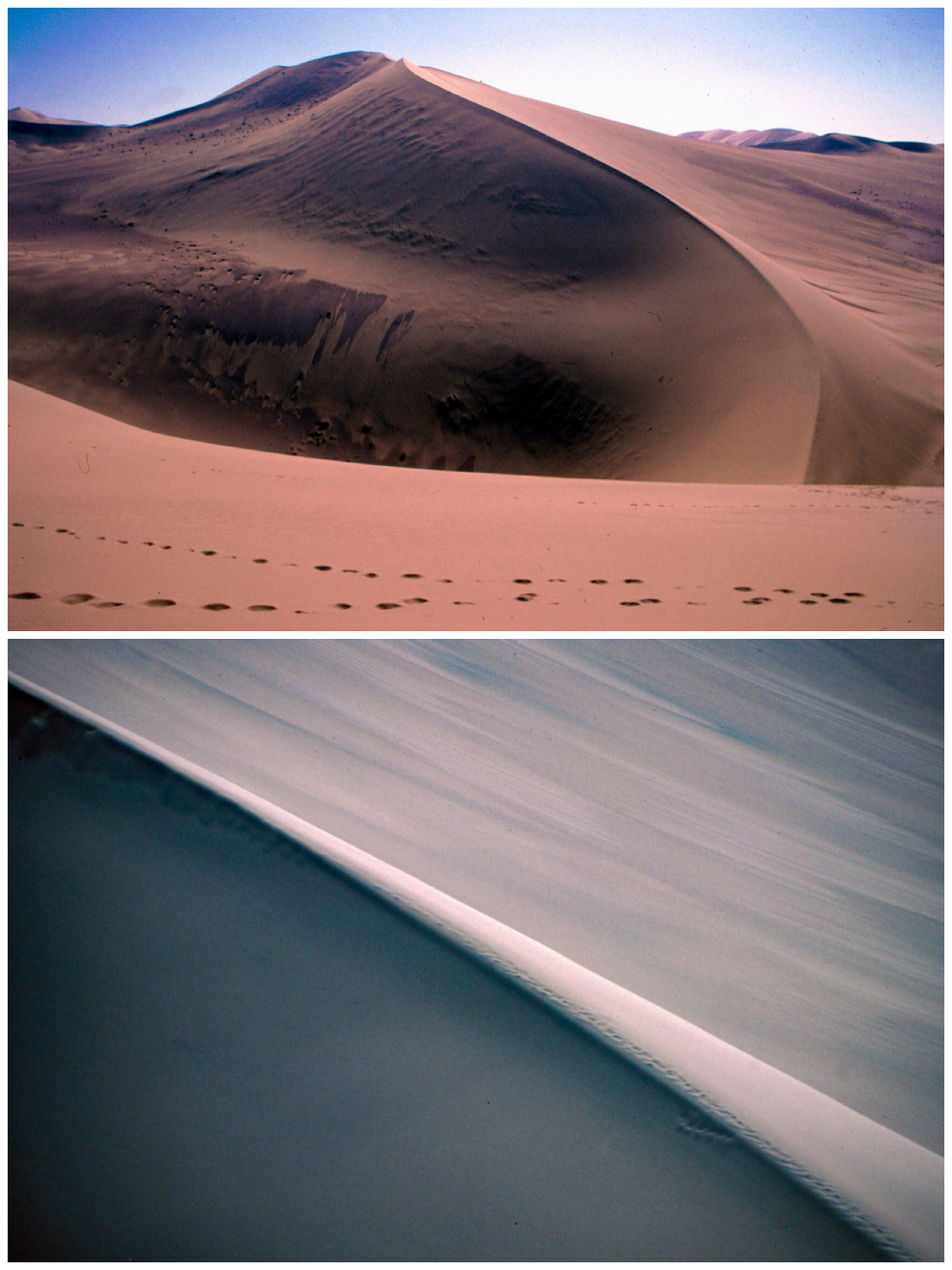
Eventually I reached the track leading up towards the massive sand dunes. Many camels were tethered while men sat alongside, chatting. Resisting calls to go 'camel riding' I walked on, wanting to be alone in the desert. Apart from an isolated cottage, there was initially no hint of habitation or vegetation. On that first visit to the dunes, it was early morning, just after sunrise, with the landscape bathed in an ethereal light. Ahead lay ridge after ridge of sand. Walking, I kept going deeper into the emptiness. I thought of early travellers who if they made mistakes with direction could be so easily consumed by such a desert.

Trying to climb uphill proved difficult, at times leaving me breathless. The sand so dry, the grains so polished that it appeared impossible to secure a strong foothold. It seemed two steps forward before sliding backwards. Reaching a ridge it did feel easier to walk towards the summit. The view, the panorama, was of great sweeping ridges rising higher, joining up classic barchan dunes as though straight out of a geography textbook. I was alone on this sea of sand, bordering the Taklamakan and quietly dreaming I was an early explorer, 'Bruce of the Desert'! No sound apart from the crunch of my boots, no birds, no obvious signs of animal life. Then in the distance, almost out of the Silk Road days , a camel 'caravan' ascended a distant slope - it was carrying visitors on their desert adventure. Between mountains of dry sand appeared a small area of greenery and water, to which I vowed to reach. From the ridge, I ran and slid while trying to create some 'singing' sounds, sadly to no avail!

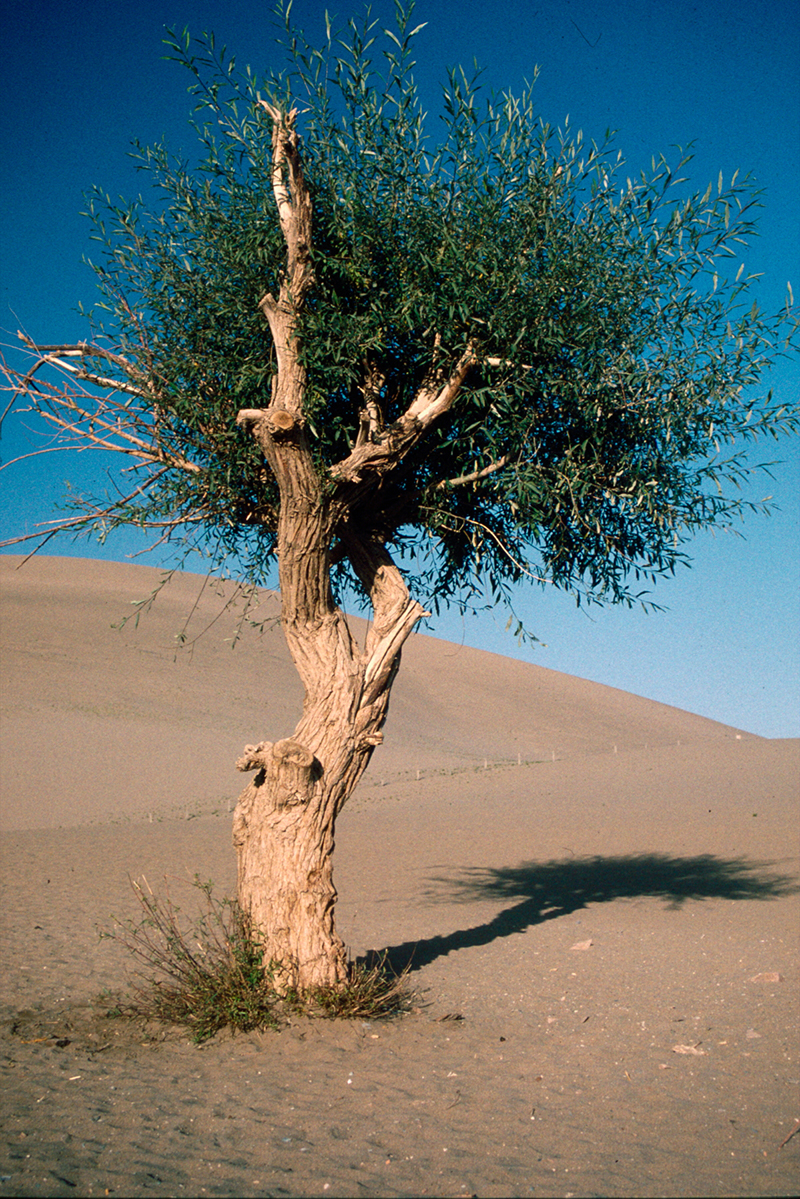
Back on the track, a yurt with camels sitting nearby was possibly for tourists? Ahead lay the famed 'Crescent Moon Lake' (yueyaquan) I had first seen from the dunes. A natural crescent-shaped pool it lies apparently where wind exposed a natural spring coming from normally concealed porous rocks. Overlooking its placid waters rose a brown wooden former temple and pagoda. As I headed back, a solitary tree rose from the seemingly waterless desert. A tractor carried local people as I returned towards the camels I earlier saw resting near the roadbed just as tourists were arriving. I had had the place to myself, alone in the desert.

Wishing again to be alone, for after all I wanted to think about this amazing piece of geography, I hired a bike from a cafe. Cycling out of town on the road towards the airport I veered right to follow a gravelly track penetrating deeper and deeper into the wilderness. Stopping eventually, after taking some photographs, I sat down to write notes on this experience before the rather long haul back towards Dunhuang and straight into a cafe!

Most evenings I would go between the cafes and the nearby market square. There I would sit at a stall, watching the constant activity, such moments enhanced by aromas of baking bread, hot, spicy food and roasted chestnuts.
Dunhuang's Mogao Caves are regarded as the most impressive and best kept example of Buddhist cave art anywhere in China. Travelling by small bus out from town in 1996 certainly emphasized Dunhuang as an oasis settlement for the road quickly moved beyond any farming and into seemingly lifeless desert. Near the airport, we turned right onto a well-made highway across salt flats and gravelly wastes. Small mirages were created by the intense sunlight and whiteness of the ground. Eventually set into cliff faces above a small river, there were the grottoes. 492 still exist, with the oldest traditionally dating back to 366 AD. Over the following ten centuries Dunhuang flourished as a major centre of Buddhist culture, enhanced by its position on strategic overland trade routes. Tall trees initially restricted my view of the caves but walking closer I came upon a lofty series of wooden balconies accessing a cave housing the Great Buddha. Originally rock-cut stairways and paths connected the caves, later to be replaced by wooden walkways as the stairs had gradually collapsed. Abandoned and increasingly deteriorating, the caves were apparently rediscovered by Wang, a Daoist monk, in 1900. Many caves, then only be accessible by ropes and temporary ladders, were often filled with windblown sand. Today considerable restoration has gone on to preserve what remains. To prevent farther deterioration most are closed to the public but a select number are carefully managed for visitors. It was fascinating entering a cave excavated right up almost to the cliff top, containing a 31 metre high 'Sitting Buddha' .

Before leaving Mogao I headed off across the gravelly wastes to a hill overlooking the valley of the grottoes. It was like a narrow stretch of green piercing a scene of seemingly total aridity. Next to me rose several highly weathered stupas. As I stood there I became aware of the stillness, the silence, no movement, no obvious animals or birds. Again I was alone in the desert beneath a piercing blue sky.

Although Dunhuang was small at that time in the 1990's there felt much to see, to experience including a movie location way out by the dunes where historical dramas had been shot.
As usual I was at my happiest wandering around town, watching everyday scenes, sitting at small food stalls writing notes and just taking in the experience of Dunhuang. With every journey comes the time to depart, leaving behind places that temporarily were 'homes from home' but each departure again emphasized what had been Dunhuang's early geographical isolation. My first exit in 1996 was by road, passing beacon towers from crumbling sections of Great Wall, to Liuyuan on the railway from Langzhou to Urumqi. The following year it was from Dunhuang along a sand swept highway climbing up towards the Qinghai-Tibet Plateau.
If I were to return today a train could carry me from Beijing or Lanzhou directly to Dunhuang and soon a new line will open up to Qinghai - modern Silk Road travel!