(Source: China Daily)
Exploration and discovery at Yunnan's Erhai Lake
By Bruce Connolly | chinadaily.com.cn | Updated: 2018-10-20 08:48
"Geology gives but geology also takes" — a very true statement, but particularly so for northwestern Yunnan. The area boasts some of the the finest, most dramatic scenery in China, but it has been produced at a cost that includes serious consequences. Yunnan is influenced by the same natural forces that created the Himalayan peaks and ranges of Tibet. Throughout geological history, via a process known as plate tectonics, what is today's Indian subcontinent has been moving very gradually northward. Each shift — often accompanied by earthquakes or tremors — pushes up, folds or fractures the land. In northwest Yunnan three great rivers, the Nu, Lancang and Jinsha, have gouged out deep gorges along such geological ruptures.
Dali, my personal "Heaven on Earth", occupies a stunning location between 4000-meter-high Cangshan Mountain and the shimmering waters of Erhai Lake. That lake has fascinated me since my first sighting in 1995, travelling by bus from Xiaguan or New Dali to Dali's walled ancient city.
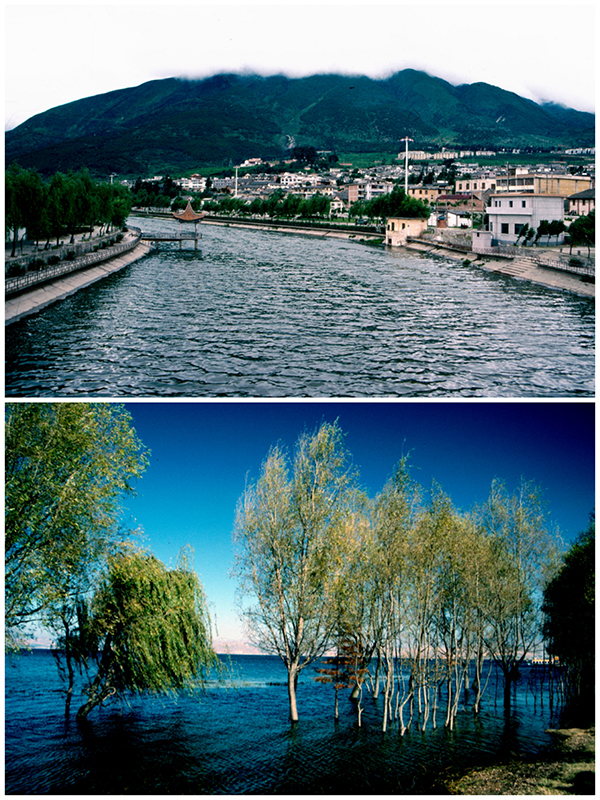
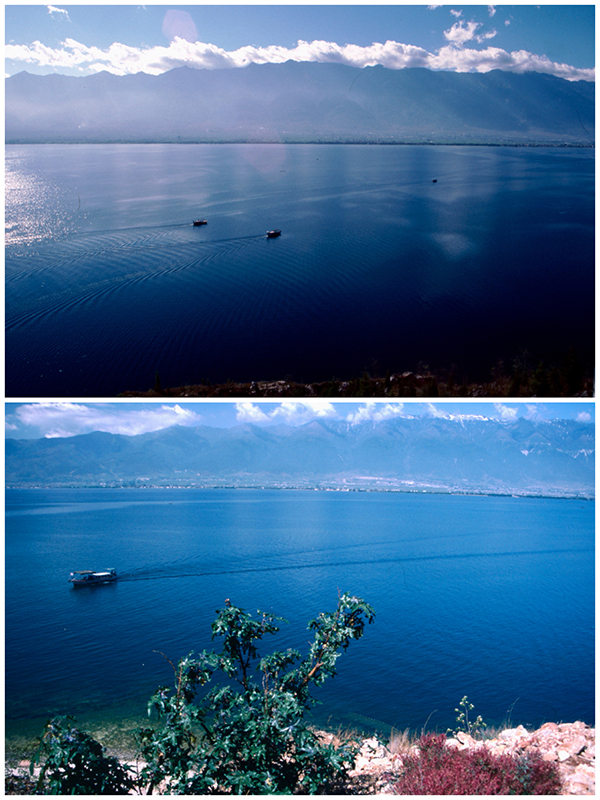
The physical beauty around Dali can be attributed to geological activity. Erhai, or "Ear-shaped Sea", stretches approximately 40 kilometers north to south. It is China's second largest highland lake after Dianchi, also in Yunnan. Erhai sits along a fault line with relatively shallow water spreading along the course of this line. Streams and rivers today gush down, feeding the lake with the melting snows and ice on Cangshan. The Miju and Mici rivers flow in from the north, along with the Bolou from the east. There is one outlet, the Yangbi, which leaves the lake at Xiaguan. In 1995 I stood on a bridge over its strong current, thinking of the water flowing west to join the Lancang, ultimately entering the sea through Vietnam's Mekong Delta.
Over several years with Dali as my base, I was able to explore much of the area surrounding the lake including villages, towns and islands. There was a tranquility about the area at that time that seduced me regularly into returning to its shores. Enchanted by the beauty, I would often sit for lengthy periods watching activities on both land and water.

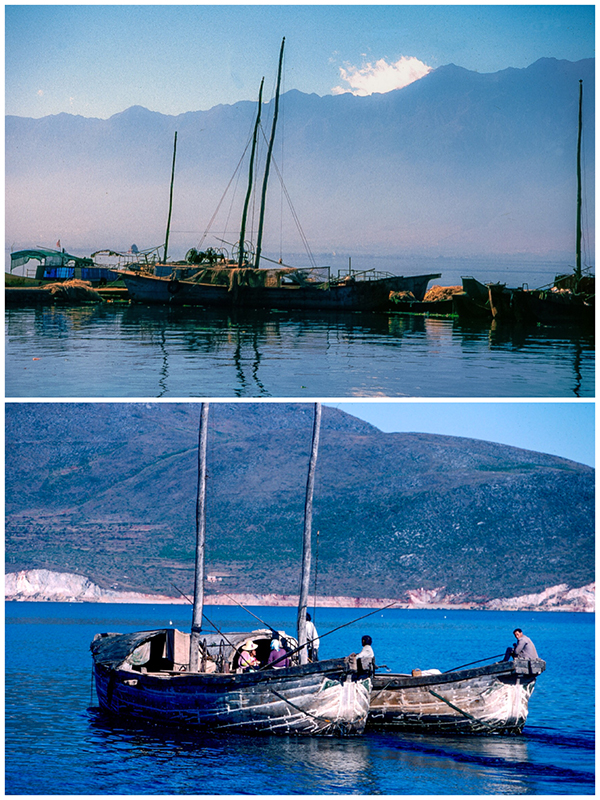
My first visit to Erhai was by foot, from a guesthouse in the old town. Walking east across an extensive plain of dark brown alluvium, I continued past rice fields and irrigation channels to reach Caicun. This was a fishing village of two-story white-walled buildings set around a small square. Beyond, steps led down to the waters, where several long and narrow fishing vessels were tethered. As I gazed forth, women washed clothes by hand while others collected water in plastic buckets suspended from wooden shoulder poles. Out from the shore, nets supported by bamboo rods acted as fish traps. I watched as a man rowing a boat appeared to be throwing grass into areas enclosed within the nets. Meanwhile a sailing vessel moved south across the lake. In the evening fishermen would go out on bamboo rafts, using cormorant birds to dive for fish.
Returning to Dali, walking or by 'horse-taxi', the view was of the sheer backdrop of Cangshan. I would debate with myself, Yunnan is the 'land of eternal spring' but it could also be a 'land of eternal youth' for there was always, for me, this feeling of 'Shangri-la'. A desire of not wanting to leave what initially felt as a location so relaxing and so detached from the world's increasing urban hassles.

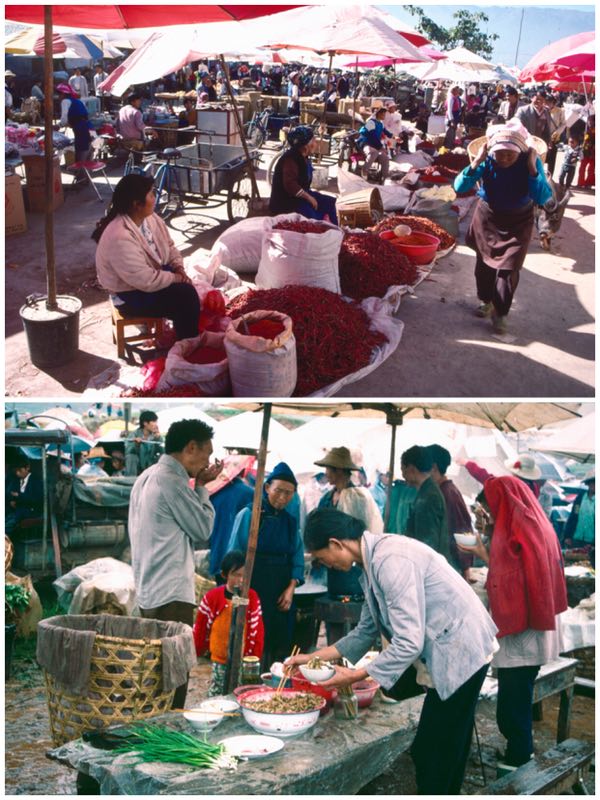
For my first venture to Dali in 1995, I scheduled it to include a Monday. Why Monday? It was market day at Shaping, 30 kilometers to the north. Normally a quiet village at the head of the lake, a bustling market would congregate on a nearby hill. I had read descriptions of how it attracted groups of people from various ethnic nationalities living in the vicinity. Many would come down by horseback from fairly remote mountain villages and communities, at that time only accessible by tracks.
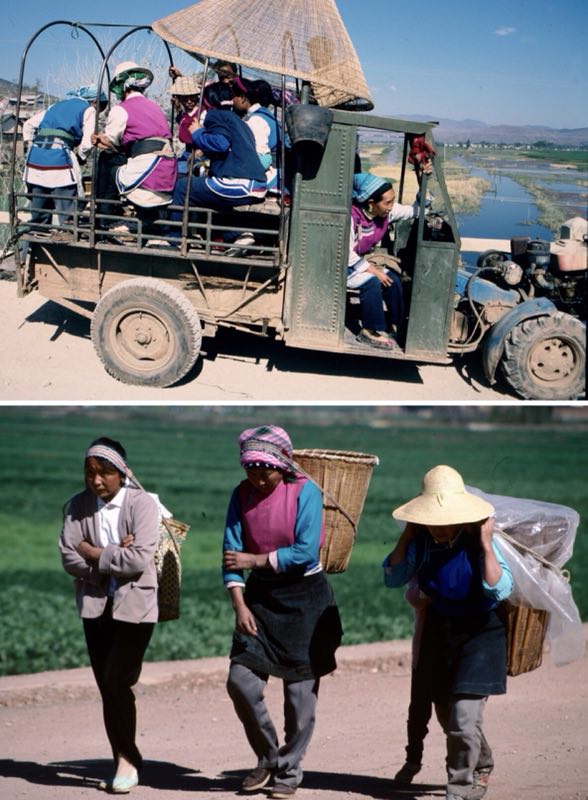
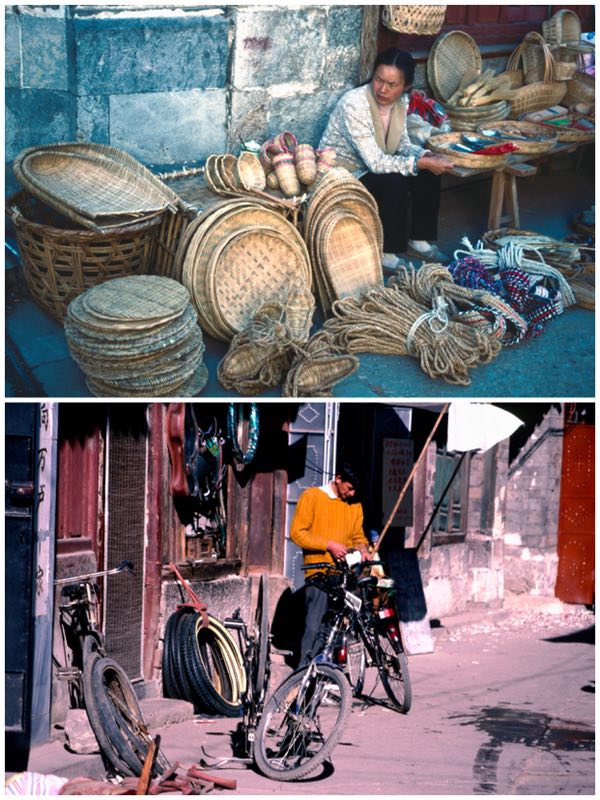
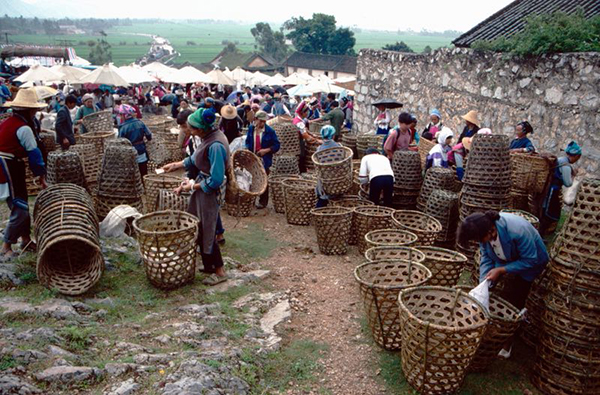
It was raining when I headed to the market by mini-bus, but it was still a fascinating scene. Many women walked alongside the road, carrying bamboo baskets supported by colorful head straps. Getting closer to Shaping, I saw more and more horses — some roped together in line, carrying sacks of goods to and from the market.
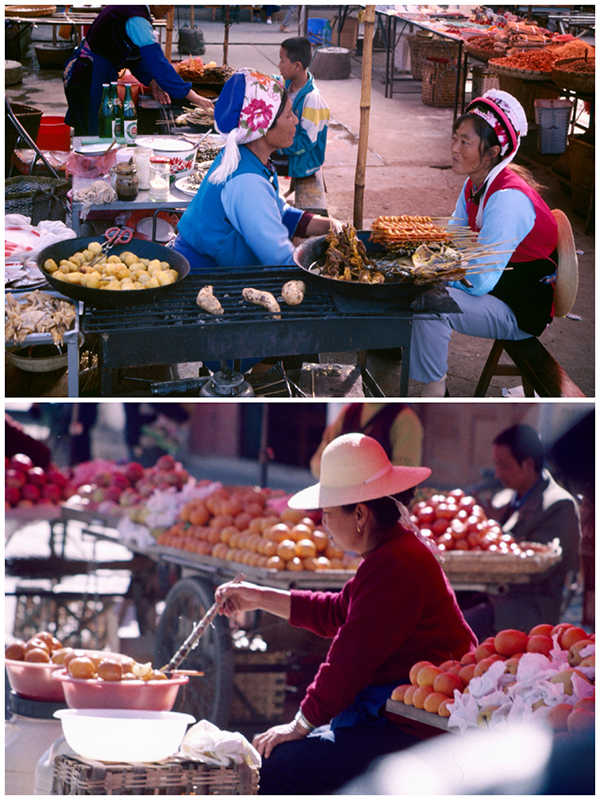
Despite the weather and the muddy conditions underfoot, the entire area was a photographer's dream. I tried to work out the different nationalities: Bai, Naxi, Black Yi, Tibetan and so many others. 1995 was a time of few tourists at the market, giving it a much more natural, local feel. Over subsequent years returning with British geographical study groups or on my own, I could see changes happening. But in 1995 I was transfixed by the range of fishing merchandise such as large bamboo fish traps, or wooden saddles and gear for horses. Rows of stalls acted as "pop-up" dining areas where locals worked their way through bowls of steaming, spicy noodles, meat kebabs and grilled potatoes coated with "mouth-blowing" red pepper sauce. Steamed buns, along with local flat breads, were freshly prepared as accompaniment.

For me having grown up in a seemingly sterile urban environment back in the UK here was the reality of upland rural life where technology was low or intermediate. Initially it felt l was looking seemingly at a 'time warp' where a culture or lifestyle was 'frozen in time' but every return visit showed a progression towards the technological and commercial norms of contemporary society.
Back in Dali, I would spend all evening in a cafe on Huguo Lu, writing notes while trying to recall fascinating moments from the market.
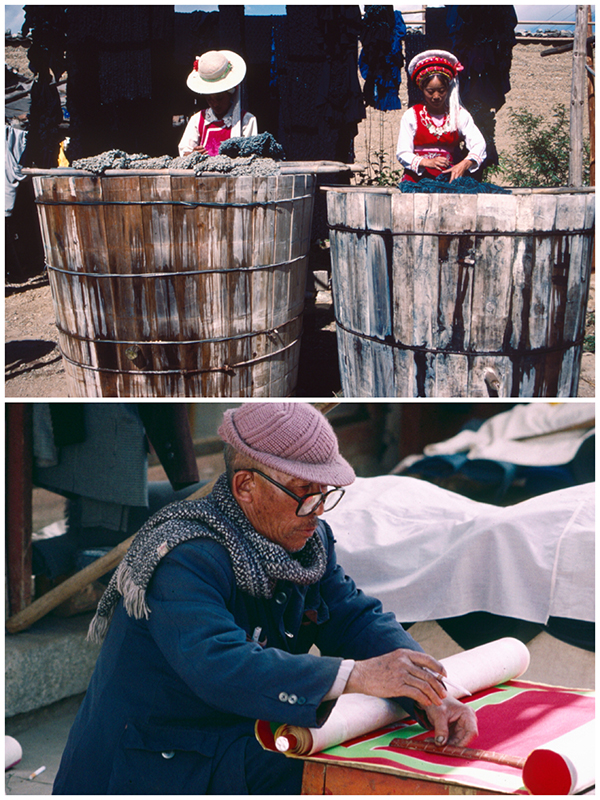
Although I enjoyed Dali, it was suggested I take a trip 20 km north to the small town of Xizhou, where Bai domestic architecture had been carefully preserved. The journey involved taking a bus along the main highway and alighting at a road junction to continue by "horse-bus" into town. Heading straight for the market square, I sat for a while taking in the scene watching people gather, including many women in traditional ethnic dress. Compact restaurants and food stalls prepared simple snacks such as fried potatoes and the cheese for which the area is famed — a legacy of the 13th century invasion by Genghis Khan's forces.
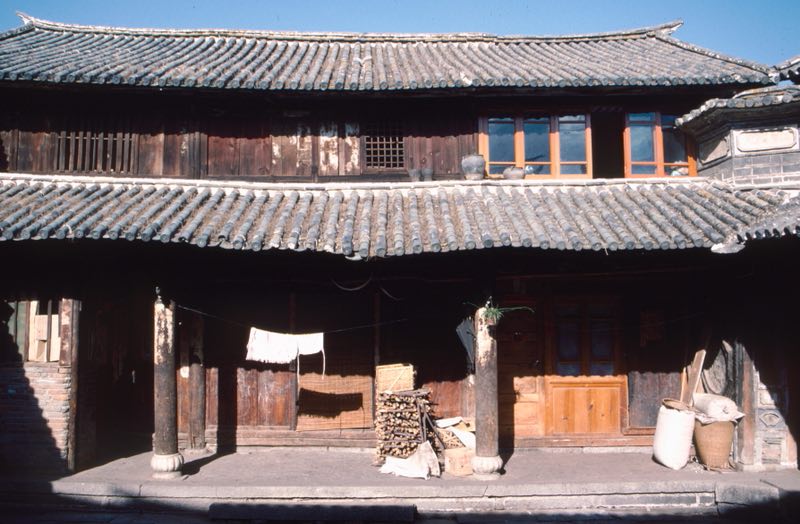
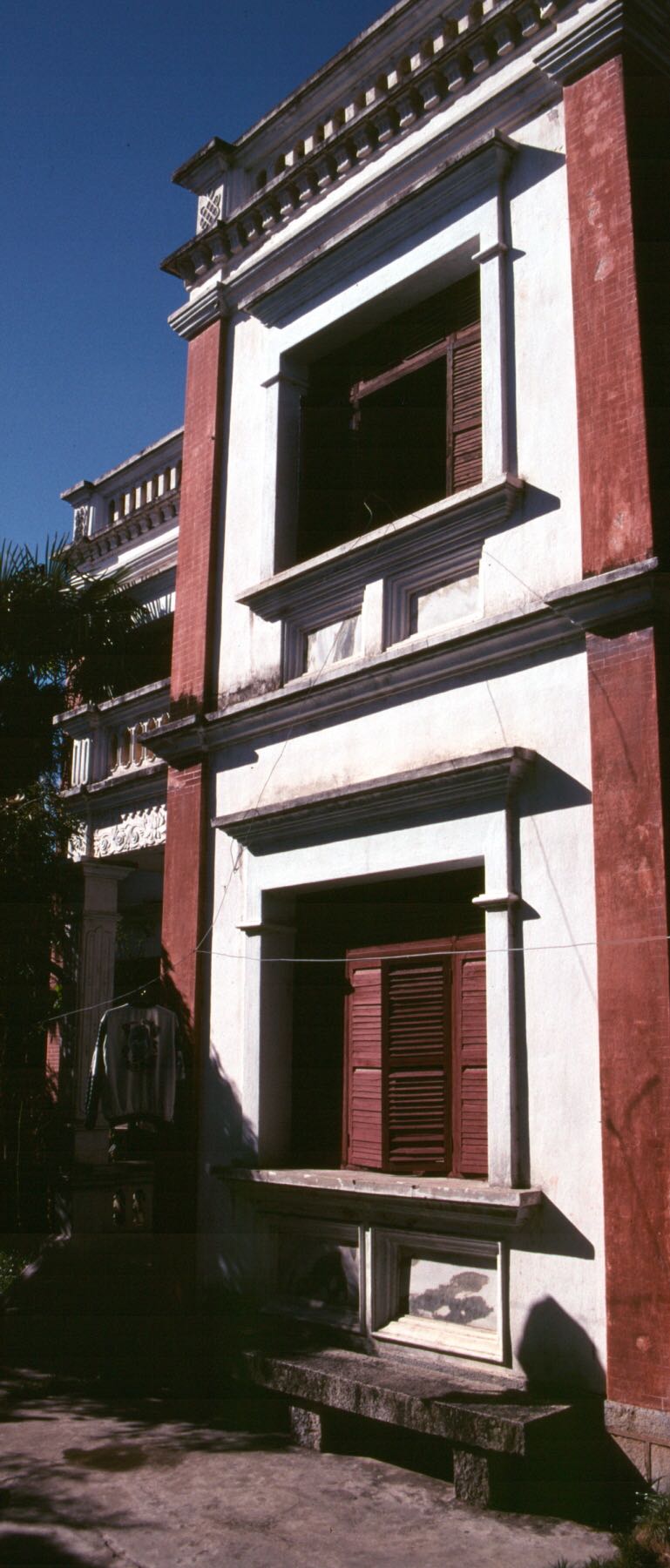
Bai architecture can be attributed to earlier wealth accrued in Xizhou. Its often large, beautifully preserved courtyard homes featured copious use of locally sourced marble and wood. During the Ming Dynasty Xizhou was a major trading centre along the Tea Horse Trail from southern Yunnan and southeastern Asia up to Tibet. Commercial prosperity continued through the 19th and 20th century as shown by elaborate dwellings, some of which are open to visitors. One prominent former home was actually built in French style, including white shuttered windows. Xizhou, historically associated with academic excellence, also had a wartime Flying Tigers landing airstrip. Although much less commercialized than Dali, its reputation attracts growing numbers of visitors. Although relatively small, I did find Xizhou delightful for both walking and photography, and enjoyed its unique local foods.
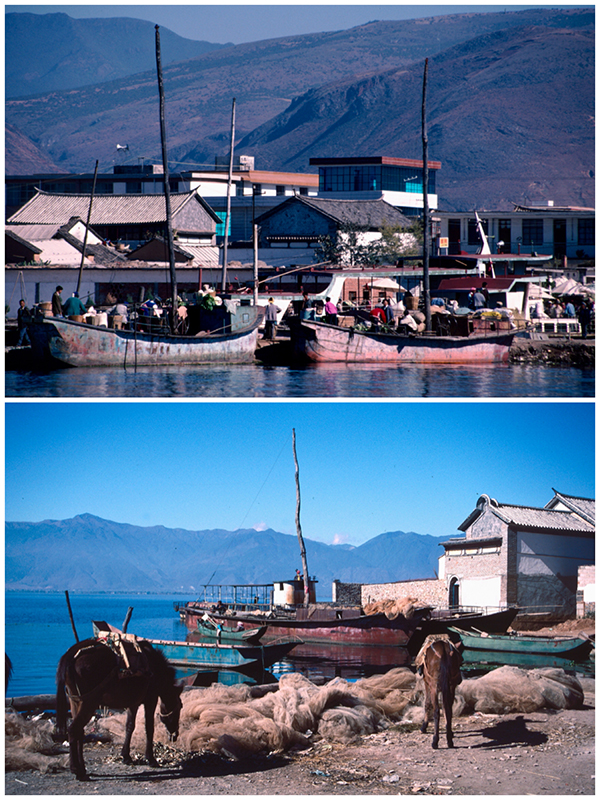
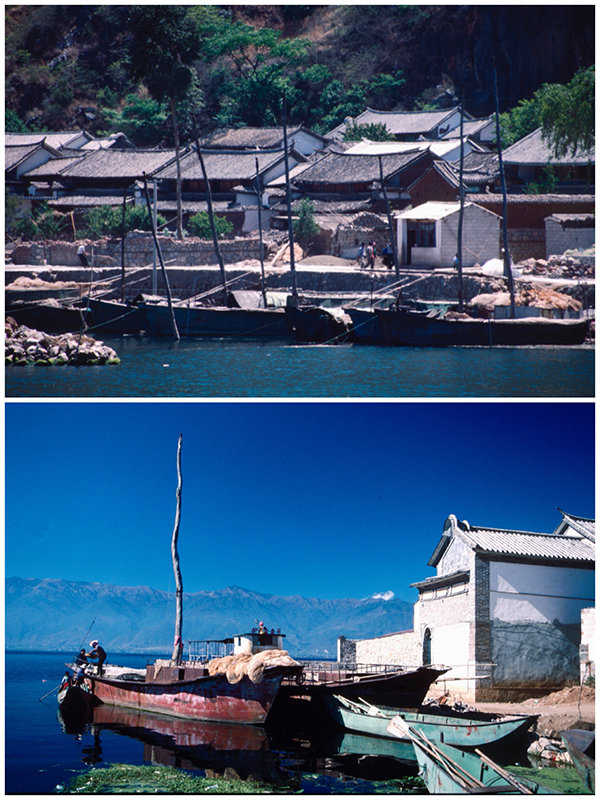
During my stays in Dali, the main road north to Lijiang ran along the western shores of the lake. Eastern areas were then little-developed, and quite isolated. Today, a railway and expressway connecting with Lijiang have significantly changed this status. In January 2000 I decided to travel by boat to Wase — a journey of almost an hour. This proved to be a memorable local moment, as it really did feel like stepping into a timeless place. I noticed many traditional two-story domestic and commercial buildings with sloping tiled roofs. They clustered around quays where several metal or wooden-hulled sailing barges had berthed. Fishing nets were piled along the waterfront, where packhorses lined up to carry goods to and from isolated villages. Like Shaping, my principal reason for visiting was to experience the lakefront market. Narrow alleys crowded with people wearing costumes and headgear, representing some ethnic groups I was unfamiliar with. Many a film canister of photos was shot in Wase, for as anticipated, it was a "once-in-a-lifetime" visit on a beautiful day.

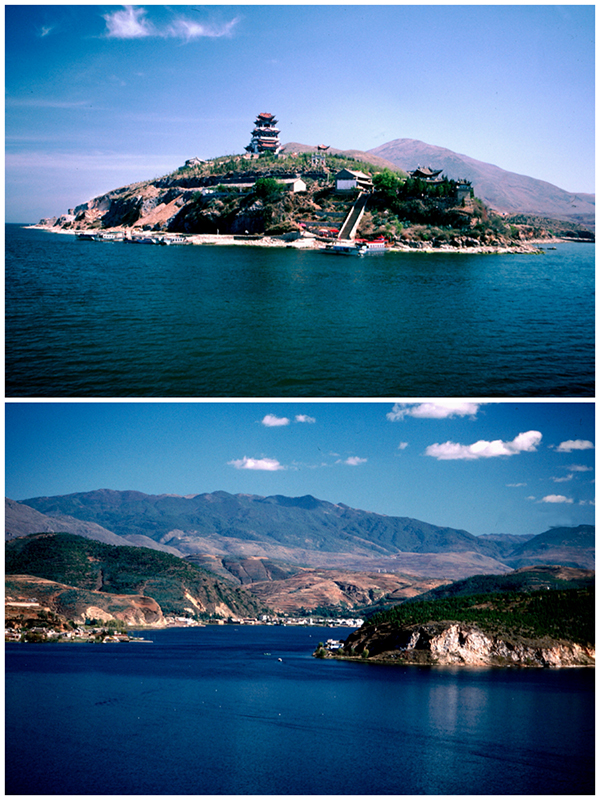
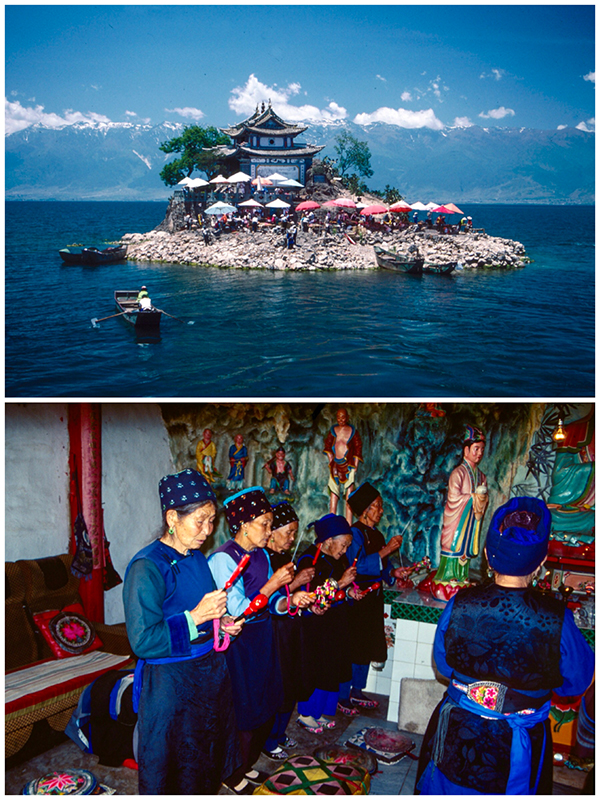
My sailings on Erhai have included everything from metal-hulled fishing boats to quite luxurious vessels mainly used by tour groups. Every voyage continued to reveal the sheer physical, human and historic beauty of the area. Cruises towards the north of the lake often start from Xiaguan, heading first to Jinsuo Island. Around 200 Bai households lived there, mainly in and around the small villages of Jinsuodaocun where the boats dock. It was a perfect location for walking along narrow alleys lined with Bai-style homes before emerging towards fertile fields surrounded by flowers and trees. I managed to visit an active local temple before rejoining the boat. Cruising over to the Tianjingge Scenic Area a steep climb led ultimately to a pavilion providing stunning, indeed panoramic views of the lake and of course, Cangshan Mountain.
Continuing by boat, following the eastern shore near to Wase, Little Putuo Island came into view. Amazingly, a petite Ming-dynasty temple almost covered its entire surface. With a backdrop of the snow-capped peaks rising above Erhai's western shores, it was amazingly photogenic.
My first visit to the Erhai Lake area in 1995 involved a lengthy bus journey from Kunming. On my final visit, I departed by air to Yunnan's tropical Xishuangbanna. Dali Airport sits atop a flattened hill. Immediately after take-off the ground drops away to reveal stunning views of the lake, the islands, Cangshan and of course, Dali — my personal "Heaven-on-Earth".