(Source: China Daily)
Fascinating adventures within and around Baotou
By Bruce Connolly | chinadaily.com.cn | Updated: 2018-09-21 08:32
Between Inner Mongolia's two principal cities, Hohhot, the capital, and Baotou, its major industrial centre, a wide east-west valley allows rapid communication by both road and rail. To the north rises a line of mostly treeless hills beyond which an almost waterless desert stretches right through to Ningxia, Gansu and across northwestern China. This green corridor overlaps the Yellow River's Great Bend. Were it not for those waters then desert would inevitably have covered much of what today is fertile agricultural land.

The railway and indeed the roads are effectively modern day updates for the historic northern Silk Road This corridor has long had significance as a major routeway between central Asia and Beijing. From Lanzhou in today's Gansu Province flotillas of sheepskin rafts once carried goods down the Yellow River to Baotou for onward transshipment by camel caravan. This traffic was however only one way for that river's fast moving currents made it impractical to sail back upriver, instead carts or camels were employed. However construction of a railway from Beijing eventually reached Baotou in 1923 transforming that formerly remote settlement into a railhead for traffic from across much of the northwest. In the 1950's the railway was pushed through to Lanzhou, eventually linking right through to Xinjiang.

Baotou is literally 'The land with deer', or alternatively Lucheng, 'Deer City'. Approaching it on that warm September evening in 1997 to the south appeared a seemingly endless sea of sand bathed in the soft glow of early evening sun. The city, at that time, had an older eastern area but a newer western district, where I would stay, stretched westwards to major industrial works established in the earlier 1950's as part of China's drive to develop and modernise its economy. Although nomadic tribes had long moved through the area it was not until 1809 that Baotou was actually incorporated as a town.
Across from the my base, the Baotou Hotel on Gangtie Dajie (Iron and Steel Road), spreads Arding Square. Fountains played when I walked there in the warm autumn air. Drink stalls provided convenient locations for people watching although I tended to be the curiosity for amused locals. It did appear that western Baotou was a relatively new town built to provide modern facilities for the influx of industrial workers from other parts China.

The square then in 1997 was home to an exhibition hall illustrating the city's significant industrial role, particularly with iron and steel, but also railway trucks, heavy duty vehicles, textiles, agricultural produce and more. Surrounding areas were rich in coal and 'rare earth' deposits. The mines at Bayan Obo represented the world's greatest source of 'rare-earth' metals.

It was in Baotou that I was to have some great 'China experiences' for I had been invited to visit the vast works of the Baotou Iron and Steel Company (baotou gangtie gongsi). Ahead, along Gangtie Dajie, rose the tall cooling towers of the original steel works but I would be taken to a newer complex. Wearing a yellow safety helmet I was ushered into the control centre for a huge blast furnace. Much of the production could be managed simply by touching buttons while monitoring the processes on computer screens. It was fascinating to then be taken around the shop floor and being able to watch so much close up. Another vast hall manufactured metal rods for reinforced concrete building construction. Large slabs of red hot steel were squeezed through giant presses eventually emerging as seemingly endless thin bars finally wound into coils. Railway wagons waited to be filled. Amazingly much of the work was automated, few workers actually involved. Later being driven through this huge complex making up Baotou Steel I felt very privileged at having witnessed some of the workings of this important heavy industrial plant.
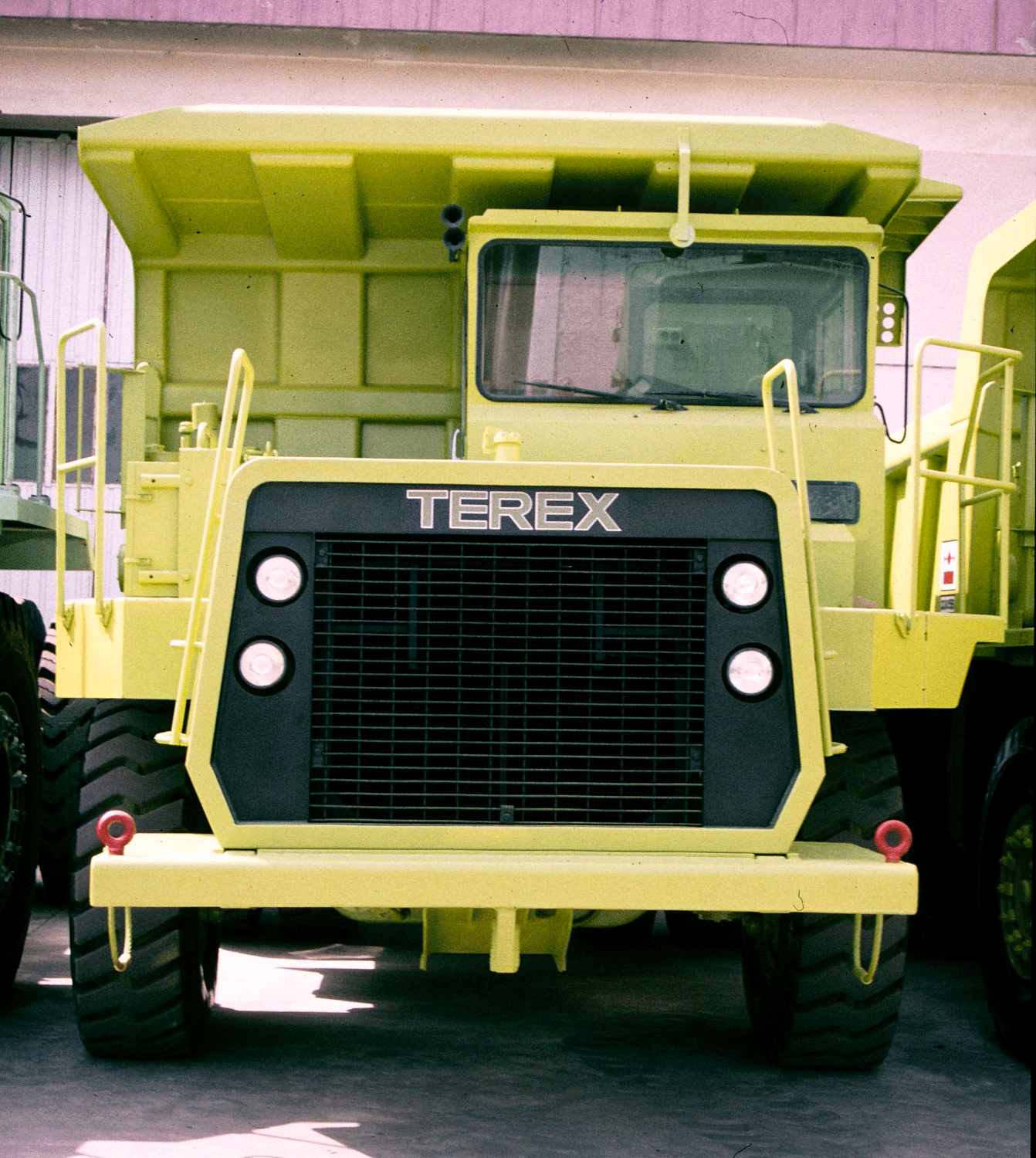
Later I was driven to the city's Qingshan District where a large China-UK-US joint venture was located. The company, North Hauler, manufactured giant Terex earth-moving dump trucks for mining and construction projects including the then on-going Three Gorges Dam on the Yangtze River. Many of the vehicles were so large they had to be transported by railway, in parts, and assembled on-site. Amazingly there I met two fellow Scots who were representing the overseas part of the joint-venture with North Hauler. A great local delicacies lunch followed, accompanied by considerable boisterous singing by the restaurant staff!

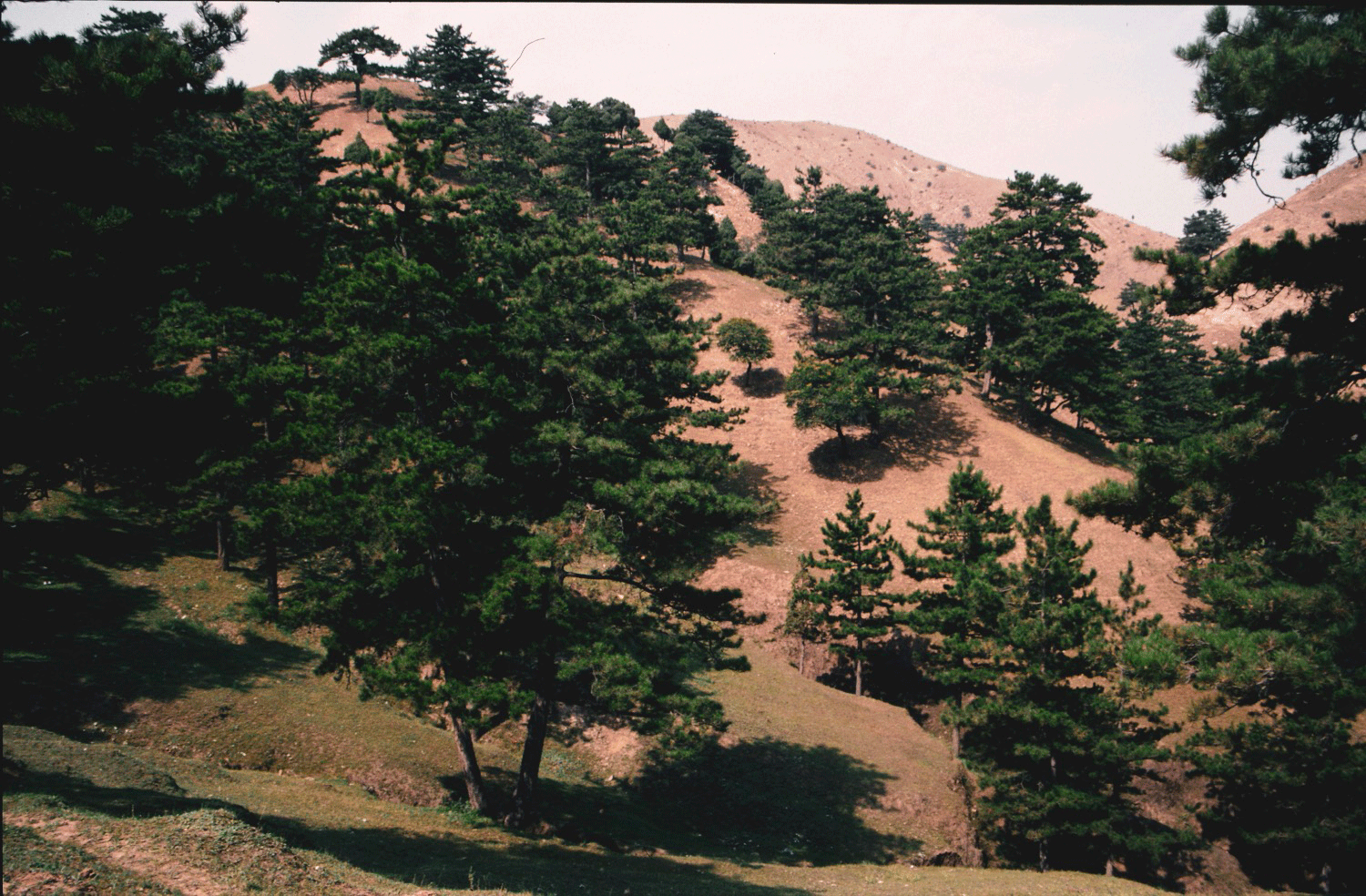
From Baotou a road winds north across rolling hilly country before, at the top of a pass, it reaches the remains of the Zhao Great Wall. Built during the Warring States Period (475-221 BC) its line can clearly be seen and was easily accessed from a car park by the road. Beyond lay the small coal mining town of Shiguai - what delighted me there was seeing a steam-hauled passenger train setting off for Baotou. For another 25 kilometres the road gradually climbed a mountain valley where flocks of goats and sheep grazed next to a river. Finally, 70 kilometres from Baotou, almost surrounded by partly forested slopes of the Daqing Mountains, sat Wudangzhao, one of the finest temples within Inner Mongolia. Established in 1749, the form of Buddhism practiced is of the Gelukpa or Yellow Hat Sect. I felt the architecture, with white walls, flattened roofs and narrow windows seemed Tibetan in style. Its name, Wudang, referring to the willow trees growing on the surrounding hills creating a quite majestic setting. It comprised of six main halls containing a large collection of Buddhist art including sculptures, murals and works in gold, silver, copper and wood.

The darkened halls, with a pervasive aroma of incense , and lit with flickering butter lamps were fascinating to slowly wander through. However what really attracted me was the opportunity to scramble up a nearby slope to a hilltop pavilion. Sitting there, the view was inspiring but so was the music drifting up from the temple. It was a song, I was informed, of the Qinghai-Tibet Plateau sung by Li Ma. Back in Baotou I bought a recording of it which kept intriguing me until later that year, 1997, I reached Qinghai and in 2000 finally got up to Tibet itself.

Back in Baotou, the city's main hotel would again offer a comfortable night before a totally different residential experience the following evening. Just south of the city, a busy road crossed the Yellow river before striking towards what at first looked an almost forbidding landscape. Shimmering great dunes were reaching for the cloudless sky. We were heading in the direction of a real sand desert! From the road that would lead ultimately to Dongsheng, an unpaved track diverted westwards, seemingly towards the sand hills. This led across a wide, mostly dry river bed when suddenly, ahead trees and even grass appeared. This was an oasis, an area where there was water, allowing life to take hold. Set amidst the trees were a group of circular yurts, I would stay in one overnight. Carpets covered the floor on which stood a small tea table. The 'bed' was a slightly raised platform covered by a warm quilt.

On the grass outside my little desert 'home' a camel stared at me as I headed towards the edge of the oasis. Climbing small dunes the view was out across amazing water cut patterns left over within a mostly dry river bed. As a geographer, I was totally transfixed, indeed spellbound as I stared across the wide, empty spaces.

Back in the compound a large yurt functioned as a dining room where great piles of mutton were served up along with fried potatoes, corn, mapo dofu and copious quantities of baijiu accompanied by lots of traditional singing! Darkness had fallen, but the overhead sky was bright with so many stars. Across the valley the sound of a steam-hauled train heading to Dongsheng resonated as I walked back out of the oasis to again climb a star-lit dune. For those moments I was an explorer!

Next morning, as dawn rose over the desert, I went back out to the same location, climbing again the soft, powdery sand. However this time I was intrigued by the many animal tracks across the surface - some showed claw marks, others were slithery, possibly a snake? Then I remembered desert animals are nocturnal - they come out at night, exactly were I had walked!

After a breakfast of milk tea, meat and bread sticks it was back out across the dry river bed to the main highway that ran south passing Xiangshawan, the 'Resonant Sand Gorge'. When I was there several years later a chairlift carried visitors across to the dunes, but in 1997, I had to put on large cloth overboots and physically climb the forty metre high sand walls! Hard work! Beyond however, travel was by camel, the 'ship of the desert', across a sea of rolling sand hills. It was so beautiful, I just wishing I had time to go farther across this incredibly peaceful wilderness. Descending back to the river valley was fun - slowly sliding down while creating a deep resonant sound with my feet.

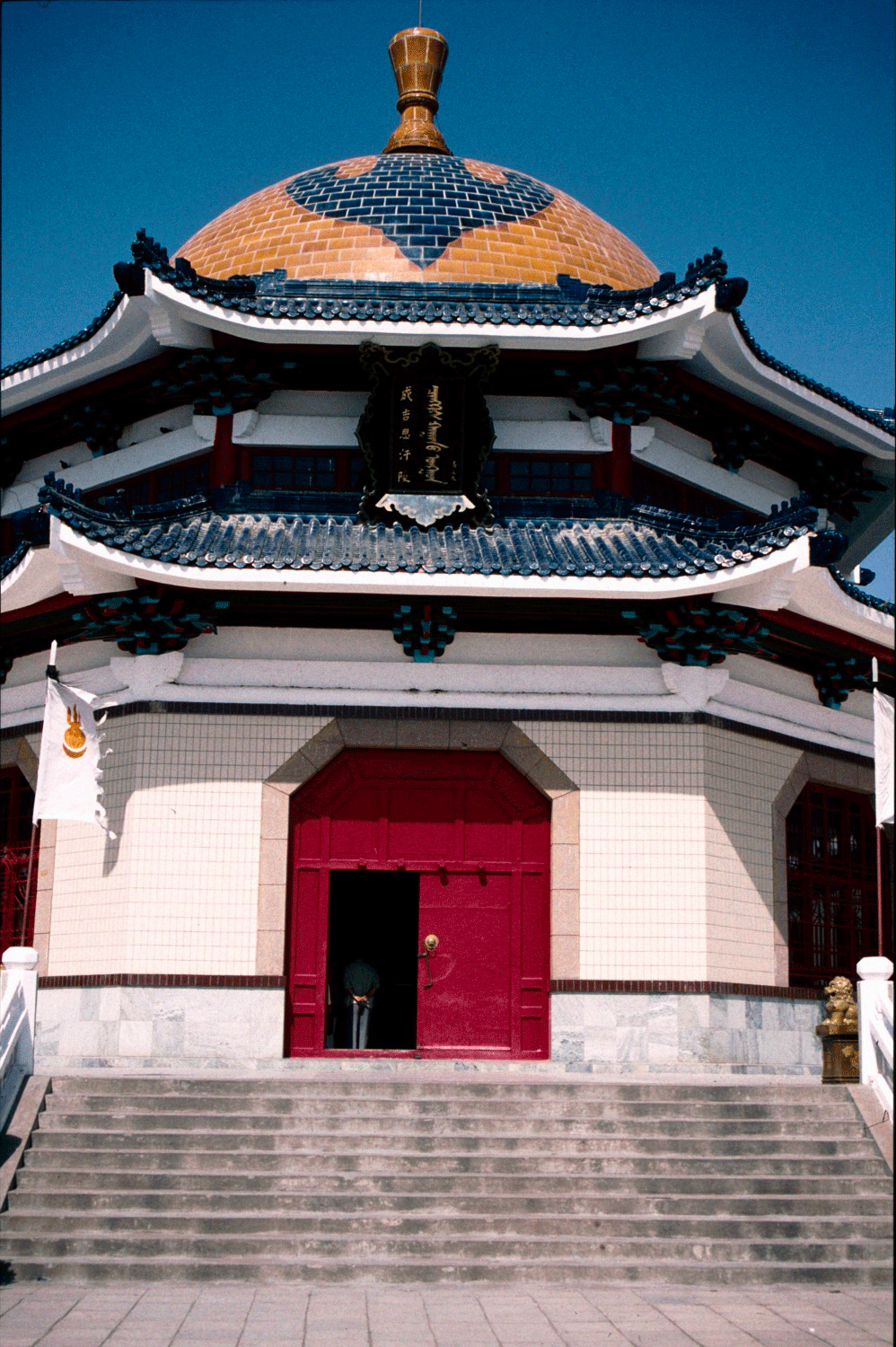
In 1997, the road onward to Dongsheng was narrow and crowded with coal lorries. A few years later an expressway greatly eased the journey. The area I would pass through known as Ordos, referred to as 'people guarding the palaces' - the four temporary palaces of Genghis Khan and later his tomb. I was there to visit the Genghis Khan Mausoleum (chengjishan ling) at Ejin Horo Qi, an hour south of Dongsheng. The main building resembled three large interconnected yurts with roofs tiled in dark blue and yellow. Within the halls were many displays of smaller yurts, domestic equipment associated with the nomadic life; decorated saddles and military equipment that would be carried or worn by the horsemen. It was fascinating wandering through the halls looking at statues and various images of Genghis Khan. To show traditional respect I was invited to drink from a metal bowl of baijiu and this was at 10.30am!

Outside, it was a beautiful warm morning. A small dagoba marked an earlier location of the shrine. Nearby was a former film set scattered with yurts, wooden wagons, great chariots while sheep grazed nearby.

All great memories of Inner Mongolia that I reflected on while being driven through a mixture of semi-desert; grasslands; farmland and villages before the road crossed the Yellow River near Shuanghezhen to climb up onto the plateau that would lead back towards Hohhot.