(Source: China Daily)
A walk down memory lane: Dazu town in 1994
By Bruce Connolly | chinadaily.com.cn | Updated: 2018-08-28 07:55
Note: In 1994, Chongqing and Dazu were part of Sichuan province. In 1997 Chongqing became a municipality that today includes Dazu.
In the early 1990s China was well into major economic and social reforms. Growth inevitably was uneven; such was the scale of the task. While southeastern coastal cities were on a rapid development curve, inland areas were often just starting out. For much of southwestern China the main "highway" remained the extensive waterways culminating in the greater Yangtze River catchment area. However, away from the tentacles or tributaries of the river, many towns continued semi-isolated, almost in time warps, relying often on narrow multi-use roads resulting in lengthy, slow travel.
In 1994, I set off on a journey of discovery, partly by rail or road but mostly by boat from Chengdu to Wuhan. After two days on a small ferry between Leshan and Chongqing I decided to temporarily leave the waters and head 160 kilometers northwest, to Dazu, a country town renowned for its Buddhist grottoes.
Departing early morning by bus from Chongqing the route led up through tunnels to a mountain town before joining sections of a partly completed expressway. At times alongside the railway to Chengdu the journey encompassed a series of agricultural communities where it was fascinating observing geese transported on bus roofs!
Pulling off at Youtingzhen we continued north toward Dazu where pedicabs/trishaws gathered around the bus station. Not so sure of hotel names I asked in basic Chinese to be taken to the "Fandian". Apparently the town's main hotel was being rebuilt and instead I was carried up to the Beishan (North Hill) Hotel conveniently located for walking toward a hill of the same name. Its delightful garden proved an ideal spot to write up notes on my local explorations. Digital technology was non-existent in 1994.
Arriving in time for a simple lunch I was soon exploring this town whose only mention in my guidebook was about its nearby grottoes! Indeed few tourists actually visited Dazu itself, mostly arriving by tour buses heading directly to the grottoes. A consequence was a relaxed, unhurried feeling and indeed a good place to stay before my onward river journey. Dining was no problem - along with some simple to order meals in the hotel, local streets would come alive at night with many stalls serving cheaply priced dumplings, noodles, hot pot and wok-fried dishes.
Next morning my objective was Beishan Hill, departing early, walking slowly. The estimated time for the climb was 30 minutes but that did not take in the heat and humidity. Initially the route led up through a park via a long series of steps where hawkers sat trying to sell small stone statues. Ahead lay the famed grotto carvings, featuring not only Buddhist but also Taoist and Confucian influence. Possibly there are over one thousand pieces scattered in 40 locations around Dazu. They are rated alongside China's other great Buddhist caves including Dunhuang, Luoyang and Datong. Beishan for me was more accessible while the larger site at Baoding Shan (Treasured Summit Hill) would prove to be too far away. Earliest works date from around 650 AD but the main period of their creation was from late 9th century onwards.
Reaching the grotto entrance, admission was 10 yuan. Along the cliff face were a series of rock reliefs carved into open cliffs where many darkened niches enclosed small statues. Some passages were cut into the red sandstone itself. Work was underway to upgrade the facilities with laborers chanting, struggling as they heaved stone blocks suspended from bamboo poles. Beyond the grottoes tree-shaded steps led uphill providing ever improving views both down over Dazu and up toward the pagoda where small Buddha figures were embedded in alcoves around its sides.
The heat increasingly made the climb hard work - I felt desperate for iced water! Some small houses clustered nearby, people friendly but curious as to why a lone foreigner would suddenly emerge onto this plateau? I reached a little temple adorned with flags while musical sounds emerged from flutes and crashing cymbals. It proved a great vantage point to take in the superb views across this extensive dissected sandstone plateau. Again I passed curious but always friendly farmers, villagers and even families as I descended alongside at times precipitous drops. Thankfully a small pavilion provided shelter from menacing thunderstorms.
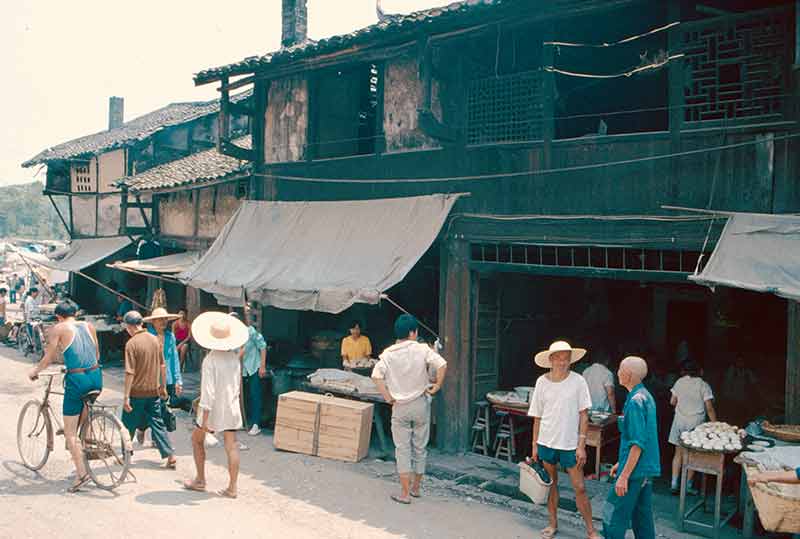
Another fascinating evening lay ahead as I explored the bustling streets of the old town. When I look back to that period I remember every meal was local Chinese cuisine, which I loved. There were no fast food restaurants to even slightly tempt me. Dining often resulted in friendly conversations with local people. My evenings would finish sitting at a pavement stall slowly enjoying a cold local beer while watching the constant flow of Dazu life. Maybe it was a lack of air conditioning but my travels at that period showed many people would spend long evenings outdoors, dining, socializing, walking, chatting. A feature of small towns then were the public loudspeakers, mostly playing music interspersed with local news and announcements. This again was the pre-smartphone era; indeed it was a time when there were few personal phones even in homes. Reflecting back, people appeared to talk much more with each other than we see today.
For me, walking was also a passion and next morning, after a quick bread and fried noodles breakfast I was again heading out of town, water bottles in my daypack. I had no map, simply relying on instinct and my desire to return to the countryside. From a bridge spanning a muddy stream I looked toward green swathes of rice fields - since my earlier days in Guangdong and Hainan I became passionate about walking within such landscapes. Criss-crossing the padis a village lay ahead with one house rising over a pond where pigs wallowed. Beyond lay forested slopes, girls shouted across to me, pointing toward an uphill path. Soon I was succumbed by dense vegetation and feeling a bit nervous in case of snakes. Coming out to a clearing with a single adobe walled farmhouse a boy beckoned to follow him up a slippery, muddy path through a forest of bamboo. He was a nimble walker; I was slow and ponderous for after all I was carrying heavy camera gear. He led me onto a substantial path and pointed "that way". On my own again, and resting briefly beside the trail, some farmers approached and in universal sign language pointed toward another path. Apparently they had seen me walking the previous day.
Soon I was passing the now familiar local temple before emerging onto a ridge directly below the pagoda. The weather beautiful, I sat there in blissful embrace with nature while also watching a woman shaded by bamboo hat, scything herbs. She stopped before pointing toward a path leading up to another ridge. There, a donkey-hauled cart transporting villagers passed as I sat looking over the reddish terrain. Below stretched agricultural terraces, irrigation channels fed from small reservoirs and the occasional village.
Colorful butterflies fluttered while blue feathered birds swooped around before I started heading downhill. I had found a miniature "Shangri-La" and was reluctant to leave. Farmers supporting bamboo shoulder poles headed back up to their villages as I retraced my steps towards the hotel to wash, change clothes and go back out for another fascinating evening immersing myself in Dazu evening life.
Rural walking I loved but wandering the old town streets with its unique regional architecture equally enthralled me. I was witnessing again a 'time capsule" of earlier Sichuan life. Within the older areas buildings were often two floors, open fronted and incorporating wooden frames intertwined with adobe brick. There was this continual gentle movement of people accompanied by a background of trishaw bells ringing, with only a few motorized vehicles. Blue trucks, however, transported villagers back home from their shopping trips. I noticed that this often lack of mechanization led to the clarity of natural sounds not being drowned out. There were no car horns.

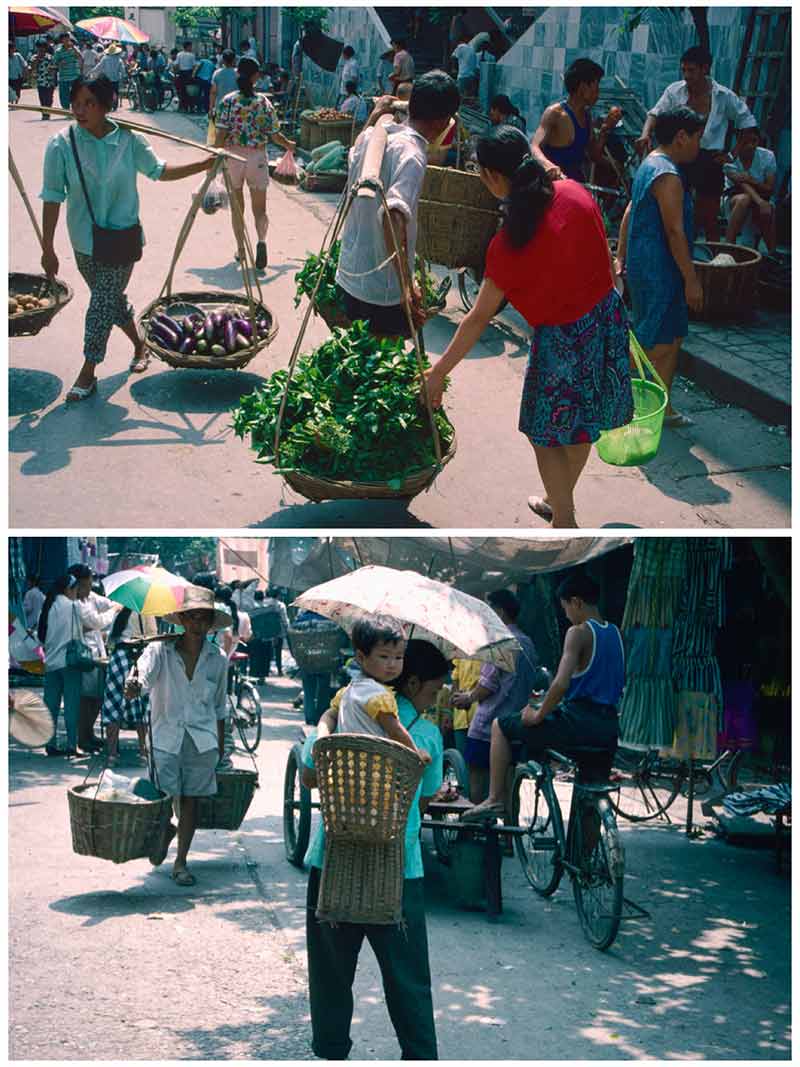
Within the older areas I delved into the vibrant diversity of local markets and shopping streets. The range and colors of fresh vegetables was so captivating as were the bamboo products spread out on the ground - baskets, chairs, baby carriers, tables, domestic items. People were fascinated at me photographing what for them were everyday items. As a photographer I was transfixed with the photo booths - for a few yuan people could have photos taken with backdrops of worldwide exotic locations. In 1994 few Chinese travelled overseas and here were the precursors of today's international selfie shots! Alongside porters carrying goods suspended from bamboo shoulder poles mothers transported babies within back baskets. Then there were the noodles, suspended over wooden frames to dry in the hot sunshine. Noodles, the length of which I had previously never come across. Then the spice stalls with their exotic aromas; watch repairs; shoes; clothes; firecrackers and even outdoor dental stalls!
Teahouses had long been part of Sichuan culture and along one older street I came upon several open fronted establishments where people, mostly men, chatted away the time or played cards while slowly sipping some delicate local teas. This was semi-rural China so different to even nearby Chongqing and a far cry from fast moving Guangzhou where I had lived the year previously.
As I walked, or stood captivated by the scene, a busload of international tourists passed the end of this old street. Some jumped up trying to film with their video cameras this scene of what would soon be a disappearing example of rural Sichuan life.
Next morning as my bus for Chongqing departed alongside the tranquil waters of the Laixi River, where people fished, I looked back over Dazu and up toward the Beishan Pagoda, feeling thankful for the now memorable experience that the town had given me. I had stepped momentarily into a rural China then in a "time warp" that retained much of earlier rural Sichuan. Thinking back I wished I could have stayed longer for as I looked around I could see construction of a new town emerging around the old. China was changing and I was there at a time when the rapid opening up of the coastal provinces was starting to impact inland. Indeed when I looked online about Dazu, as I wrote this piece, I saw a bright, modern, small city so far removed from my 1994 discoveries. My smartphone maps, I could not find the streets I had explored 24 years previously. My photographs, however, remain as records of that period of transition but I would love to return to produce a photo-comparison
It has been an honor for my 1994 photography of Chongqing, the Yangtze River and Dazu to be featured as part of a recent exhibition at the Chongqing Art Museum. That exhibition illustrated the changes undergone across the city and surrounding areas over the past 40 years.