(Source: China Daily)
Shanhaiguan - A strategic pass where Great Wall reaches sea
By Bruce Connolly | chinadaily.com.cn | Updated: 2018-07-10 16:25
Travelling recently to Tianjin from Beijing by 300 km/h high-speed train I thought back 22 years to 1996. A very different experience on a slow-moving 18 coach "green" train heading to Qiqihar in far northeastern China. I was going as far as Shanhaiguan on the border of Hebei and Liaoning provinces. Unlike today's spacious reclining seats and air-conditioned comfort I was in a hard-sleeper cubicle with five other passengers. On those older trains there was much more time to socialize, to share food, experiences and so on. For me, rail travel then was more of an adventure but looking back, I was also seeing a country so different from today, one going through stages of modernization.
As my handwritten scribbling notes, not far south of Beijing "donkeys hauled wooden ploughs across the fields. On long, straight highways, shaded by tall poplar trees, mules also pulled carts transporting harvested crops and at times, people. Shepherds looked over grazing flocks near villages of single floor courtyard buildings located alongside fish ponds. At stations, fruit sellers offered their produce through the open carriage windows. There was also considerable heavy industry and a seemingly constant movement of long freight trains."All of this before arriving at Tianjin where platform staff members stood at attention saluting as our train pulled in. Changed days indeed!
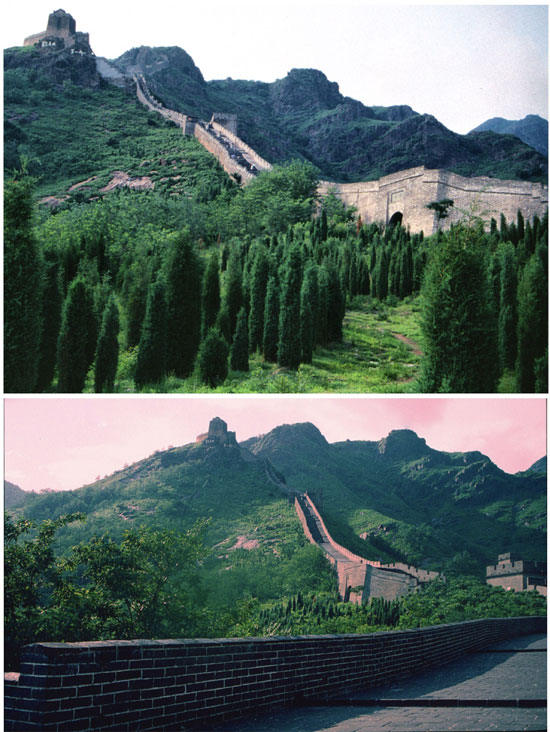
Beyond Tianjin the railway passed canals, salt beds, fish farms, oil wells, port development, urban construction and yes, more donkey carts alongside railway yards with working steam engines. Gradually open countryside and rolling hills increased before stopping at the beautiful coastal resort of Beidaihe, the large ocean port of Qinghuangdao, and shortly after Shanhaiguan. I had arrived at a small city located where the Great Wall of China rose from the sea to climb steeply up a mountain range before stretching out on a momentous journey 7,300 kilometers across northern and northwestern China to Jiayuguan in Gansu.
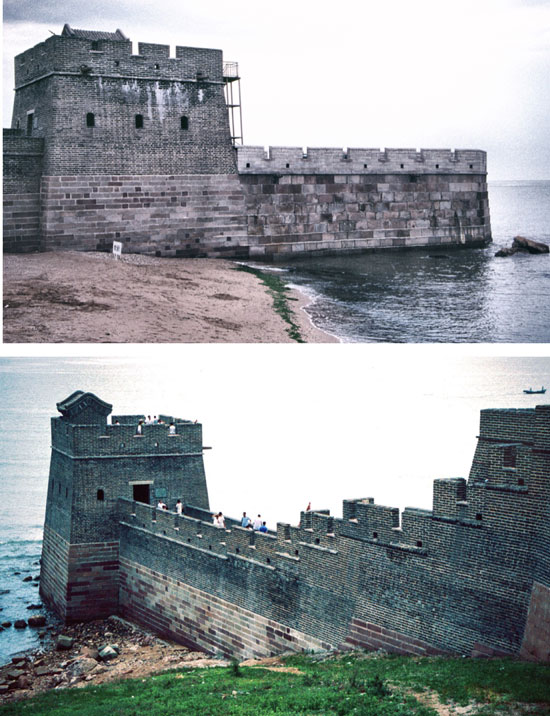
My initial plan in 1996 had been to head straight from Beijing to Shanghai but as I sat in a small restaurant near my hotel at Beixinqiao, looking at a photograph of the Great Wall's "Old Dragon Head" (laolongtou) I thought this is where I should start my six-week journey. In the pre-smartphone days finding accurate travel information could be difficult for solo foreign travelers. However, Beijing Railway Station had a special office for international visitors where staff members spoke English and helped me secure my ticket for Shanhaiguan. But where would I stay, again no online assistance but with a bit of local help I found myself booking into a new hotel close to the old town walls. Initially planning for two nights, I stayed six. Following a pleasant lunch, where hotel staff members helped me through the menu, I was out exploring.
Initial feeling on arrival was of a small, partly industrial city straddling the main railway and highway to northeastern China. However, passing through an arched passage in the Old Town's brick walls I knew Shanhaiguan had been my correct decision. A stepped path wound up onto the 14 meter high, 7 meter thick walls where I stood looking over both the walled older town and the increasingly high-rise growing beyond the walls. South rose the clock tower of the railway station while to the north, across mostly flat rooftops, I raised my eyes beyond the grand gate, the 'First Pass under Heaven', to follow the Great Wall as it climbed up Jiaoshan Mountain. A spellbinding vista. Meanwhile, spread out below were the cardinal main streets of this square-shaped compact town criss-crossed by a maze of narrow alleys enclosed within a 4–kilometer-long city wall. Historically entered/exited via four large gates only the eastern Zhendong Gate survives. A moat parallels the wall's south, east and northern sides. From the midpoint of the Old Town's rises the distinctive Drum and Bell Tower.

As I sat there transfixed I noticed no cars were within the historic area - only bicycles, three-wheel "tuk-tuks" and "sanlunche" taxis. Commerce however sprouted everywhere with many small open-fronted shops selling a profusion of household goods. In an alley directly below me a trader sat amid his extensive display of bamboo brushes.
Shanhaiguan is one of the major passes along the entire Great Wall. Today a popular tourist destination it was declared a National Cultural Site in 1961. Throughout history it served as a major defensive outpost protecting Beijing and the country from the various warlike groups from what is today's Dongbei or China's Northeast. With a relatively narrow gap between the Yan Mountains and the Bohai Gulf the pass has had a strategic role dating back at least to the Northern Qi Dynasty (550-577AD). The present structure was erected under the command of Ming Dynasty General Xu Da in 1381. In the 16th century another Ming general, Qi Jiguang started the construction of a military city around the pass, turning it into one of the most heavily fortified in China.
Standing there on the wall it was easy to appreciate the town's strategic and route importance. The railway, connecting Tianjin and its port with both Beijing and Shenyang, reached Shanhaiguan in 1893. Ultimately it connected with Dalian, Harbin and Russia. Today the Jingha Expressway (G1) and National Highway G102 linking the Northeast with Beijing skirt between the northern end of the Old Town and the mountains.

The "First Pass under Heaven" with its restored eastern gate was my first destination. A long cobbled slope led up to the parapet and ultimately toward its strong watchtower, or "First Gate Pass", overlooking the route into Shanhaiguan. Looking east I could pick out, beyond the moat several rice fields, and the earthworks of a former defensive walled settlement. To the north the wall snaked up Jiaoshan Mountain before disappearing on its long westward journey. I asked myself was how it was ever constructed in such difficult terrain? Below in the square, tourists were gathering for photo shoots with a backdrop of the gate. Those days before "selfies" and even owning cameras, many people would dress up in period costumes at photographers' stalls.
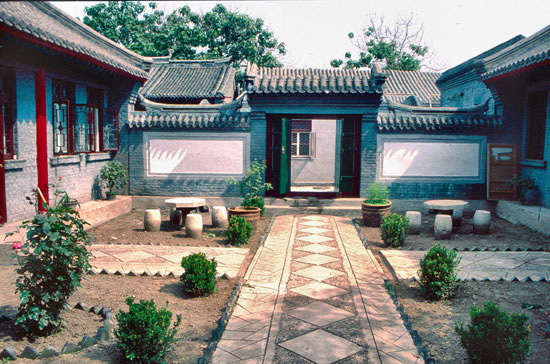
It was time for lunch. East Street (dong dajie) ran between the First Pass and the Bell/Drum Tower. It was lined with small, low-rise restaurant buildings. One had a hand-written notice about "English Menu". A lady came out to show me the menu - soon I was tucking into some of my favorite dishes. She chatted with me about her hometown and how the restaurant was an extension of their grand family courtyard home, which I was invited to see. This was the hospitality I found in Shanhaiguan, a genuine friendliness including one morning when she learned I was going to walk up the mountain, a packed lunch was spontaneously prepared.
At times I would just explore the town's narrow alleys, photographing local people and daily life scenes - everything from people playing chess to schoolchildren crowding little shops for snacks - the scene often with a background of the Bell and Drum Tower. In the evenings, sitting at outdoor drinks stalls I watched people, some dressed in classical northeast Hebei costumes dance or exercise next to the city walls while snacks were grilled on wood-fueled barbecues. Constantly bicycles passed, heading for a passage in the walls with "Shanhaiguan" etched in the stonework above.

A passageway under the railway led to a road heading in the direction of the Bohai Gulf. I wanted to reach literally the first brick on the Great Wall! However the highway took me initially to a very different part of Shanhaiguan, toward its ocean port. Passing through an area increasingly of warehouses and recent commercial development finally I reached the beach. Beyond, several large ships were bathed at a major quay complex but in the foreground a more traditional scene. Wooden fishing boats pulled onto the beach alongside much paraphernalia of coastal fishing including nets, buoys, anchors and more. Children played among the vessels as I headed west along the shore, eventually reaching both original and restored sections of the Wall which I followed, passing through a traditional temple complex before descending down metal ladders to eventually stand where the dragon's head literally drinks from the sea at Laolongtou or "Old Dragon Head". Incredible to think the Wall would stretch 7300 kilometers from there to the deserts of Gansu!
Heading back to Shanhaiguan, I followed an earthen path running along remnants of the Wall, back to the restaurant on East Street to plan for the next day. I returned there for breakfast before heading out of town via a passage in the city walls, passing flocks of goats wandering across a road that would eventually lead up to the Jiaoshan section of the Great Wall. Initial stretches of the Wall were earthen but as I approached the mountain it had been beautifully restored. Surprisingly it was very quiet and I found myself often alone. So amazing was the area and the experience I made two visits. Walking up from the entrance onto the broad stone/brick covered structure I would slowly move uphill, stopping to admire rainbows - mid-summer is the rainy season! From what started gentle the gradient increasingly steepened followed by a series of stone steps within a narrow passage leading to metal ladders climbing straight up the walls of a prominent tower beyond which an increasingly ruinous wall snaked across distant peaks. The views, the feelings, totally amazing, I was reluctant to leave but I had to go back to town. The next day I would return to Beijing, but not before revisiting revisiting snack stalls and the restaurant who all helped my stay in Shanhaiguan. In a life of travel, it is often the local people who make a place so great, who leave the traveler with so many personal memories. That has certainly been my "China Story".

Time to leave Shanhaiguan and head onwards to one of the world's largest and fastest changing cities, Shanghai! Initially travelling back to Beijing, hard seat, on a train coming south from Jiamusi in far northeastern Heilongjiang. On a hot, wet and humid afternoon I realized we were not coming into Beijing Railway Station but to a much smaller Beijing South - open-air platforms and bridges to struggle across with luggage and then find transport into the city - so different to my frequent movements through today's ultra-modern Beijing South!