
(Source: China Daily)
Yunnan's Honghe: Historic towns, ethnic nationalities and a unique cross-border railway
By Bruce Connolly | chinadaily.com.cn | Updated: 2018-03-21 11:02
The highway descended through a narrow gorge as it headed to scenic Stone Forest (Shilin) from Kunming, capital of Southwest China's Yunnan province, in 1994. A tall bridge carried the Nanning-Kunming Railway across to a tunnel high up on a steep cliff. There I noticed what seemed an older line clinging to a ledge. This was a narrow-gauge railroad track dating back to the early 20th century, part of a route from Vietnam. By 1910 this French-initiated project connected the port of Haiphong, near Hanoi, with Kunming. Due to often difficult mountainous terrain, the 855 kilometer route was built with a one meter gauge compared to the standard 1.435 meters. Five years later, in December 1999, I departed Kunming North Station at 4 pm, heading south along that very line. A slow but fascinating journey with sleep impossible due to countless bends and heavy braking as the seven coach train navigated its way across frequent viaducts and penetrated seemingly endless tunnels before pulling into the border city of Hekou. The railway continued onwards to Vietnam via a bridge over the Nanxihe, a tributary of the Red River (Honghe).
It was 7 am; the air felt humid and sultry, the town covered with dense fog. With some help, I found my hotel and slept for several hours before awaking to a panoramic view of the main river. Beyond were tropical forests climbing up towards the mountains of northern Vietnam. The mist had gone, the sky was blue and daytime temperatures were around 25 degrees. Perfect!
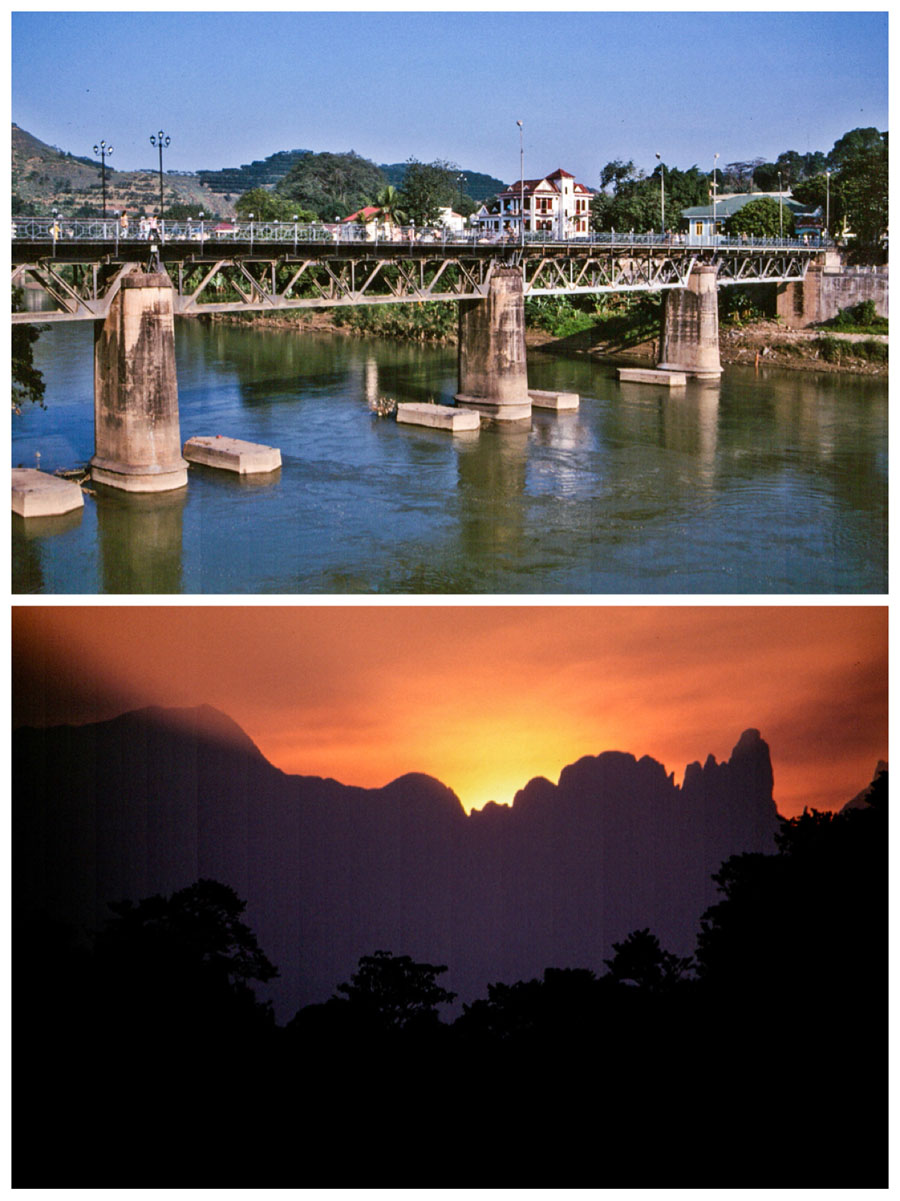
I spent five fascinating days in Hekou - then not a tourist destination but more a commercial node where trade between both countries came together. I would watch as endless streams of women wearing circular bamboo hats pushed bicycles heavily laden with goods north across the border bridge towards the railway station. Tropical produce was loaded onto freight trains for onward shipment while goods from China, including many sacks of potatoes, were shipped back across the border. Coal and machinery also went south. Regularly I looked over to the compact Vietnamese city of Lao Cai with its seemingly attractive French-influenced domestic architecture.
Motorcycles were popular in Hekou, drivers wearing green army-style hard hats. Ethnic groups, particularly the Hani, in colorful traditional costumes walked the streets. Small restaurants abounded, offering mixtures of domestic and Vietnamese cuisine. Fish heads were popular - "No thanks!" I would repeat. Coconuts were piled on street side stalls alongside hammocks, large calendars, polished stones, clothes and so much more.
Most nights I went to a bustling indoor market where Vietnamese dialects blended with more familiar Chinese tones. I would sit at a small food kiosk, consuming bowls of hot spicy beef noodles, while transfixed at the constantly flowing scenes around me. A stallholder's television featured Vietnamese folk songs with quite beautiful scenic images. Leaving the market I would sit by the Red River and have a cold beer while watching the sun setting over jagged southern peaks.

From Hekou it was back on the railway to Kunming before continuing onwards, by bus, to Dali alongside stunning Erhai Lake. There I would welcome the new millennium before heading back to Honghe. If I followed that route today, there is an overnight train that connects Hekou directly to Dali via the new standard-gauge lineup to Kunming.
My stay in Hekou suggested Honghe could offer quite unique and at that time little-visited destinations. The full title, Honghe Hani and Yi autonomous prefecture, reflects both the Red River and its two major ethnic groups, the Hani and Yi.
Returning in January 2000, by express bus from Kunming, I headed first to Gejiu. Known as "Tin City" due to extensive deposits of the metal that is mined and smelted there. Silver had been extracted in the area during the Yuan and Ming dynasties while tin really commenced from the mid-18th century. Minerals and metallurgical products were then carried by mule caravans to Manhao on the Red River upstream from Hekou before ferrying down to Haiphong.
A primary reason for building the railway I spoke of earlier concerned tin extraction and transportation. By the 1930s minerals accounted for 80 percent of the traffic exported along the line; in reverse, coal was carried up for Gejiu's smelters. However, reaching the town was problematic due to steep gradients. It was not until 1921 that an ultra-narrow gauge railway, only 0.6 meters wide, finally connected Gejiu with Bisezhai. On the main line to and from Kunming, Bisezhai lies close to Menzi, capital of Honghe Prefecture. In 1889 Menzi opened as a treaty port, with most trade at that time being cross-border.

Gejiu today is spread around an extensive lake in a seemingly crater - like depression close to the top of a mountain. Part of its beauty, ironically, originated from a combination of exceptionally heavy rainfall and a mining accident in the early 1950's. Water built up in the mines with groundwater rising to the surface, flooding much of the city's narrow valley. The consequence is today's attractive city center scenic spot!
It was fascinating spending a few days in Gejiu, walking around the lake; discovering the former French-style railway station; watching from a waterside square people from various ethnic groups dance or exercise to music from Yunnan's Xishuangbanna. Unlike Hekou, there were noticeably few bicycles because of the hilly terrain. Pleasant downtown garden cafes proved ideal for evening relaxation over cold drinks and spicy potatoes while local life in its varied colorful styles passed by.
From the lake, the view included Laoyin Mountain and it felt inviting. A chairlift offered easy access to the summit but walking was my preference. A paved trail led initially to the restored Mt Baohua Temple, dating from 1670. It was a lovely spot to relax while looking over its yellow-tiled roofs towards the forested slopes beyond. It was so peaceful to walk alone on this path for an hour in beautiful sunshine. The city and its lake were spread below and increasingly impressive the higher I climbed. Close to the summit plateau a restaurant provided a comfortable rest, cold drinks and more stunning views of the surrounding landscape. Eventually heading back down I reached the lake just as the setting sun started to bathe the slopes in a reddish orange glow. A perfect ending to my visit.

The next morning a new chapter started as a bus carried me onwards over a hilly road passing rows of maturing sugar cane. Goats grazed wherever they could. A branch of the narrow railway wound close to the highway before we pulled in to Jianshui. After the modernity of Gejiu it felt initially like a town where time had stood still. Its charm soon emerged. Close to the bus station rose the crimson walls of squat Chaoyang Tower - a gate structure dating from former encircling defensive walls. Originally built by the Hongwu emperor in 1389, it felt a precursor for the grand Ming structures of Beijing. Several times I would climb onto its terrace to view the tiled rooftops and narrow, winding alleys of the older town. Jianshui was one of the earliest developed cities in southern Yunnan, dating back to the Tang Dynasty. It grew as a place of trade, culture, art, pottery and more. Its thriving, bustling alleys reminded me of Lijiang pre-tourism. Beyond lay an increasingly modern city.
Days would be spent exploring the alleys where sections specialized, for example, in bamboo scaffolding poles; back baskets; fish traps; circular wooden tobacco pipes; orange colored tobacco; herbal medicines; metal tools and so much more. Every step passing low-rise adobe brick buildings revealed more and more curiosities. Tofu and goat cheese were roasted over charcoal grills. There would be open-fronted shops, some for local doctors, dentists, hair salons, general stores. Street markets attracted large crowds, people frequently wearing ethnic costume. A school was within an ornate single-floor courtyard structure. Children crowded around adjacent food stalls offering spicy fried potato snacks for just 2 jiao (0.2 yuan)! I often frequented an outdoor one-table cafe, to enjoy 2 yuan bowls of spicy noodles in soup. On wider streets, cows, some with red flowers attached to their harnesses, pulled carts passing men carrying goods suspended from shoulder poles. People got around by bicycle or three-wheeled motorcycle taxis. I, as usual, walked everywhere.
Jianshui's Confucius Temple, dating back to 1285, was modeled after Shandong's Qufu Confucius Temple and throughout history also had operated as a school - many small study rooms lined its walls.

Reflecting periods of commercial prosperity were grand residences, such as the private garden of the Zhu Family. An exquisite complex of yards, water, gardens and residences it also offered hotel accommodation with delightfully furnished rooms.
Heading several kilometers out beyond the urban core a three-wheeled 'tuk-tuk' transported me through the countryside before passing through a narrow market alley leading down to the confluence of the Lu and Tachung rivers. There stood one of Jianshui's remarkable structures - the 17 arched Twin Dragon Bridge (Shuanlongqiao). With small pavilions at either end a large three story tower rose in the middle. An old man smoking a large pipe sat there while women with infants strapped to their backs walked across it. I spent an hour wandering along and under the bridge (January is dry season). Around Jianshui there are numerous Qing-era stone bridges, many still used. For the traveler, these are great locations to look across nearby agricultural communities.
Heading back towards Kunming I stopped for a couple of days at Tonghai, walking on forested Xiushan hill while enjoying the tranquility of its famed temples. There I realized that even after almost three weeks exploring Honghe, so much still remained to discover.
Today the meter gauge railway from Kunming to Hekou only carries freight trains. A recently completed standard-gauge line connects both cities via Yuxi, Tonghai, Jianshui and Menzi.


