(Source: China Daily)
Throughout history, southwestern China's Guangxi, now the Guangxi Zhuang autonomous region, was reliant on water transportation. Seagoing vessels plied the coastline between Vietnam and Guangdong's Leizhou Peninsula. Nanning, Guangxi's contemporary capital, connected via the West River, or Xi Jiang, with Guangzhou and Hong Kong. Initial railway construction did little to alleviate the area's relative isolation from the Pearl River Delta thanks to long, circuitous journeys. However, the Guangdong San-Mao Railway opening in 1991 significantly shortened distances, turning Nanning into a hub for journeys not just to Guilin but ultimately to Guizhou and Yunnan via the "NanKun" line, Beihai on the Beibu Gulf and even to the border with Vietnam. In recent years, Guangxi has continued opening up through ongoing high-speed rail construction.
In late 1990s I visited Nanning several times. It felt different from other regional capitals. Maybe it was the soporific heat that negated lengthy daytime walking, but the weather created a tropical atmosphere, transforming the city's parks into splendid botanical gardens. For hours I would enjoy simply sitting at a cafe overlooking the Yong River — part of the West River system — watching boat traffic. The passenger vessels I had frequented in the early 90s were by then redundant due to transport infrastructure updates.
My trips to Nanning were an opportunity to discover some of Guangxi's ethnic history through its excellent Provincial Museum. A city with a history going back over 1,600 years, it sat at a crossroads between China and southeastern Asia. In 1999 it was already expanding outwards and upwards, with smart offices rising above wide boulevards, although cars were then still relatively rare. Older areas remained fascinating, bustling with outdoor restaurants alongside so much of the life of Chinese inner cities I enjoyed, indeed loved. With the few foreign visitors something of a novelty, and hearing regular cries of "Hello" and "Can I practice my English", I quickly appreciated Nanning, finding it both friendly and relaxing. It transformed into more than a pleasant hub to spend a few days while planning my onward travels.
My original plan was to head straight to Guilin, but the more I looked at my map the more I was interested in going first to Beihai, a city located on a peninsula jutting out from Guangxi's southeastern coast. A good choice, for I discovered much more there than initially anticipated.

A scenic railway journey connected both cities, winding through sub-tropical coastal landscapes, passing rivers with fishermen on bamboo rafts and tea, rice and rubber plantations. Considerable road and urban construction was underway. Pulling into Beihai's large, modern terminal in 1999, only two daily trains connected it with Nanning and Guilin. Today it is served by 28 high-speed 'D-series' trains, including 7 travelling to Guangzhou in under 6 hours!
The station sat in a new area, then in early stages of development. My hotel was in the heart of established Beihai on busy Zhongshan Road, close to a beautiful park of the same name. This was a great location for walking — after only a few minutes I came into one of the city's older areas. Streets were lined with the traditional domestic and commercial architecture of southern China. There were similarities to parts of coastal Guangdong or older zones of Haikou. Often the white-colored buildings, which I refer to as "Sino-Portuguese architecture", were built out over the pavement to protect from sun or rain. Commercial life, often associated with fishing, was conducted there. Ropes, nets and anchors were on display at 'walk-in' shops, and women would sit for hours sewing fishing nets. Heavy gear such as propellers were welded or repaired. On the streets, women wearing the ubiquitous circular bamboo hats pedaled bicycle carts.
Sections today are included within Beihai Old Town (Lao Jia) or Zhuhai Pedestrian Street.
Beihai, whose name literally means "north of the sea", has had a long history as a seaport on the north shore of the Beibu Gulf — a position allowing it to serve international maritime trade for much of southwestern China as far north as Yunnan. It was also a prominent harbor on the Maritime Silk Road.
After 1876, eight Western nations set up consulates and associated facilities there, and some of the buildings still remain. This might be a reason why, even in 1999, there were some good bakeries within the older city.
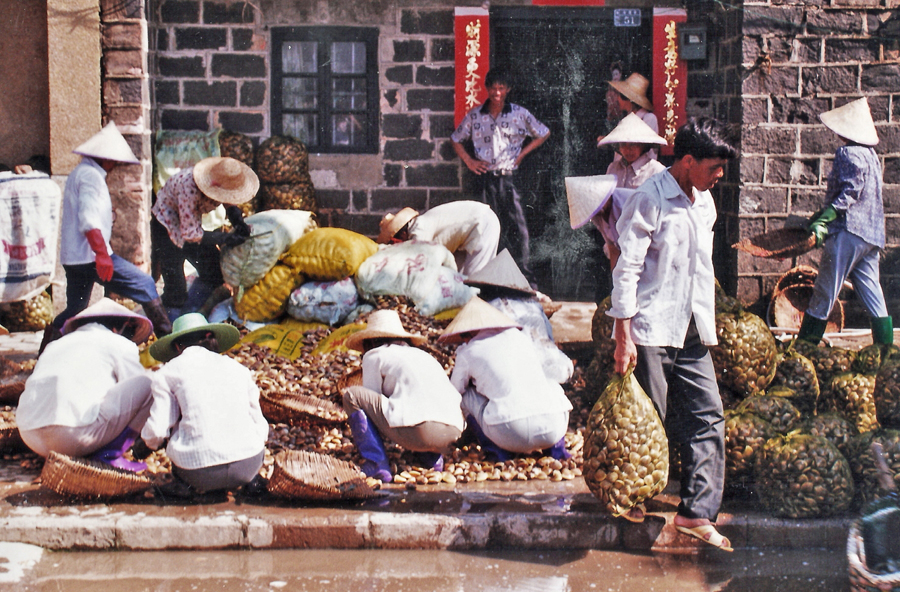
Walking around I came upon Beihai's distinctive vernacular, a mixture of local languages and dialects. Colloquial speech included "Qin-Lian", a southern branch of "Yue Chinese" found along coastal areas of Beihai, Qinzhou and Fangcheng. To an outsider such as myself, it resembled what in the West is known as Cantonese. Indeed there were the almost musical-sounding tones which I remembered clearly from living in Guangzhou. Today of course, Putonghua is widely spoken due to universal education.
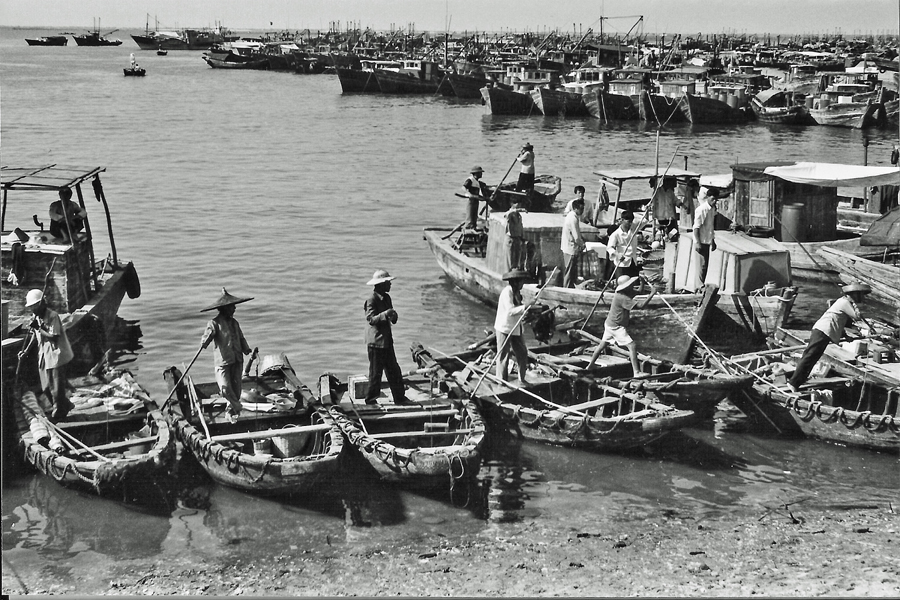
Bordering the historic district a centuries old fishing harbor buzzed with activity. Small sampans rowed by women wearing circular bamboo hats acted as water taxis for large ocean-going fishing boats anchored offshore alongside older sailing vessels. The sampans continually landed crateloads of fish and harvests of shellfish. Boxes were then piled up along the harbor walls, where women packed the shells into polystyrene containers for onward shipment. Tall frames rising from the waters were part of a system for lifting submerged nets, harvesting fish straight from the sea floor.
I was informed that most of the fisherfolk in Beihai were Dan people who followed a traditional lifestyle, living on the cockle boats crowding parts of the fishing harbor. Known according to their way of life Hao ("oyster") Dan collect oysters and fish; Zhu ("pearl") Dan gather pearls and fish in the shallow waters off Beihai's coast and Yu ("fish") Dan live solely from fishing. The Dan have their own passionate folk songs and ceremonies which I would sometimes encounter.
With seafood in abundance, it was of course prominent in local cuisine. Directly south of the fishing town, Waisha Island is a low lying area of reclaimed land separated by a narrow canal. In 1999 it buzzed with many temporary-looking wooden buildings and large tents set up as seafood restaurants. Noisy and colorful, it was fascinating to down a cold drink while watching diners negotiating over fish of all shapes and sizes, including squid, octopus and crab squirming around in large glass or plastic tanks. Once caught, they reemerged prepared in a variety of dining styles, including Sichuan hotpot. Sea breezes spread an aroma of sizzling fish across the island. Tourist stalls overflowed with coral and decorative shells.

Adjacent bustling seafood markets provided a cacophony of noises, with traders shouting out prices per jin followed by lengthy but usually friendly haggling. With so many different fish and aquatic products on display, some freshly caught and others dried and saltedit proved very colorful and an excuse to hide from the strong sunshine outside.
By Chinese standards, Beihai was relatively small, but is today a fast-growing city. With a sub-tropical climate modified by its maritime proximity, daytime temperatures can be hot and sultry. Howeverit was pleasant to walk around in the evening. Night markets opened up at dusk in the older areas, offering unique dining experiences where vendors rapidly transformed fresh ingredients into tasty meals. Unlike today, in 1999 there were no western restaurants or bars, no fast food — just local Options. During my week in Beihai, I became part of the "family" at a local restaurant opposite my hotel on Zhongshan Road. I was sad to say goodbye — a familiar story along my personal China journey.
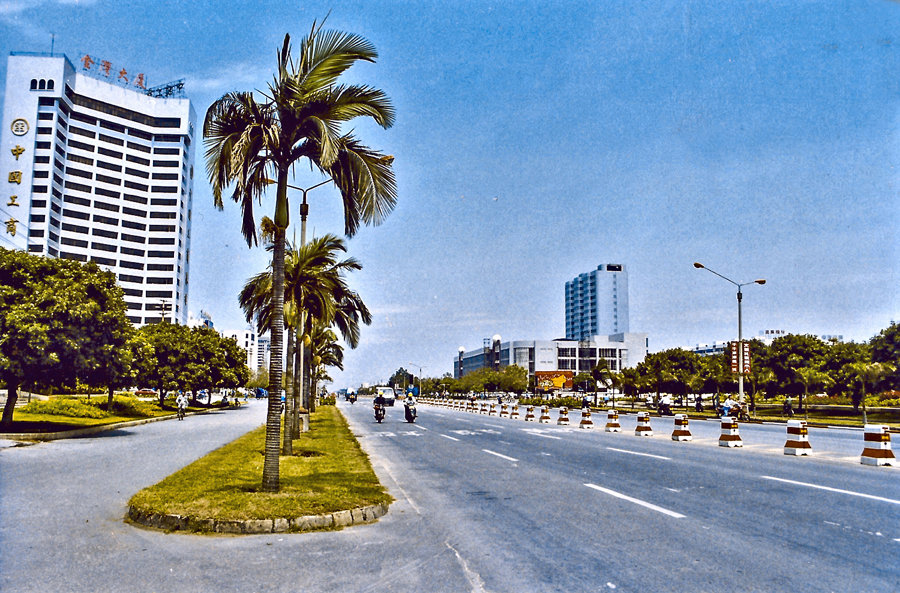
The climate encouraged lush tropical vegetation, flowers and an atmosphere of a "garden city" enhanced by scented aromas. Combining blue sky with palm-lined boulevards, there was an almost Hawaii-like feel to the city's newer areas. With some of China's best atmospheric conditions, Beihai was already regarded as one of China's most livable cities, indeed a place for a comfortable retirement.
In present times with its now excellent air, rail, road and marine connections Beihai is marketing itself as a top tourism destination. Despite being open internationally since 1982, both domestic and international tourism in the late '90s still felt in its infancy — a very different scene from today.

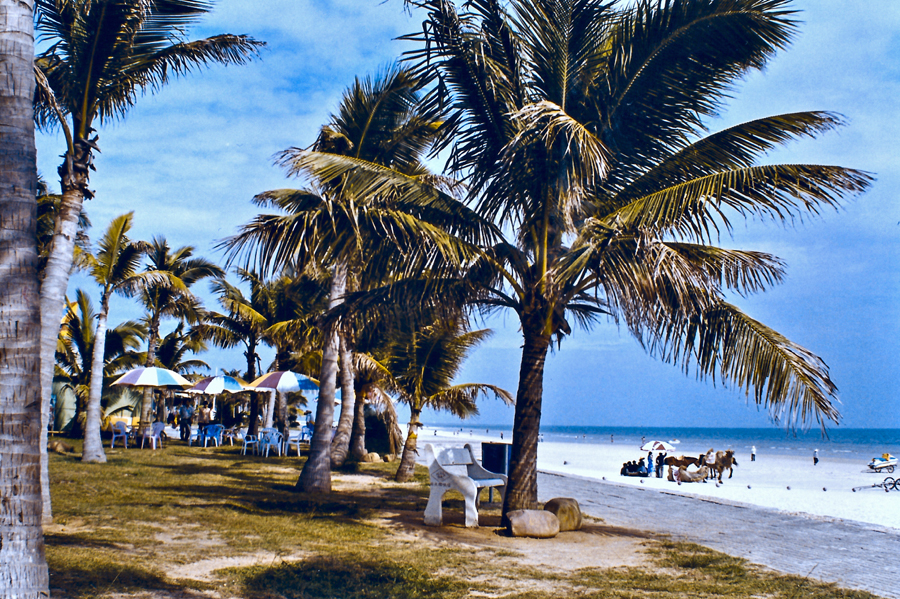
Yintan (Silver Beach) was an area renowned as particularly beautiful when moonlight is reflected by the beach's quartz sand. For me it was a place to consider how China was changing and to ponder the future for such ecologically sensitive areas. Here, people swim, float on air beds, ride jet skis or simply play on the sand with what at that time seemed enough space for everyone to enjoy the beach. But could the area's environment and infrastructure cope with the explosive growth and consequences of tourism I had witnessed in other parts of the world? Only a short distance away was an almost timeless scene of the historic fishing town — yet at Silver Beach, hotels, cafes and restaurants seemed to be rapidly opening or going under construction. Today's satellite maps show the area has come a long way since 1999, with considerable areas of parkland alongside resort developments.
I spent my remaining time enjoying and appreciating the quaintly dilapidated but totally fascinating Old Town of Beihai before reluctantly saying zaijian, heading back to Nanning and onwards to Guilin.
The author is senior blogger of China Daily website.