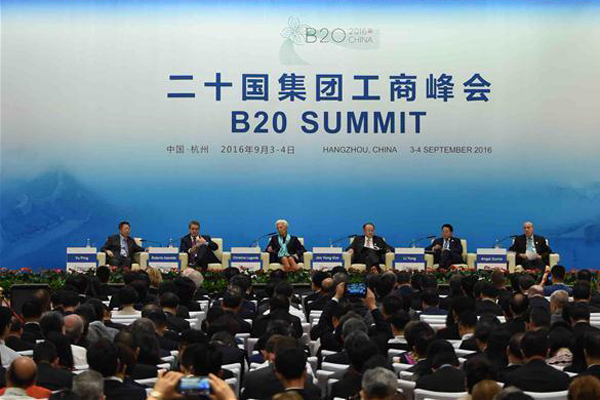
(Source: China Daily)
G20: Toward an innovation-based economy 2020
By Margit Molnar | chinadaily.com.cn | Updated: 2016-09-06 14:46
Innovation has been selected by the Chinese Presidency as a key theme for the G20. This move provides a new impetus to policy actions around the world to revive the global economy and achieve strong, sustainable and balanced growth. At a point where macroeconomic policies, especially monetary policy, have reached their limits, a new impetus is very much needed. Innovation can be a powerful driver of productivity growth, the only way sustainable long-term growth can be guaranteed. G20 countries committed to a series of ambitious structural reforms and actions encompassed in the Blueprint in support of innovation. G20 countries sign up to a commitment to support investment in the science and technology industry, which in itself can be important in reviving growth as in many parts of the world, especially some G20 economies, recent sluggish economic performance is caused by weakened investment. Ambitions however go much further: to foster exchange of knowledge and experience on innovation-driven growth, G20 Members endorsed the creation of the G20 Community of Practice within the OECD-WB Innovation Policy Platform. In addition, they adopted the G20 2016 Innovation Action Plan which outlines guiding principles and actions, such as the adoption of pro-innovation strategies, policies and measures.
A series of Action Plans was adopted in related areas such as the digital economy and the New Industrial Revolution. Also, more research has been called in those areas to be undertaken by international organisations, including the OECD. Measuring the digital economy, for instance, is still a challenge. Our knowledge on these new fields and their benefits are still limited, but G20 countries strive to achieve greater inclusion.
Innovation also features in the structural reform agenda to achieve strong, sustainable and balanced growth. G20 countries have adopted the Hangzhou G-20 Guiding Principles for Structural Reform setting out priority areas for structural reform. These principles will serve as high-level guidance to members when considering reforms in priority areas. G20 countries chose a dashboard of structural reform indicators, both reflecting outcome and policies. These indicators will serve to track progress in structural reforms and feed into a report to be submitted to G20 Ministers in 2017.
Innovation is a theme as important for China as it is for other G20 countries. Its importance can be best captured by the fact that China chose innovative development as one of the five key principles for the current Five Year Plan. The only feasible way to continue the impressive catching up is through innovation, as is recognised in the 13th Five Year Plan, which sets the target of becoming and innovative economy by 2020. Such a transformation presupposes the accumulation of sizeable stocks of the various types of capital: physical, human, institutional and social.
Robust building of physical capital for innovation
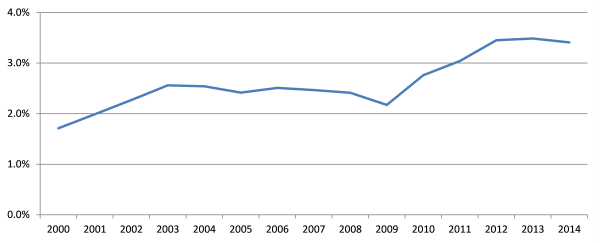
Physical capital is the most abundant of all the types of capital thanks to decades of investment-driven growth. While the misallocation of capital over the past decades is manifest in excess capacity in a number of manufacturing sectors, the channelling of investment towards high-tech and new industries is apparent in recent years (Figure 1).
Figure 1. High-technology investment is expanding rapidly
Share of investment in high-tech industries in total fixed asset investment
Robust accumulation of human capital while increasing skill deficit in computer programming
Human capital, either measured by the expected lifetime income of individuals or simple indicators such as education attainment or enrolment, accumulated rapidly, in particular in the past two or so decades. As the share of the working-age population falls, wages rise and the relative prices of capital and labour change, leading to substitution from labour to capital. More capital-intensive production, in turn, demands higher skills. According to OECD research using the MyCOS survey data of 800 000 tertiary graduates, the skills with the most acute shortage include computer programming and soft skills (Figure 2). Making up for the programming skills deficit is a prerequisite of widespread development of Internet-based industries and the whole Internet Plus initiative.
Figure 2. Programming skills are falling short
Percentage of graduates in the top ten skill categories with the greatest gap, 2013

Firming institutional capital as expected driver of entrepreneurship and innovation
Notwithstanding rapid productivity convergence and impressive build-up of infrastructure and knowledge over the past couple of decades, it has not been until very recently that the institutional environment is targeted to better suit the transition towards an entrepreneurial and innovative economy. A path-breaking achievement in this direction is the removal of barriers to entrepreneurship started during the current government. Since 2013, administrative procedures have been simplified and licencing requirements reduced. The OECD PMR indicators can capture these changes and show significant reduction of such burden both on corporations and sole proprietor firms (Figure 3). Benefiting from reduced barriers to set up businesses, the past year or so saw an unprecedented surge in new company registration, in particular in services.
Figure 3. Barriers to entrepreneurship are falling rapidly
Barriers to entrepreneurship component of the Product Market Regulatory indicator, 2013 and 2016

Once a favourable environment is established for enterprise creation, it is also crucial to ensure that zombie companies do not take up resources and through efficient mechanisms exit the market. Such "creative destruction" is the driver of productivity growth by giving space to new ideas, new products and new processes.
Social capital, the weakest link, is now targeted
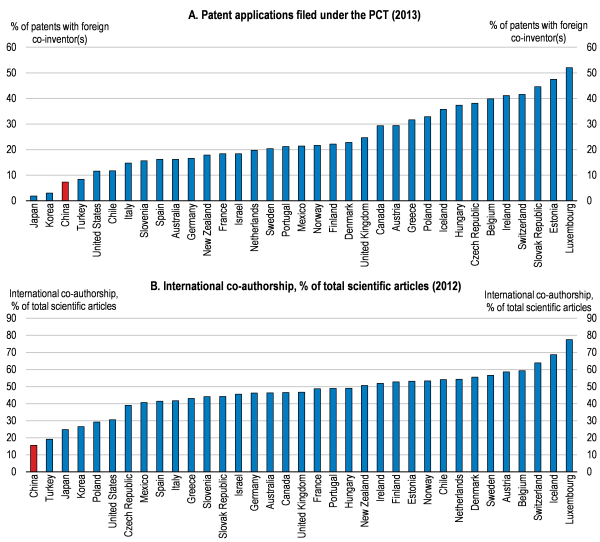
Overseas experience shows, that most innovation is a result of collaborative efforts, which presuppose well-established networks. While in China vertical linkages with customers and suppliers are strong and contribute to innovative activities, most achievements stem from firms' own R&D and only a few percentages from collaborative projects, let alone projects with overseas collaborators (Figure 4). In particular, inter-firm collaboration, which could potentially be an important source of spillovers, is relatively low. The first national-level manufacturing innovation platform, established in June 2016 aims at exploiting potential synergies and complementarities across activities and strengthen the link between development and commercialisation.
Figure 4. International networks in innovation activities are still to be developed
The author is Head of China Desk, Economics Department of OECD (Organisation for Economic Cooperation and Development).