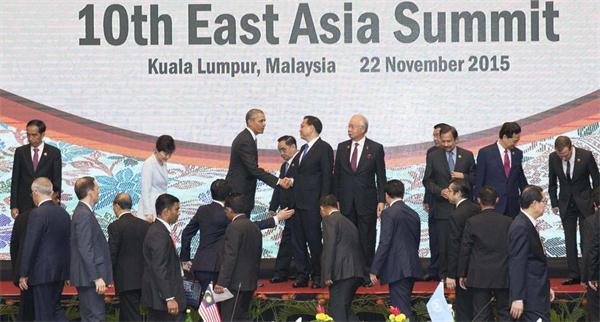
(Source: China Daily)
The rise of Southeast Asia and the challenges ahead
By Hoo Tiang Boon | chinadaily.com.cn | Updated: 2015-11-24 08:29
The signing of the Kuala Lumpur Declaration on the Establishment of the ASEAN Community at the 27th ASEAN Summit formally paves the way for a more integrated Southeast Asia by the end of the year. But it also points to a larger story that is often less appreciated: the rise of Southeast Asia and the important roles played by ASEAN and China to facilitate this.

Southeast Asia is the seventh largest economy in the world. It has a combined GDP of more than US$ 2 trillion, which is projected to grow by more than 5 percent per annum over the next few years. Intra-ASEAN trade is now more than US$ 600 billion. Conditions for further growth are also favorable: overall peace and stability; resource-rich; a growing middle class and a generally young and vibrant population of more than 600 million.
With the creation of the ASEAN Community, which envisions the region as a single market and production base with freer movement of goods, services, labour and capital, Southeast Asia is set to become even more connected, dynamic and prosperous.
These achievements are not just the product of Southeast Asian efforts. It has come with the help of ASEAN's external partners — in particular, China which has played a major role in the rise of Southeast Asia. As ASEAN's largest trading partner since 2009, China is a key driver of growth, with bilateral trade reaching around US$ 480 billion last year. At the same time, ASEAN has become China's third largest trading partner.
With the conclusion of the upgraded China-ASEAN FTA at last week's ASEAN Summit, the China-ASEAN connection is set to grow even stronger. Both sides are now in a better position to reach the goals set by ASEAN and China's leaders to attain two-way trade of US$1 trillion by 2020.
As for the regional system and strategy, ASEAN-led Regional Comprehensive Economic Partnership is supported unconditionally by China. And vice versa, ASEAN hails China's Maritime Silk Road (MSR) initiative, which when fully implemented, will further boost Southeast Asian economies since the region is a key location in the MSR route.
Southeast Asia has come a long way. Today there is general peace and stability. There is little threat of war between ASEAN states. The livelihoods of Southeast Asian peoples have also greatly improved.
Nevertheless, these gains cannot be taken for granted. As Singapore's Prime Minister Lee Hsien Loong has pointed out, the stars may not "always be so neatly aligned" in the future. Southeast Asia is still confronted by a number of ongoing challenges which can mean the unravelling of current progress. These issues should not be forgotten.
First, it is a myth that the ASEAN Community's birth means that Southeast Asia is now a regional society. Forming the ASEAN Community does not mean that the destination has been reached. It should be more accurately seen as the beginning of a more intimate process of greater regional integration.
As such, ASEAN's traditionally strong adherence to the principles of non-interference and sovereignty, as well as gaps in national and regional interests and in national and regional capacities, will continue to pose challenges to this integration process. Domestic resistance may also develop to put pressure on governments, especially if the benefits of integration are not perceived to trickle down to the masses.
Second, terrorism, whether religious and/or politically-motivated, continues to be a major concern for ASEAN governments. The recent Paris attack is a vivid reminder of the persistent threat and global reach of terror groups such as the so-called Islamic State (IS). Attacks launched by IS franchises could conceivably happen in Southeast Asia.
How this threat evolves is a serious matter because in a region that is home to significant Muslim populations, terrorism sparked by violent Jihadi extremism not only threatens the domestic security of several Southeast Asian states, it is also potentially damaging to their social fabric.
Third, because ASEAN's economy is closely linked to the Chinese economy, any major slowdown of the Chinese economy will have inevitable repercussions for ASEAN countries. To a considerable extent, Southeast Asia's continued progress depends on the trajectory of China's growth.
Finally, at the broader strategic level, the evolving US-China dynamic is watched with close interest in ASEAN. Recently, the US has made a number of provocative moves, including launching the so-called "Freedom of Navigation" operations in the South China Sea. These operations have undermined regional stability even as China has responded with great restraint.
A US-China conflict will have adverse consequences for Southeast Asia. If Southeast Asia is turned into a proxy battleground between these two powers, ASEAN will bear the most collateral damage. A conflicting situation could also destabilize the wider regional and global environment, leading to conditions that will not be conducive for ASEAN's economic development. How the US-China relationship evolves is therefore crucial for Southeast Asia.
ASEAN has done well thus far to navigate US-China competition in Southeast Asia. However, important challenges remain. That is why it is so important for the region to maintain and sustain the principles of ASEAN centrality and neutrality. A neutral ASEAN that assumes a leading role in Asian affairs and evenly balances China and the US is the best way to ensure continued peace in Southeast Asia, and to ensure ASEAN's continuing relevance to the major powers.
Hoo Tiang Boon, a coordinator, MSc. (Asian Studies) programme and Assistant Professor with S.Rajaratnam School of International Studies of Nanyang Technological University in Singapore.