(Source: China Daily)
Emoji express emotions mere words cannot match
By Song Jingyi | chinadaily.com.cn | Updated: 2015-11-23 16:41
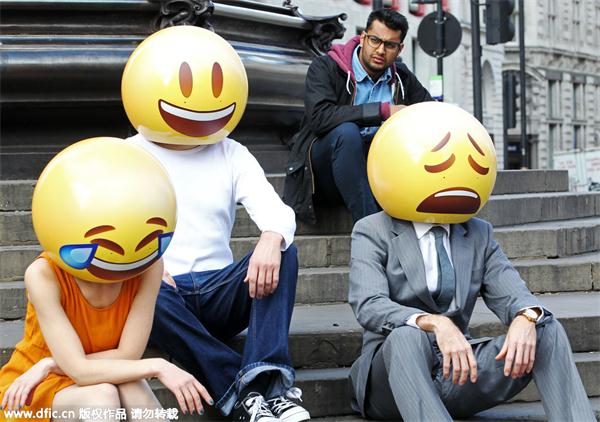
Oxford Dictionaries' announcement of the Word of the Year - a face with tears of joy, seemingly weeping over its victory - left many astonished. Unlike past years (2014 was the year of "vape"), the hallowed authority on the English language chose a photogram as the Word of 2015, instead of an old-fashioned string-of-letters.
"Our judges picked up this laughing and crying face due to the sharp increase in popularity of emoji around the world. It is not surprising, as 21st century culture, we become so visually-driven, emotionally-expressive and obsessively-immediate. Traditional alphabet scripts have a hard time keeping up and adapting to the rapid-fire demands," said Casper Grathwohl, president of Oxford Dictionaries, in a video interview published on YouTube by Oxford Dictionaries.
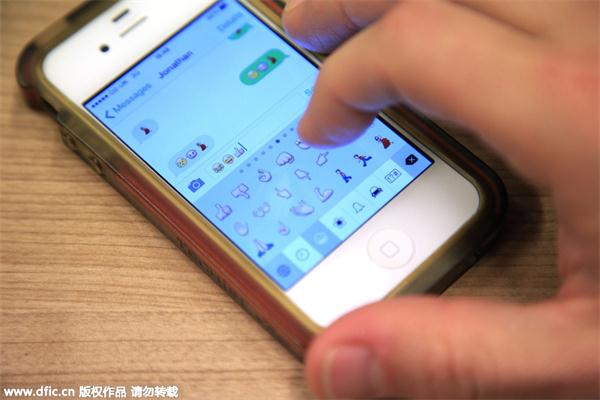
Emoji, a kind of pictograph but different from typographic emoticons, initially used by Japanese mobile operators, have been a staple of texting culture for years but it was over the past 12 months that we witnessed emoji culture explode into the global mainstream. Even Hillary Clinton asked for feedback on her official Twitter account using emoji. "The usage of emoji more than tripled in 2015 compared to 2014, Oxford data found" as reported in the Washington Post.
Monie Xiao, a postgraduate majoring in Translation at Fudan University based in Shanghai said: "These symbols have already been necessities for me whenever I chat with my friends. I tend to end up my words with an emoji almost in every message, which has become a habit."
Why have people become so obsessed with emoji?
"Emoji embody a culture of playfulness and intimacy. Monie said. "By using emoji, it can somehow make the conversation more relaxing and funny. Also, when you start the first interaction with someone or small talk on the Internet, emoji is the best choice to fill an awkward and embarrassing pause."
Zhou Jimin, a postgraduate majoring in anthropology at the Chinese University of Hong Kong, who similarly sends emoji in messages, said:" Emoji transcend linguistic borders. When I send text, I can't convey the real intention behind the words using a facial expression or tone. Simple emoji could convey a lot of hidden meanings. Look again at this face with tears of joy; don't you feel it suggests an overabundance of emotion? It might suggest the kind of glee that you will feel after finishing a heavy load of work. Emotion signals provide me a solution to lessen misunderstanding, which is one explanation for their quick proliferation."
Emoji are already butting their heads with traditional languages, but could they develop into a language? Tang Yinghong, a psychological teacher at Leshan Normal University, casts his expert eye over the pictures sweeping the world.
"As with any new medium, there are growing pains. First of all, different people have different interpretations about the same signal under the influence of region, culture and education. There is a cloud of meanings around emoji that makes it difficult to pin down its exact explanation," he said.
"Emotional signals, just like gestures, are not a language, at least, not yet. They must appear along with the speech or context to play a supplementary role to enhance smooth conversation. So this symbolic system won't take over verbal language or written language at all, let alone develop into dialect."
Other professionals or scholars also express worries about this trend. Despite this, they believe emoji are still increasingly rich form of communication and are an exciting evolution of the way we communicate in the digital world.