(Source: China Daily)
The 21st century expects a comprehensive narrative from China
By Tomas Casas | chinadaily.com.cn | Updated: 2017-01-19 14:04
When during the course of 2016 US gave up on the TTP it was more than the unwinding of a trade deal. Many saw the limits of the Pax Americana. At the core of the US reset is the lack of a business model to sustain the most sophisticated and successful economic and geopolitical superstructure the world has seen. President Donald Trump might be able to make his country great again, but even the resources of a booming America will be too stretched to continue underwriting the global order. Going isolationist operationalizes an underlying reality or more positively, sets the stage for the US to work out a more profitable geopolitical bargain.
An up-and-coming Pax Sinica would face the opposite challenge -- ample resources but scant experience and no story. A genuinely successful Sino-Swiss FTA, such as the one hailed during President Xi Jinping's state visit to Switzerland this week, would be an important thread in China's narrative, which needs to start in the Pacific.
The TTP was the pinnacle of a comprehensive institutional system. One that was able to effectively integrate soft power like the English language and Mickey Mouse, with hard power like military might and the US currency.
Order abhors vacuum and if America withdraws, the superpower able to deliver the goods will be welcomed. The leading light at last November's APEC summit in Lima was President Xi and his "China will not shut the door to the outside world but will open it even wider."
This week while China's president was making global headlines with his strong statement for globalization, his deeds spoke even louder as China's State Council liberalized services, mining and technology sectors. Of course, transitions to new orders are historically all but orderly.
For starters, America might be both skeptical on free trade arrangements but also scorn rival China initiatives. China will not inherit American-forged institutions and take them to a new height. However, America is not the ultimate consideration.
China is not in a position to propose TTIP or TPP replacements. Unlike America, it is in transition relying on forward-looking industrial policy to guide its economy through the treacherous middle-income trap. Thus China's offer will not include regulatory equivalency, open internet or labor standards.
Less ambitious bilateral or regional trade arrangements would still add substantial value. Another key is how wide sectors such as telecom, finance, technology and others will open in China, since an attractive trade deal necessitates domestic reform. That means losers, as leadership abroad is inevitably linked with creative destruction at home.
Does a generous trade deal and prosperity constitute the entire Chinese narrative or will, for instance, other important global public goods such as security be delivered if and when the American umbrella goes? Here the savoir faire related to crafting a stable comprehensive order and the attendant narrative emerges.
China can be extremely princely a partner as Philippines President Rodrigo Duterte can attest, but a case by case approach will not scale. Fortunately, China has also its comprehensive and phenomenal One Belt One Road (OBOR) Initiative. Despite some very promising elements like the Asian Infrastructure Investment Bank (AIIB), plenty of conceptual works lies ahead.
Asian countries are the most familiar with the Middle Kingdom's traditional international order, the tribute system. Historically China's gifts were more beneficial to vassals than the story of imperial kindness. Today whether OBOR or regional trade deals, the narrative's quality and legitimacy are central. Western tenets like liberalism or democracy would not be effective, but neither will a business-only approach.
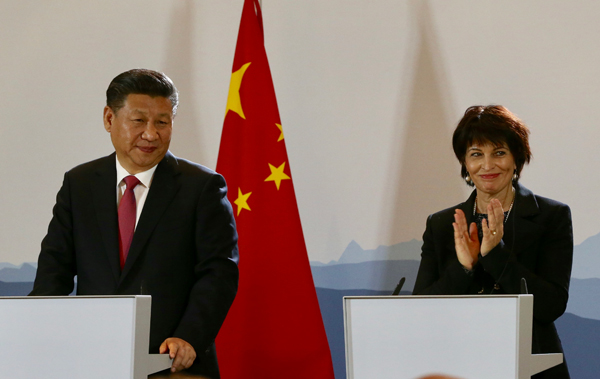
What story can China propose? On Monday at a solemn signing ceremony, China and Switzerland committed to review and upgrade their FTA in two years. There is no doubt that both countries intend to make their FTA a comprehensive benchmark, but most importantly they will do so in the context of their "innovative strategic partnership".
Switzerland is today the world's most innovative nation - China's promise for tomorrow is to deliver innovation to the world. That is an attractive tale.
Beyond the official initiatives, non-state actors such as Alibaba are also set to create new opportunities and massive new wealth around the globe by enabling and connecting people and enterprises. The underpinnings of a Pax Sinica are being crafted.
In the 20th century the world eagerly tuned into America and the 21st century expects a strong and whole narrative from China.
Tomas Casas is a faculty member at the University of St. Gallen and its Institute for International Management (FIMHSG).
The opinions expressed here are those of the writer and don't represent views of China Daily website.