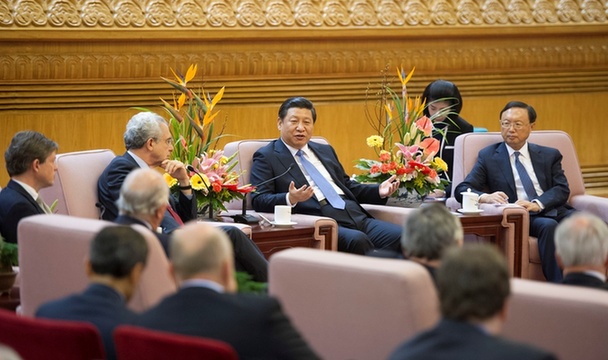
(Source: China Daily)
China emerges as the leader of an open global economy
By Nathan Gardels | chinadaily.com.cn | Updated: 2017-01-13 10:56
China has become the de facto world leader seeking to maintain an open global economy and battle climate change.
President Xi's appearance at the World Economic Forum in Davos next week comes at both an auspicious and inauspicious moment.
It is an auspicious moment because President-elect Donald Trump has all but announced America's withdrawal from the world it has largely made over recent decades — and from which Asia has most benefited. His "America First" policy promises protectionist tariffs and walls as well as a retreat from trade and climate pacts, and perhaps, even long-standing military alliances.
With Europe mired in inward-looking disarray, that leaves China as the one major power with a global outlook. Ready or not, China has become the de facto world leader seeking to maintain an open global economy and battle climate change. In effect, President Xi has become the general secretary of globalization.
The inauspicious aspect is the reverse: China's "core leader" is speaking to the converted from the pulpit in the foremost church of the global elite that gathers annually in Davos. Aligning with global business elites in such a high profile manner places China even more squarely in the negative sights of the populist wave sweeping the Western democracies. It affirms in their minds that China is the main enemy of the working and middle class in the West. As top Trump advisor Steve Bannon has explained the worldview that defines the new US administration, " I'm an economic nationalist. The globalists gutted the American working class and created a middle class in Asia. The issue now is about Americans looking to not get f—ed over."
What China can do
China is correct to insist on an open and reciprocally-fair global economy and to take the lead on climate change. But it would be wise to pay attention to the concerns of the populist constituencies. The unobvious benefits of interdependence need to be made manifest. Jack Ma had the right approach when he met with Trump to propose ways in which American small businesses — which create most US jobs — can sell directly to Chinese through Alibaba's on-line platforms.
China should also work with the Trump administration to find ways to recirculate its huge reserves earned from a trade surplus with the US into badly needed infrastructure investment in the US, which Trump has pledged to revamp.
Members of the incoming Trump administration have made it clear they don't buy into the scientific consensus, affirmed by world leaders last year in Paris, over climate change. Here China should work with the American states, such as California, that are committed to stopping global warming. California has one of the largest carbon-trading permit markets in the world. China this year is expanding its pilot projects (set up with the help of California officials) on cap and trade to the whole country. There should be a concerted effort to deepen these markets with California and other subnational entities around the world.
A China-US partnership is optimal for the world
I remember being at Davos in 2000 when Bill Clinton was the first American president to go there. It was the height of American post-Cold War triumph. Here is what I wrote at that time:
"Clearly, globalization is an American-led phenomenon. Those gathered in Davos were in awe of a US economy in the midst of its longest expansion in history, with full employment and low inflation thanks in good part to freer trade and advances in information technology. Industrial titans from Europe and Asia sat gaping as Microsoft's Bill Gates, AOL's Steve Case and Viacom's Sumner Redstone offered their version of how to make billions in the new economy. Sessions on the other great revolution underway in genetics were also dominated by Americans, from the scientists to the regulators. From so high up in the Alps you can see clearly all the way to the future. And the future, if this year's Davos meeting was any indication, will be undeniably American." It was also at that time that then-Secretary of State Madeleine Albright called the US "the indispensable power."
Almost two decades later, China is not yet where American was then. And America retains many of the same strengths I noted at the turn of the millennium.
But China has now moved way up the ladder. Yet, neither country can lead alone. The optimal arrangement for making globalization work is for the US and China to join together as "indispensable partners" based on a convergence of interests to create a world order that works for all. If the world's two largest economies, though from distinct civilizational spheres, don't buy in, it won't work for anyone. The worst thing for the whole world would be for the US and China to become leading members of hostile blocs.
The author is editor-in-chief of The World Post and Executive Advisor to the Berggruen Institute's 21st Century Council.