(Source: China Daily)
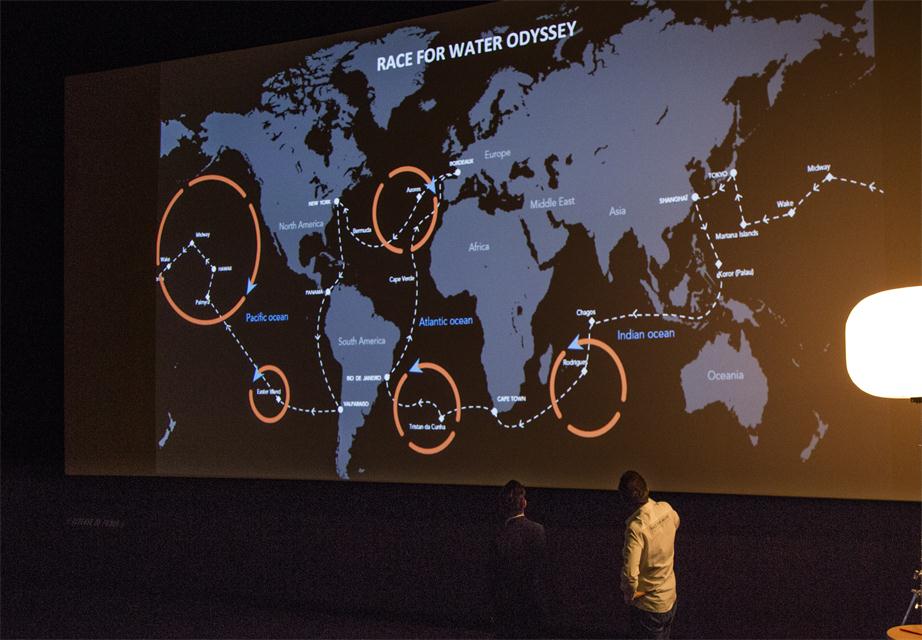
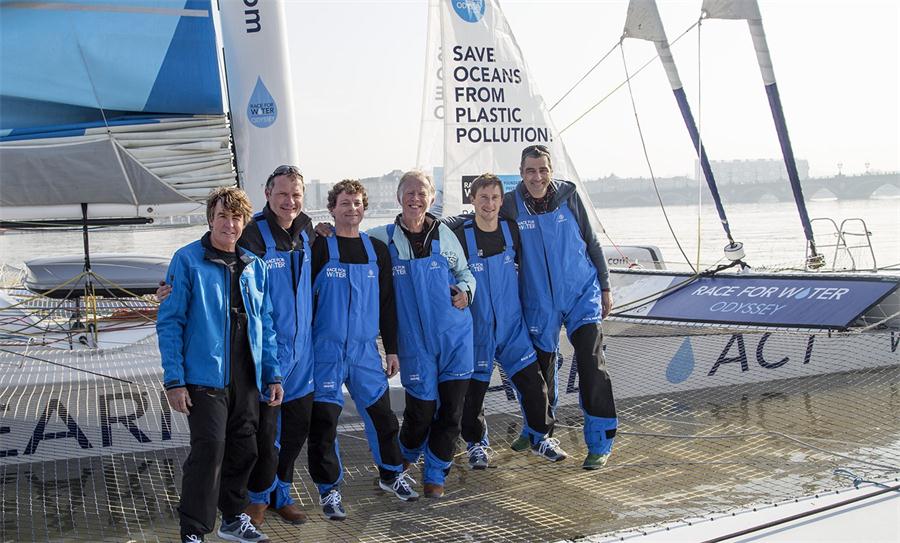
Editor's note: It is estimated that there will be 1kg of plastic for every 3kg of fish in the oceans by 2025 according to one piece with Daily News. Race for Water Odyssey, a global adventure tour launched by Race for Water Foundation, works to bring together the public on this issue by visiting the locations of each garbage patch around the world. China Daily Website spoke to Lucie Gerber, the R4WO's public relations officer who has followed up the whole journey , to know their ocean life around China and the world during the six voyagers' global expedition.
Plastic is everywhere, urgent solution needed
Q: How did Race for Water Odyssey originate?
A: It was a project that we have thought about for a long time. The mission of our foundation is to preserve water. What is the biggest threat right now to the oceans? It's plastic pollution. There are really pressing numbers about millions of tons of plastic floating in the oceans. We thought it was time to try to do something about it. But before doing something about it, we needed to know what was going on. What is happening is that some people imagine that pollution is like continents and that you can actually work on it, which is not the case. It is like a big trash soup, really difficult to map. We know that there are places that these trash vortexes are, but nobody really knows exactly where and how much trash is there. The idea is to go to the five gyres and see what is going on.
Q: What kind of work do you do when you arrive in a city?
A: Our mission has two kinds of stops, the scientific stops where we do analysis, and stops to raise awareness. On these stops, we try to speak about this problem and gather public opinion.
Q: Can you tell us about your Shanghai voyage?
A: It was a nice week in Shanghai, with the help of the Swiss Consulate and Swissnex, many local NGOs and environmental experts participated in our scientific workshop about marine pollution.
Q: What have you learned so far about China's marine environment?
A: Actually, we didn't sample any Chinese shorelines or beaches, our observations of China' s marine environment is restricted to our stay in Shanghai for a small week, the navigation along Chinese coast and our discussion with Shanghai local NGOs. Therefore we do not have specific data about China's ocean circulation, except the fact that during the navigation between Tokyo and Shanghai, the frequency of observed drifting sea debris from the boat was about 1 minute, which is much lower than other countries. In other terms, China coastal concentration seems to be higher. This means China's ocean situation is of serious concern. A new study, Plastic waste inputs from land into the ocean, published in the journal Science in February 2015, estimated that plastic debris washing into the ocean from 192 coastal countries reached somewhere between 4.8 and 12.7 million metric tons in 2010, among them, China is the biggest contributor.
Q: Since ocean trash is an urgent problem that China faces, what can we do to mitigate the issue?
A: As we observed, China already has a lot of people working in the field of waste valorization, up-cycling and recycling, but in contrast to other countries, a lot of workers are part of the informal sector. In my opinion, they need to be structured and regulated by the Chinese government. There are also some technological solutions now available, which could turn plastic waste into energy resources (oil or electricity). We need to scale up these solutions.
Q: What kind of preparations did you make before expedition?
A: We calculated that the whole navigation would last nine months to go into all five main trash gyres. We used our ambassador boat, the MOD70 sailing trimaran, which was used for racing and not for such expeditions. The distance we needed to sail was the equivalent of two world tours (more than 40,000 nautical miles). Therefore, we needed to configure it in order to ship the scientific materials as well as the necessary things to live on board.
Q: During the voyage, what was your biggest obstacle?
A: The noise! We are immersed in a "deafening empire". When we gain speed, every single centimeter of the trimaran is noisy and the worst part is that we get used to it. Our crew's ears have never gotten respite since aboard the MOD70 Race for Water.
Each zone has specific noises: whistling or squealing noises in the hold, sprays smashing into the porthole in the kitchen and the permanent growl of the water in the whole central hull. Whether it is lowered or raised, the drift is also always very loud.
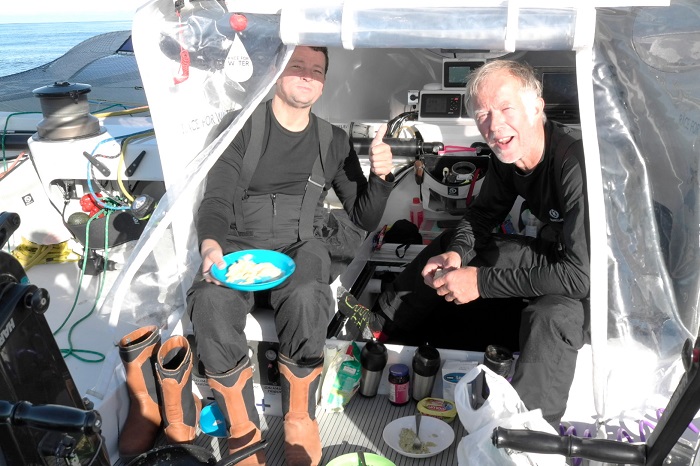
Actually, the calmer place in this "deafening empire" is our little hut on the deck, unless we get attacked by an enormous wave or by kamikaze flying fishes.
Q: Could you tell me more about how you balance scientific investigations and daily life?
A: The catamaran is only 21 meters long and has only one small cabin with two beds and a cooking corner. There is no heating, no shower and no toilet. Because we have five to six people on board, so we have to take sleeping shifts of two hours and stay three hours awake. But if there are storms or a typhoons like on the leg from Hawaii to Yokohama, nobody is able to sleep at all.
Q: During the voyage, what have impressed you the most?
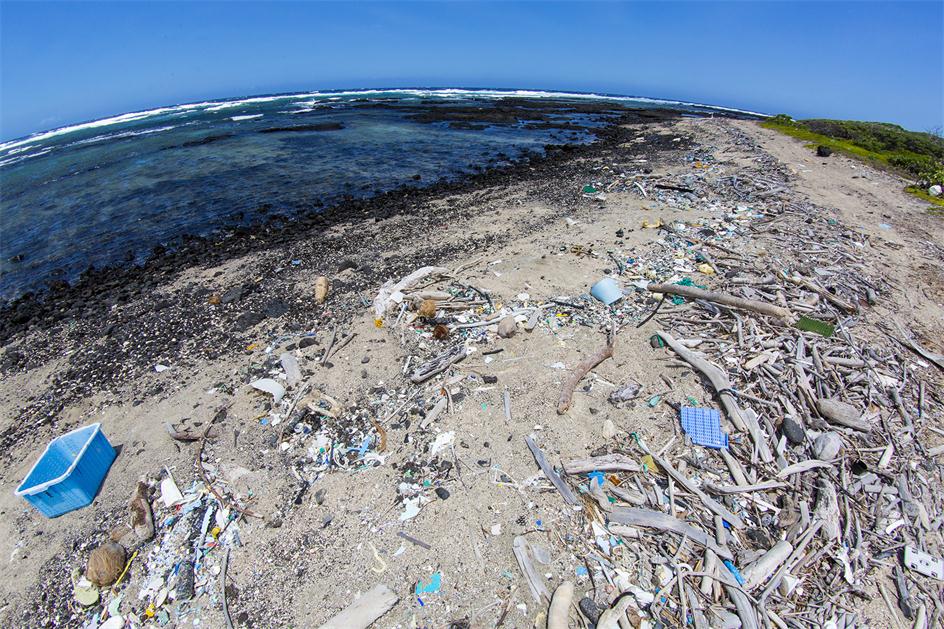
A: Two things left the deepest impressions on me. The first one was when our ship capsized in the Indian Ocean. As we were navigating by night with 18 to 20 knots of wind, a strong gust of wind turned the boat over. Fortunately, the crew was safe and unhurt inside the upturned main hull. Our shore team worked immediately on solutions to recuperate both crew and yacht. The personnel at the military base in Diego Garcia, less than 100 miles away, also agreed to assist the team. The crew was also really shocked to see how much trash there was to see on every island we visited, from the most famous ones (such as Easter Island) to the most remote one. Here is an example of a very remote island on which we went. Nobody lives on this island, but so much trash lost in the ocean.
Not the end, but a new beginning
Q: Do you think there will be another race?
A: The plan is that we will keep going. Differently, since 2015 is the first step. The second step will be more about action. There will be other missions. I'm not sure if we can call them races yet, because we are not sure what is going to happen.
In 2016, we have launched the Pilot Project which is going to transform marine plastic waste in electricity. The idea is to implement the first pilot project in Rio, during the Olympic Games. We will know very soon if we can confirm that we can go there with our new ambassador boat, the race for water solar vessel.
Q: Will next year's plan include China?
A: We won't be coming back to China in 2016, unfortunately. However, our objective is to duplicate our project and its positive effects as soon as we can, so maybe in the following years, we will come back to China with innovative technology.