(Source: China Daily)
Treasuring memories of southern Guangdong
By Bruce Connolly | chinadaily.com.cn | Updated: 2018-02-13 11:34
China's vast countryside has fascinated me since I first viewed it from the comfort of a train back in 1987. Moving south from the grasslands and semi-desert of North China's Inner Mongolia autonomous region to the lush fertile landscapes of South China's Guangdong province, I was an outsider looking in. Later, visiting Hainan, I walked amid vast swathes of rice while wandering through timeless villages. At times I felt like an alien confronting incomprehensible languages spoken in local dialects. I regularly received perplexed stares, for why would a foreigner follow rough rural tracks when he could be having the comforts of rapidly modernizing cities? How could I explain that I saw beauty in much of China's landscape? It's a feeling I still retain.
There were stunning areas for photography, sketching and painting, although having lived in Guangzhou, for example, I was not immune to urban-rural disparities. The countryside initially lacked comforts and opportunities generated by the urbanization embarked on since the late 1970s. At times however, watching the sun setting over the semi-aquatic paradise of the sub-tropical south, it was easy to forget that rural life could be hard. China was still essentially rural when I undertook that first north to south journey. Estimates suggest in 1990 that 26 percent of the population was urbanized; by 2000 around 36 percent; by 2012 it was passing 51percent, a proportion continuing to grow. Traveling today I am seeing fewer people working the land with an obviously ageing village population.
How could I become close to China's rural landscapes? As a geographer, man-land interactions long fascinated me. In 1993 I was invited to Taishan, a small city within the western Pearl River Delta. Fortuitous, for not only to the city, but to visit a rural family home within Fengqi village.
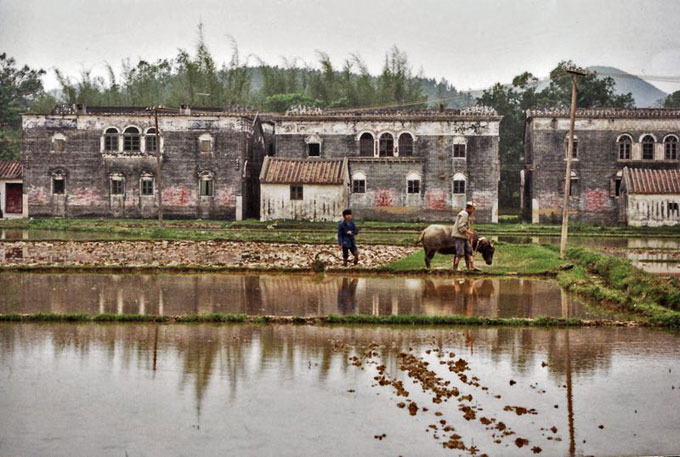
I was starting to see a pattern around Taishan. A central city, in this case Taicheng, surrounded by rural communities initially providing food supplies for the urban areas where higher levels of administration, commerce and education were mostly concentrated. Then there would be different levels of villages, including Fengqi. Wenquancun ('hot springs village'), where I would stay, is part of Sanhezhen town.
A nodal settlement, Sanhezhen is a route center with buses connecting across southwest Guangdong. At its core, a market, shops, restaurants - one where I was taken for morning tea and dim sum - and there were small hotels. In July 1993 I stayed for a few days in a simple guesthouse close to the hot springs. There I experienced my first typhoon as it swept in from the South China Sea: night-long flashes of lightning, violent sounds of the wind, glass breaking, trees crashing over, a power failure. Sleep was impossible with dawn revealing both structural damage, along with flooding across many highways. I never discovered if there was any human toll but life amazingly, quickly, returned to normal.
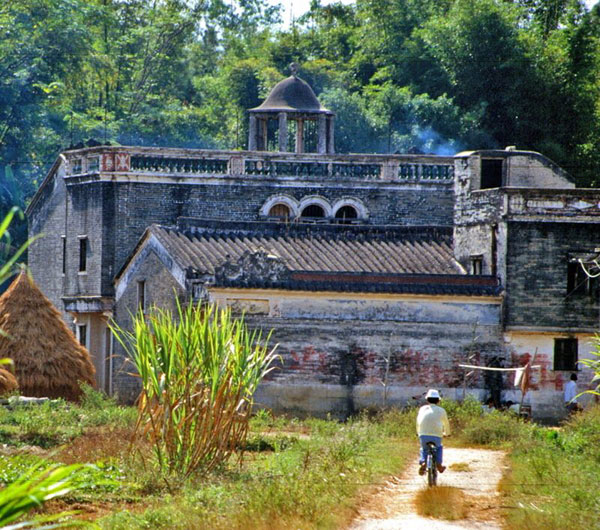
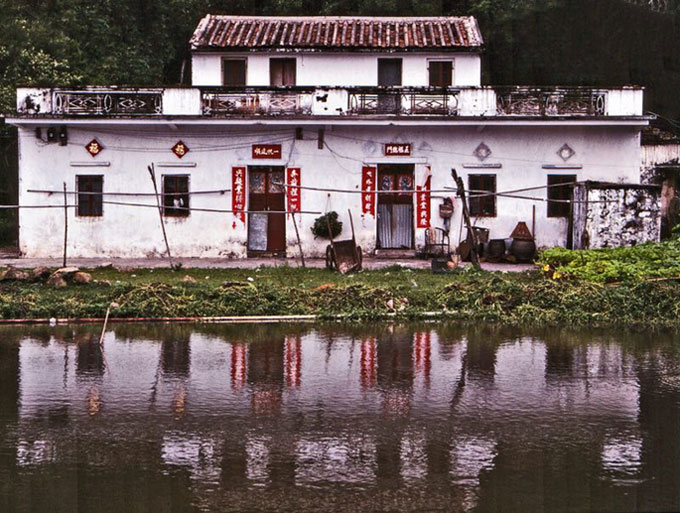
At last I got close to the countryside, cycling to nearby Fengqi village along quiet roads, avoiding scurrying chickens, passing fish ponds and pig enclosures. An initial impression was the relative size of the mainly two-floor dark brick houses and meeting halls. It was hard to age the buildings because the consistent humid tropical atmosphere would quickly darken exterior walls. Regularly I felt an Arabic influence in window design, something that had intrigued me in Taicheng, where I also saw Portuguese words on some buildings. Close to the sea, the area was influenced by movement along the Maritime Silk Road.
Not wasting land, buildings were close together with only narrow access passages between.
All so different from the UK, where farms were individual units. In China the village had evolved from a system where people would commonly share their labor during plowing and harvesting. Going inside the family home I smiled and thought how much larger it was compared to my former Scottish abode. Modern amenities, however, were few. Although televisions were increasingly common in 1993, phones were not, even within cities. People would go, for example, to a shop to make a call. Over recent years mobile technology has radically transformed that situation nationwide. Similarly, refrigeration was then a luxury few could afford. Consequently, chicken or fish for dinner would be brought, often by bicycle, live from a market. Having been brought up in the sanitized atmosphere of supermarkets this was something so different for me initially to accept, but it was a reality of rural life. Vegetables, including melons, peanuts and peppers, grew in bamboo-fenced plots behind the homes. Cooking was stir-frying, at high temperature, in a metal wok over a wood or straw-fired stove. Water was physically hauled up from a communal well to be carried inside, suspended from bamboo shoulder poles. People never complained, indeed there was a resilience I came to admire. However that was a quarter century ago. Returning over the years I noticed a steady improvement in rural living standards and amenities, partly through national/local governmental initiatives but also younger people moving to Guangdong's thriving cities sending money back. Then there were the 'Huaqiao' or overseas Chinese, who generously helped their kinfolk.
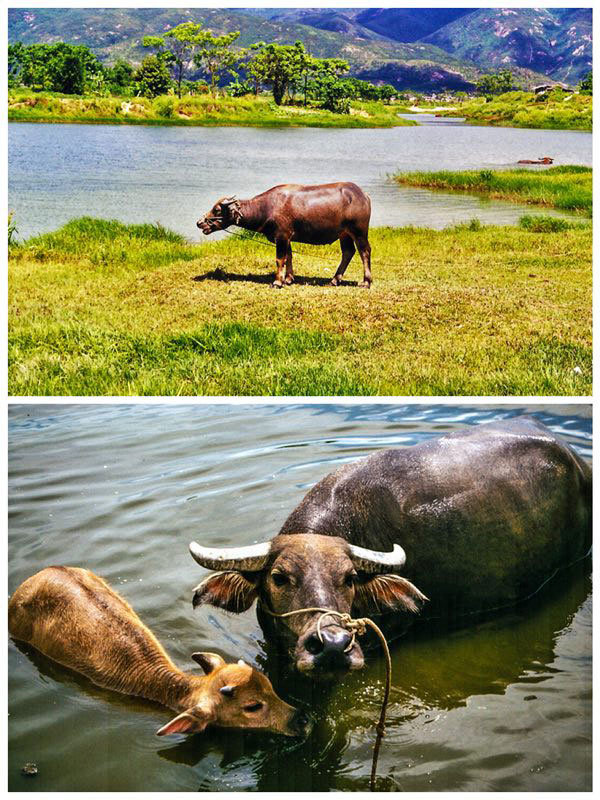
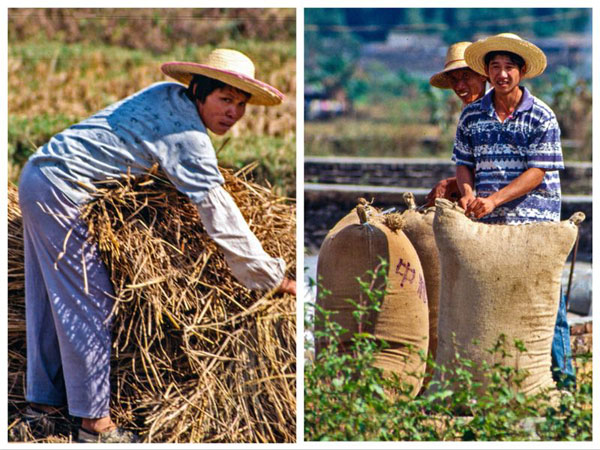
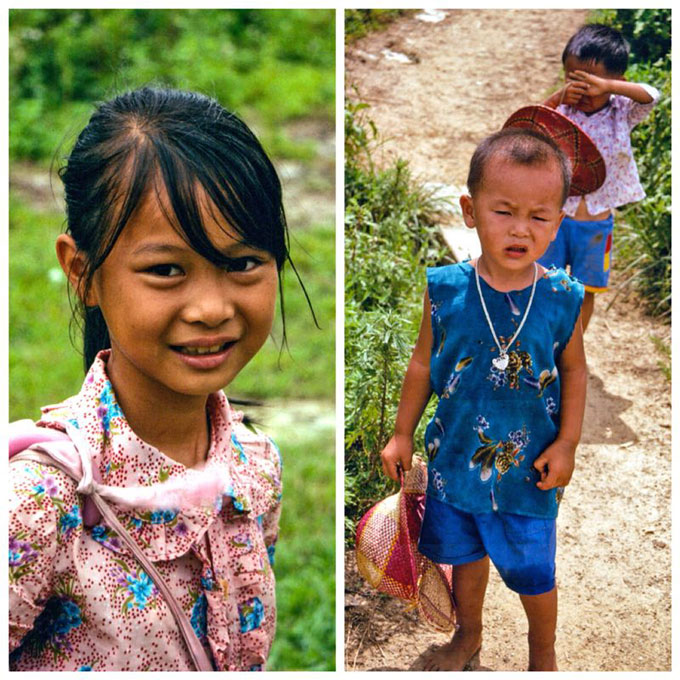
Meeting local farming families I increasingly appreciated how people's lives were intertwined with the land and its annual seasonal cycles. In southern Guangdong crops grow all year but in 1993 farming technology was intermediate. The buffalo was the 'beast of burden' pulling the plow, with entire families working together at busy times, squelching deep in the wet alluvial mud of the rice fields. In Scotland we loved to be out enjoying days of sunshine and blue skies but for China's farmers the sun beating down on their backs and necks was to be best avoided as they toiled bent down. Many wore woven bamboo hats. Light rain was a blessing, helping reduce heat effects. Some farmers worked barefoot. I asked about parasitic infections from snails or worms and also of snakes? Medical services were limited; although there might be village clinics, hospitals were in the cities - a problem in enticing highly qualified practitioners to work in the countryside.
Life felt traditional with a rhythm revolving around daylight hours. Apart from television there was little artificial entertainment. Social life was spent fishing at the river or around a small square shaded by trees where people would sit in the evenings chatting or playing musical instruments. On weekends, going into Sanhezhen for morning tea and shopping seemed popular.
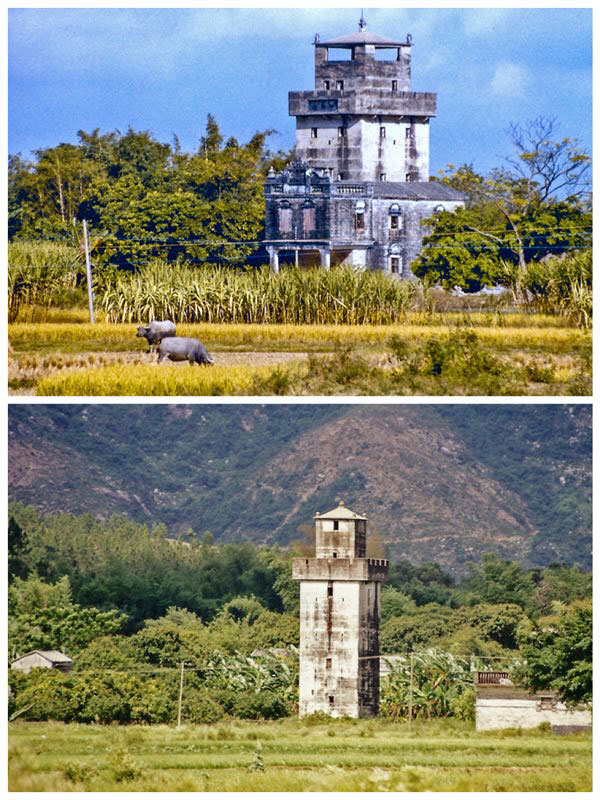
Marriage was often joyful, noisy and communal, with weddings involving the whole village gathering in the courtyard house of the family that the bride would be married into. Firecrackers blasted into the air as she was transported there, sometimes by blue truck! Every April, Qingming Festival, including sweeping ancestral tombs hidden amidst forested slopes above the rice fields, was an important occasion with many overseas Chinese returning to pay respect. I saw cars bringing family members back from the cities. Their money and generosity allowing villagers to construct modern homes, just as with earlier generations whose money earned in the US led to the rise of iconic 'diaolou' towers.
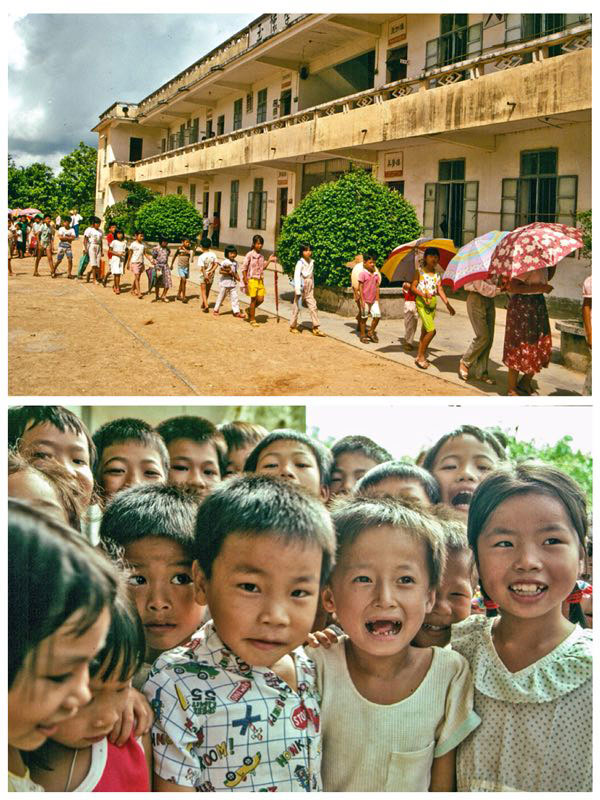
It was a joy to visit a rural elementary school, a lovely moment to come upon so many smiling, laughing children lining up to meet me as I went to their classrooms. Larger two-floor buildings had been constructed to serve clusters of villages replacing earlier, smaller and more localized structures. One such former school near Fengqi was being used as a day center for the elderly. The larger, better-equipped buildings, to which the children would walk every day, provided simple library, science, music and sports facilities.
Rural children would go on to a larger middle school, sometimes boarding. Increasingly through access to higher levels of education it would result in some children heading to Taicheng, Jiangmen or even Guangzhou. Exposed to 'bright urban lights' and a lifestyle quite different life to their parents, a reluctance to return to village life and a more conservative rural society, would inevitably set in. This movement away from the countryside consequently reduces the rural labor supply. In the early 1980s the Responsibility System, introduced by Deng Xiaoping as part of incentivizing agricultural production, was an important moment in both stimulating rural development while increasing food production. Before the relatively recent urban transformations, many village communities prospered. Today challenges facing the countryside are being partly met through consolidation agreements creating larger land units where mechanization and scientific farming methods can be applied.
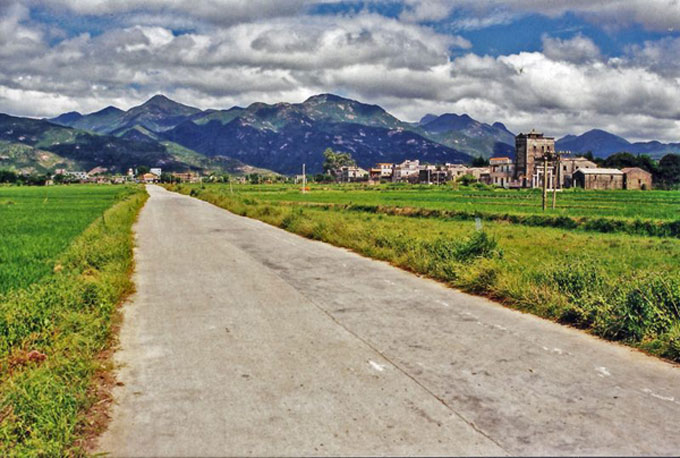
Rural road construction is now a national priority to improve access for villagers to markets and services. I remember in 1993 there would be one main highway from where off-road communities would be accessed by concrete or gravel tracks. People mostly used bicycles or three-wheel carts, although later visits showed growing small motorcycle usage. China today increasingly is a car-owning society that loves to travel. Improved road access can encourage local tourism through home stays, guesthouses offering rural experiences, and more. Around Wenchuancun fashionable hot spring resorts have opened, creating employment while stimulating economic growth.

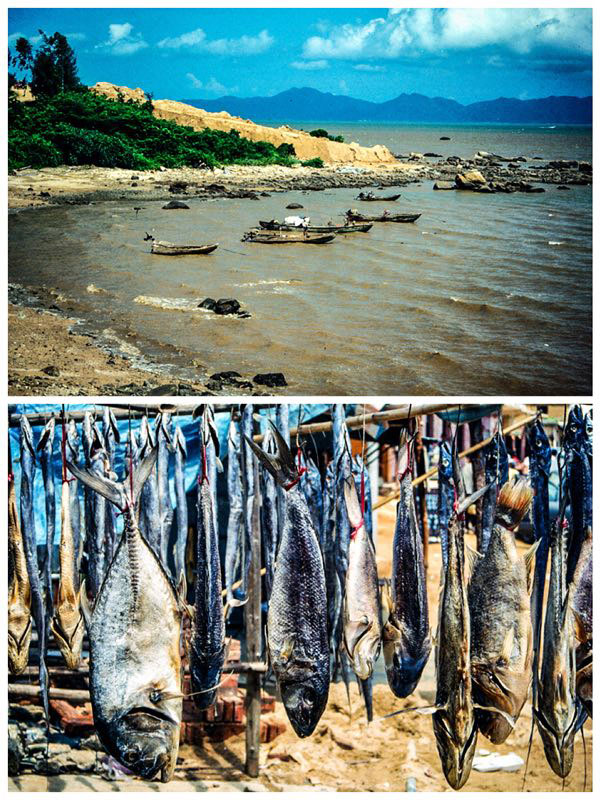
In recent years expressway construction has facilitated ease of access to Guanghai Port on the South China Sea. In 1993, small wooden boats brought in catches of fish to be dried on wooden frames around the town. Today tourist facilities have grown along the coast and on nearby Shangchuan and Xiachuan islands, accessed from Guanghai, providing peaceful retreats far from urban bustle.
Modern smartphone technology and online searching provides some insight into contemporary Taishan. While new highways have helped promote rural development, in Taicheng roads within the older historic area have been transformed into pedestrian streets. Modern hotels, shopping and dining experiences have opened. The area around Sanhezhen is much more developed from what I was introduced to in 1993, then a fascinating time to discover this part of southern Guangdong.