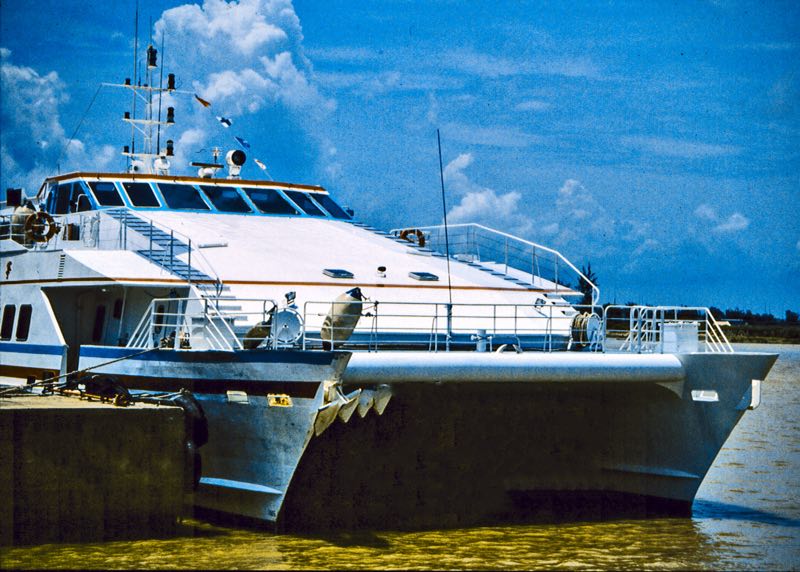
Catamaran 'Taishan' at Guanghai Port 1993. [Photo by Bruce Connolly/chinadaily.com.cn]
(Source: China Daily)
Experiencing the Greater Pearl River Delta during early years of development
By Bruce Connolly | chinadaily.com.cn | Updated: 2018-02-06 16:50
In the 1990's travelling to Guangzhou usually involved transiting through Hong Kong. Train, express bus or planes provided convenient onward connection. However, I regularly took a different approach-I travelled by boat! From Kowloon's Hong Kong China Ferry Terminal fast, sleek catamarans connected a myriad of towns scattered around the coasts, waterways and rivers of western Guangdong.
The vessel, "Taishan", would speed me for several hours across the Pearl River Estuary, passing Macau, several islands, rivers emptying into the South China Sea before berthing at Guanghai. A compact port, it was a popular entry/exit point for some of China's diaspora or "Huaqiao" (overseas Chinese). Over centuries the Delta was a major gateway from China to the world from where countless generations set off to live or develop business far removed from the countryside of south Guangdong.
My onward journey, by bus, passing rice fields, forested hills and seemingly timeless villages brought me to Taishan, or more appropriately Taicheng as the urban core is known. A small city at the heart of my China story, there I would immerse myself, relaxing in local tranquility before heading north to increasingly bustling Guangzhou.
The Pearl River Delta with its navigable tentacles connects vast swathes of southern China. It has long been at the heart of the country's economic growth. In 1987, the culmination of my railway journey from Scotland to Hong Kong was by train from Guangzhou. Initially passing intensive farmland, the scene dramatically transformed at strikingly modern Shenzhen. In '87 it was one of the pioneering special economic zones that would test radical models of reform and development. One result, capitalizing on what was then a vast supply of cheap labor, a corridor of manufacturing, spread back along the railway. Villages around today's Dongguan, for example, metamorphosed into an urban area of over eight million-part of a megacity now currently forming around the Delta with Guangzhou at the apex.
Initially urban growth and transformation across the western Delta was slower. There was no railway, roads needed upgrading and a reliance on water transport remained. Consequently settlements retained longer their earlier heritage, particularly architecture and traditional lifestyle. Over recent decades ongoing infrastructure projects such as intercity rail, expressways and many bridges, including soon to open Hong Kong to Zhuhai crossing, have considerably altered accessibility so boosting local economies.

My first incursion was in late August 1992 when colleagues in Guangzhou invited me to Jiangmen and nearby Xinhui located between the West and Xinyu Rivers. In '92 it was an introduction to lifestyles so different to my norms back in Scotland. Women drying tangerine peelings on quiet roads near a river where men squatted while playing cards: kindergarten children walking in line emerged from a park as we set off by small boat to explore mangrove forest swamps encroaching upon a bird island sanctuary. The geography of the area fascinated me-a level topography of fertile alluvium interspersed by hills that at one time were islands. I started to appreciate the relationship with multiple waterways. Although a benefit in the days of river-based commerce it would hinder development until the construction of a network of elevated highways swept over the channels.
Lying to the east of Jiangmen, Zhongshan has long been associated with one of modern China's great leaders, Dr Sun Yat-Sen, born on Nov 12, 1866, in nearby Cuiheng Village. In July 1993, heading south toward Zhuhai and Macau I spent time discovering Zhongshan's charms. The older city districts around busy Shiqi River featured examples of architecture I increasingly identified with southern Guangdong. Buildings built out and over pavements/sidewalks to protect against sun and rain.
I kept coming upon physical evidence of influence stemming from trade and movement along the fabled Maritime Silk Road. Kaiping sits alongside the Tanjiang River. Visiting Fengcai Middle School I was intrigued by architecture displaying possible Arabic influence. Rising in nearby counties were the amazing Diaolou Towers, resembling miniature fortified Manhattan skyscrapers built in some instances by people who had made their fortune in the US. Several such examples are also around Taishan, a city that would provide a positive introduction to the western delta geography, lifestyles, people and a city at the heart of China's historic outward migration.

Between 1992 and summer 1993 I had lived and worked at Guangdong Foreign Languages Normal School in suburban Guangzhou. I was there on a provincial governmental international exchange program. In late June '93, mentally "preparing" for my return to Scotland but within myself I wanted to explore more of China. Would I ever be back, I kept wondering? However, as I have often discovered in China, great moments do happen. I had been teaching graduate classes who were then packing up to go home when an invitation came my way. "Bruce, we know you really want to see China. Please come with us to Taishan for a few days?" "Where?" "Taishan near the South China Sea in a beautiful area west of the Delta."
A few days later, Linda Chen and her classmate Jessica were leading me to a Guangzhou bus station for a five-hour journey to Taishan. I discovered I was not staying within the city itself but in a large central village, Wencun ("hot springs"), surrounded by smaller agricultural communities including one where Linda had grown up. I had hardly been booked into a small guesthouse when a warning was issued. "Typhoon is coming!" An exciting introduction to rural coastal Guangdong life! Cities such as Taishan have located far back from the coastline partly because of a recurring typhoon danger alongside earlier threats of piracy.
Taishan was a community I quickly appreciated not least for its relaxing, almost sublime, atmosphere, to me it was therapeutic. It had also retained so much of its heritage. People seemingly apologetic would say, "Oh but it is old" to which I would reply, trying to look "astonished" and say, "It is wonderful. Please do not change it!" This was at a time when China was changing, when there was little concept of preserving the past and everything should look modern. Those days have thankfully changed.

Regularly I would walk the iconic "Sino-Portuguese" commercial streets of older Taishan, constantly fascinated with what my friends saw as "everyday". We would climb the hills surrounding the city where tea bushes grew, visit temples hidden on the slopes or retreat to a lakeside teahouse enjoying its soporific tranquility - the sun setting over the waters surrounded by palm trees limp in the sultry air. This was a China I grew to love.
It was in Taishan I increasingly appreciated the linguistic diversities of China and why Standard Chinese, "putonghua", is so strongly encouraged nationwide. Taishan City has its unique Taishanese dialect, part of the Yue linguistic branch of Chinese that includes Cantonese. Until recently it was the form of Chinese most commonly heard in American cities such as San Francisco. Beyond the urban fringes, putonghua was little understood as I discovered waving down a rural bus and explaining I wanted to go Taishan, Taicheng, Toishan or even Hoisan (Taishanese)! Indeed there could even be linguistic differences between neighbouring villages. I did eventually reach the city, went into a cafe and ordered "gali ji rou fan" (curried chicken rice) in putonghua, no problem!
A reason Taishanese was common in the US it was one of the "Four Counties" ("sze yup" in Cantonese, "siyi" in Putonghua) that included Xinhui, Kaiping, Enping and Taishan, all within Jiangmen prefecture. In the 19th and early 20th century, this area witnessed sizeable emigration to the US, Canada and Australia. Some went to labor in the California gold fields or transcontinental railway construction. Working with Radio Beijing, during annual Australian Writers Weeks, I would interview Australians who traced their backgrounds to Taishan or Zhongshan. We shared our mutual fascinations. Today of course people from across China have migrated internationally with Putonghua now widely heard.

Taishan has a museum focusing on its position as "Home of Overseas Chinese". Estimates vary of what percentage Chinese in the US could claim Taishan ancestry, but certainly considerable. Many have risen to different levels of prominence with American political, cultural, business and social life. Often "huaqiao" return, not just retracing family roots, but supporting many causes within both urban and surrounding areas. Education throughout the Four Counties has profited considerably from their donations, sometimes in the creation of well equipped private schools but also helping local state establishments with building projects.
Taishan Yi Zhong (No1 Middle School) has long been regarded as an institute of excellence within Guangdong. A beautiful campus with almost classical-styled buildings, it has also benefited from overseas donors, for example with swimming and other facilities. It was both an honor and fun to be regularly invited to meet staff members and students while giving lessons. Asking the youngsters, in English, their ambitions, the reply could be "I want to go to America!" "What? Why?" Because Taishan people have large diasporas both in North America and Australia, and it was a tradition that many people in the 1990's still aspired to. Jokingly I would say, "OK. You go to America and I come to live here!" "You come here?" was the bemused reply. "Yes because I think this city is great!" Following tradition, Linda, her family and others I got to know in Taishan moved to America and have settled into Californian life. However, I still have not forgotten their kindness in introducing me to a city and area I would never had known but for them. Taishan remains in my heart to this day, having played an important role in generating my ongoing passion for China.
Later we would experience the countryside but that is another story.


