(Source: China Daily)
Guangdong's spectacular growth in the early 1990's was mostly around the Pearl River Delta, but infrastructure development was also starting to open up a very different landscape, the remote, mountainous interior, as Bruce Connolly was to discover.
In the early years of China's 'Opening Up' Guangdong with its Special Economic Zones and preferential policies was, and still is, an economic powerhouse driving forward China's Growth. Activity was centred around the Pearl River Delta close to Hong Kong. Guangzhou, at the delta's apex, was my home from 1992-93. An exciting time to be in the city but I was increasingly aware that there was much more to Guangdong beyond internationalising cities. As a geographer, a traveller, I was anxious to explore but infrastructure was not there for solo foreigners. However, as often happens in China, good fortune struck. An unexpected phone call, a friend knowing my desire to travel, was returning home for the summer. "Would I like to come to Lianxian?" "Where?" "Lianxian, in the mountains of northern Guangdong, between Guangxi and Hunan." "When?" "Tomorrow. Be ready at 7.30am. We will pick you up!" I had not even time to think when I mumbled "OK. Thanks."
Lianxian, today know as Lianzhou, there was no information in my guidebooks while asking around all I could discover was, "Remote. Far away. Poor, underdeveloped. Be careful!" Nobody seemed to have been there except my friend, her hometown.
Next morning I was in a car with several others as we headed north from Guangzhou towards Qingyuan for lunch aboard a floating restaurant on the North River (beijiang). I would be thankful for that meal as it would be a long time before eating again for an unexpectedly arduous journey awaited.
The low lying plains soon gave way to a steeply rising mountainous landscape peppered with lakes and rivers. As we headed up so trucks coming downhill were loaded with livestock to satisfy the ever growing demands of Guangzhou. A new highway to facilitate the area's move away from remoteness while stimulating investment was under construction. This a feature I remember clearly of Guangdong at that time, creating a modern infrastructure. Good roads while reducing journey time improve accessibility so helping commerce including tourism, hopefully lifting people out of rural poverty. Looking at maps and satellite images on a smartphone today clearly illustrates the considerable level of modern facilities including expressway connectivity now around Lianxian.
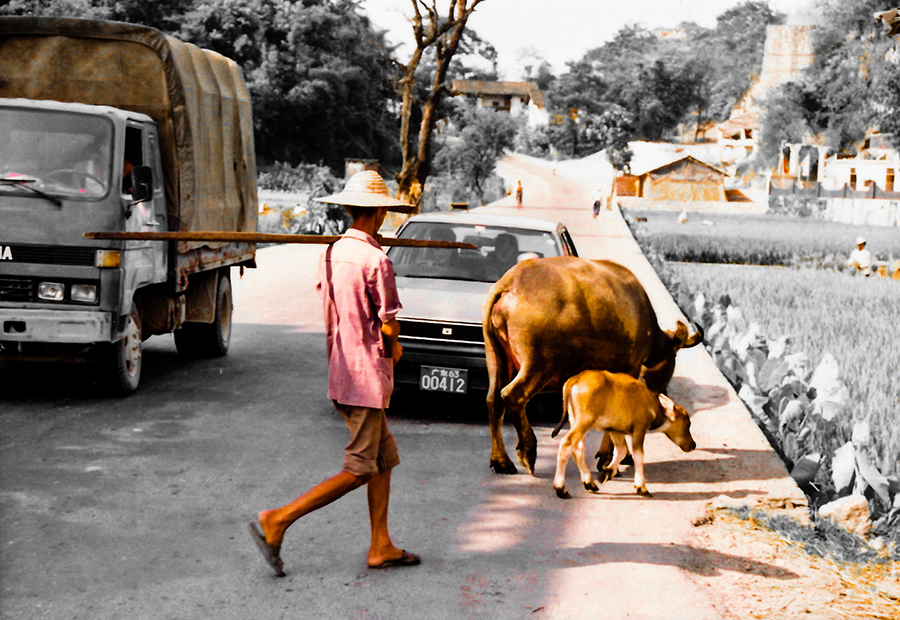
In 1993, with the highway construction underway, often only one lane was open, resulting in stop, go, forward, reverse while following earthen unpaved diversions. Where there were traffic bottlenecks entrepreneurial locals had set up food and drinks stalls!The drive did however provide an opportunity to observe the natural, seemingly timeless beauty of the area, where buffaloes pulled ploughs while small 'tuk-tuk' carts moved between villages surrounded by golden fields of maturing rice overlooked by forested steep slopes. Particularly scenic in the setting sun we were however still a long, long way from Lianxian.
The route continued higher with new tunnels avoiding high passes although where construction was not complete the old road crawled round a series of hairpin bends precariously perched above sheer drops. As the highway started loosing altitude so villages increased in frequency. We pulled up at a roadside restaurant around midnight before reaching Lianxian at 4.00am. I collapsed onto my bed, rising four hours later!
I ate healthily in Lianxian with much fresh produce from the surrounding countryside. Breakfasts of local breads and rice porridge at open-fronted diners were opportunities to observe a regular movement of people in dark blue ethnic costumes; women supporting infants in back carriers. The Yao nationality populate the upland regions of central southern China. Lianxian with its mountainous backdrop was appearing fascinating, very fascinating. Apart from bicycles and 'tuk-tuks' laden with farm produce it felt very quiet but ideal for walking.
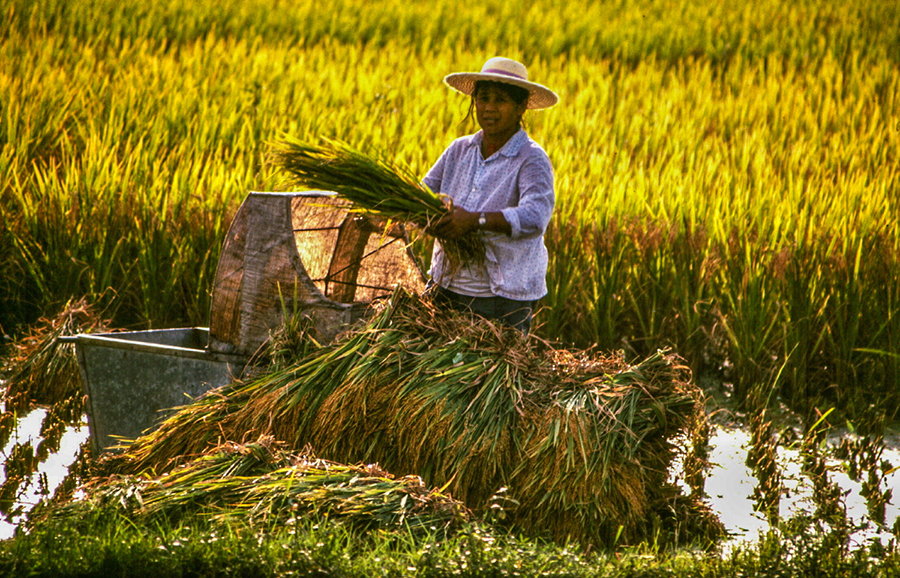
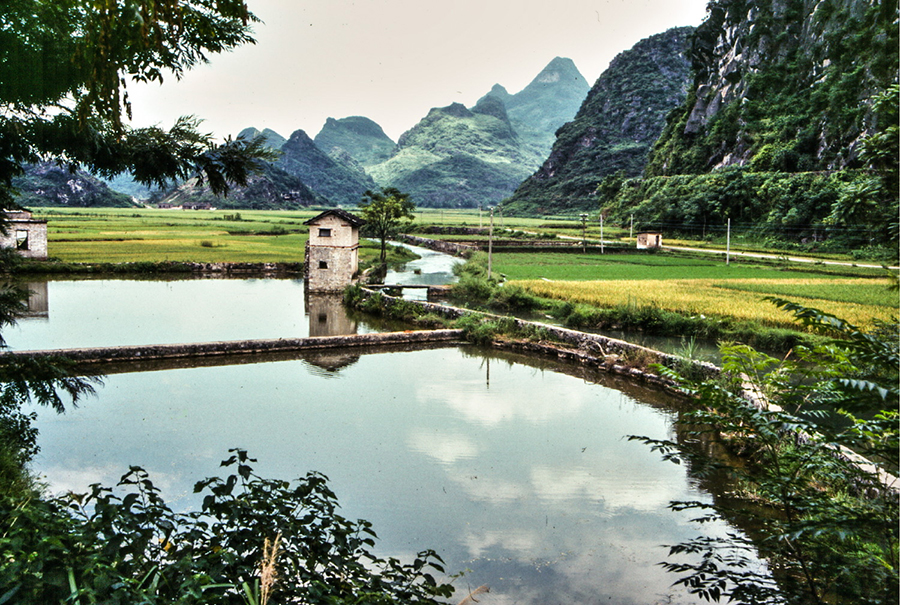
Several rivers merge at Lianxian resulting in any journey out from town following valleys buzzing with agricultural activity. Golden yellow predominated with mature rice stocks being harvested and threshed inside wooden, pedal powered, boxes. The discarded straw thrown forward for collection and used as cooking fuel. Men stood in the rivers casting fishing nets. Buffaloes grazed on the grassy banks or pulled ploughs preparing land for fresh seed sowing or transplanting. Small villages alongside bustling fish ponds were numerous. Melons piled alongside country roads where Yao women shaded themselves with unique black umbrellas.
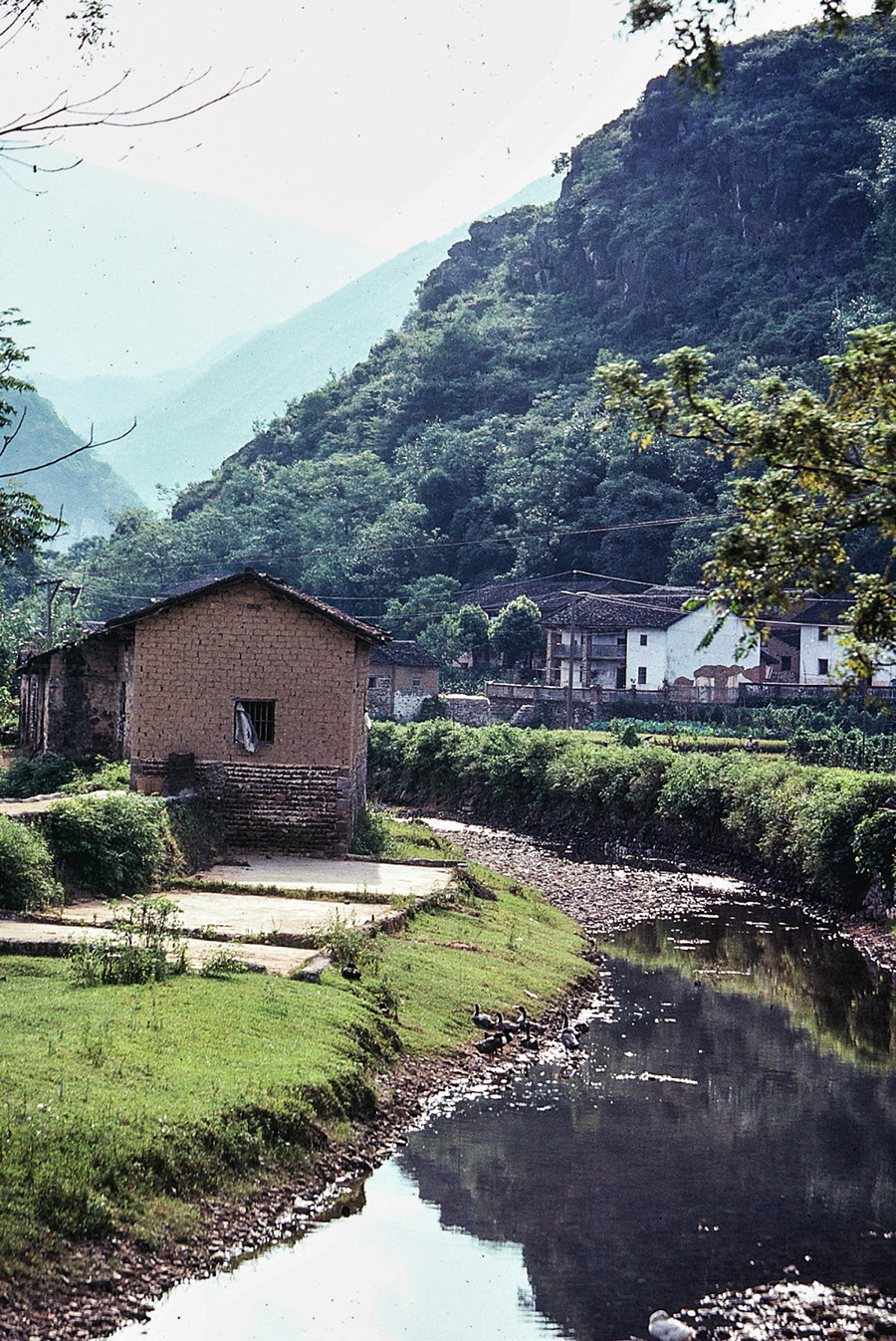
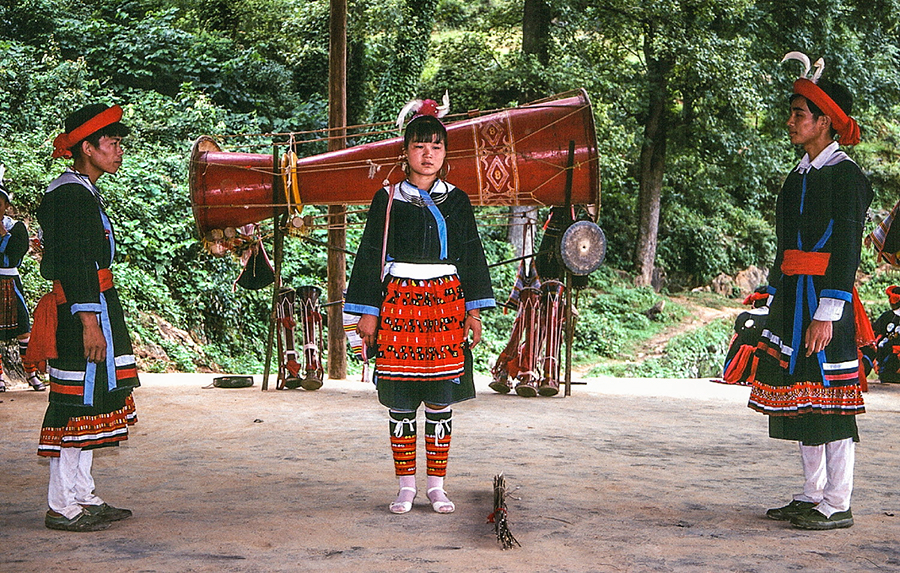
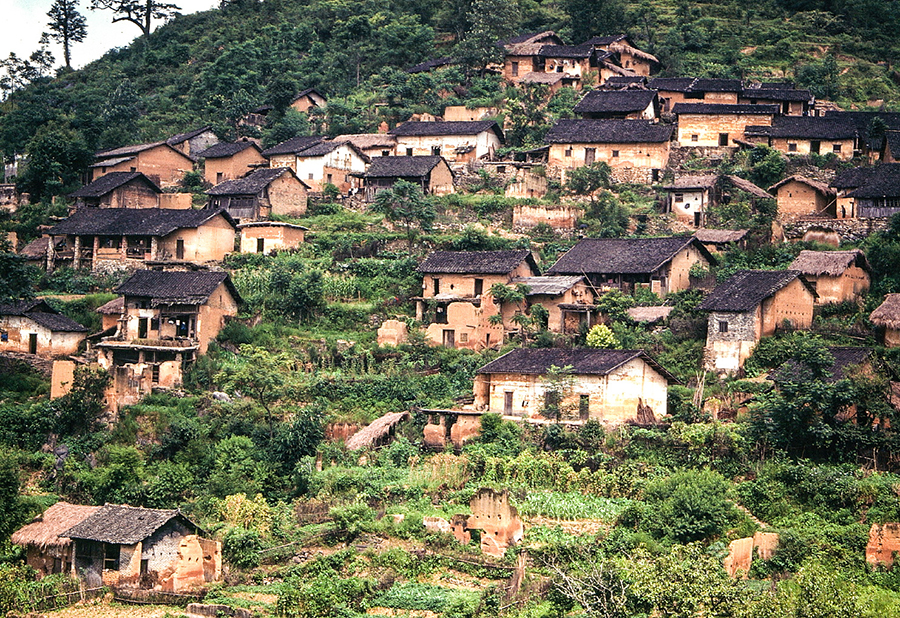
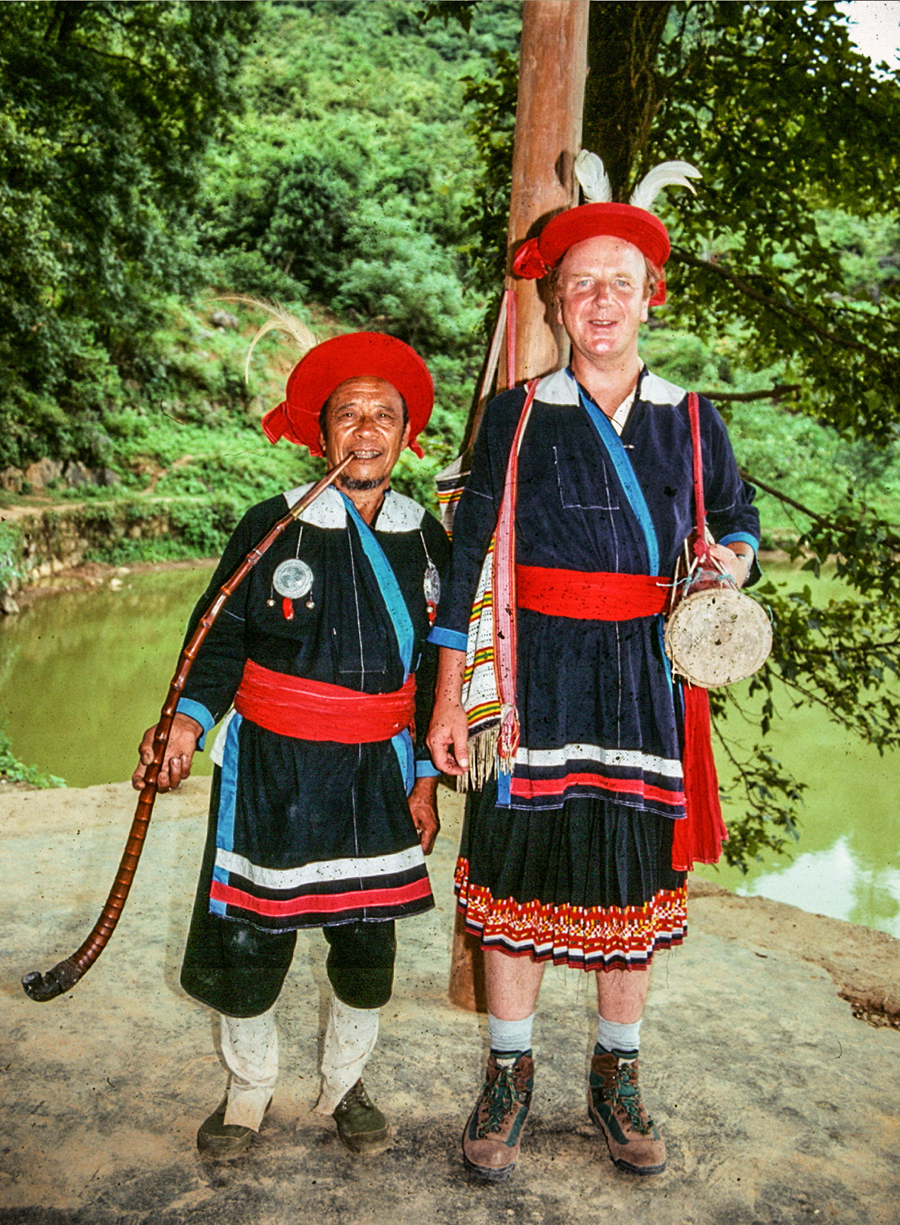
Within a limestone landscape reminiscent of Guilin I was driven along a narrow winding road with adobe built villages climbing the slopes - any patch of level land was cultivated, grain was spread out to dry. Walking onwards from the road end we came towards a larger village accessed by a path across a small dam. Children played around a pond where buffaloes wallowed. I was received by the village leader, wearing a red turban-like headgear while smoking a long bamboo pipe. Strong liquor served in a metal bowl is a traditional welcome before being invited to sit within an open-fronted meeting area facing the pond. To my surprise gunpowder exploded. Girls and boys in ornate black and red ceremonial costume, with white or red lower leg gaiters, emerged to bang large drums, play wind instruments while performing Yao traditional songs. At the end of the ceremony I was invited to dress in Yao ceremonial costume for photographs beside the village head. Many bemused villagers came to watch. Was I the first foreign visitor to their village? It certainly felt very far removed from my daily life back in Guangzhou!
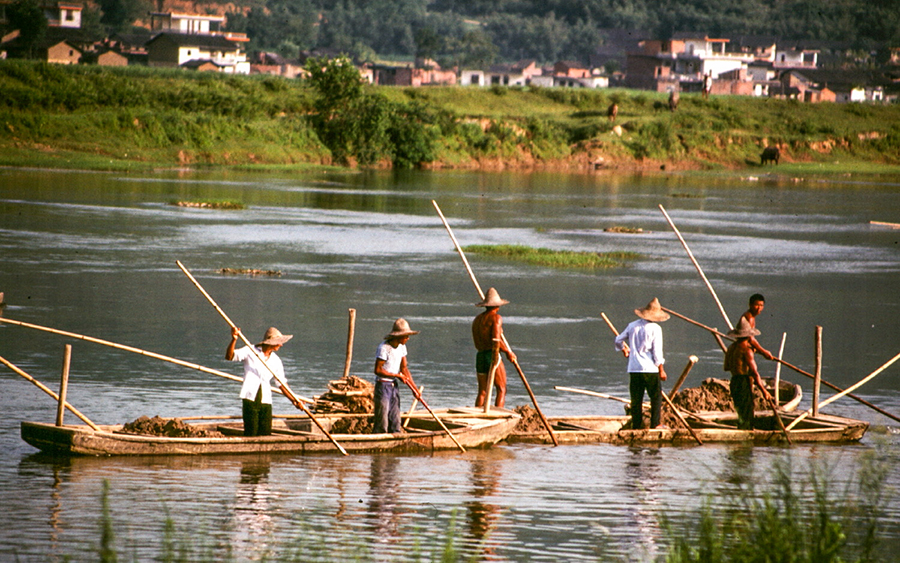
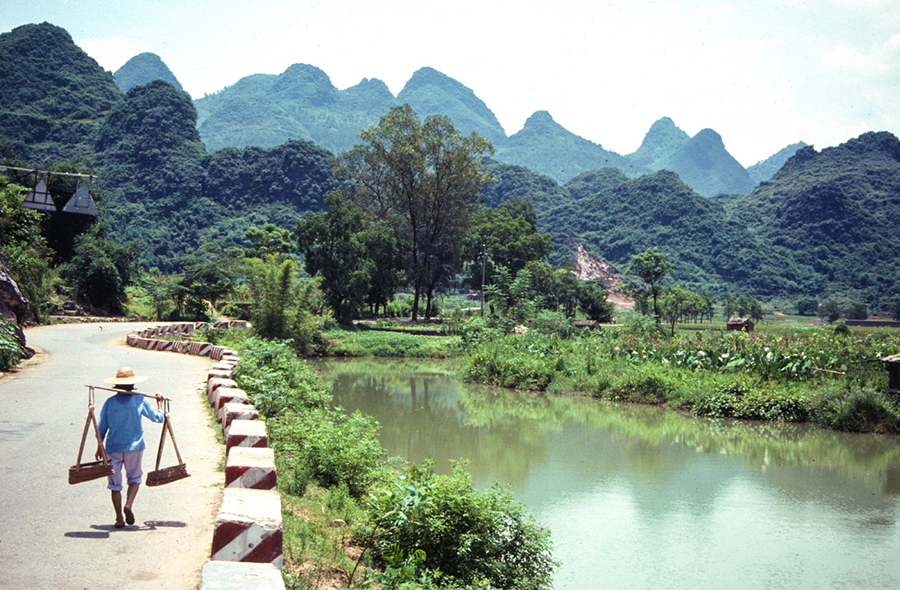
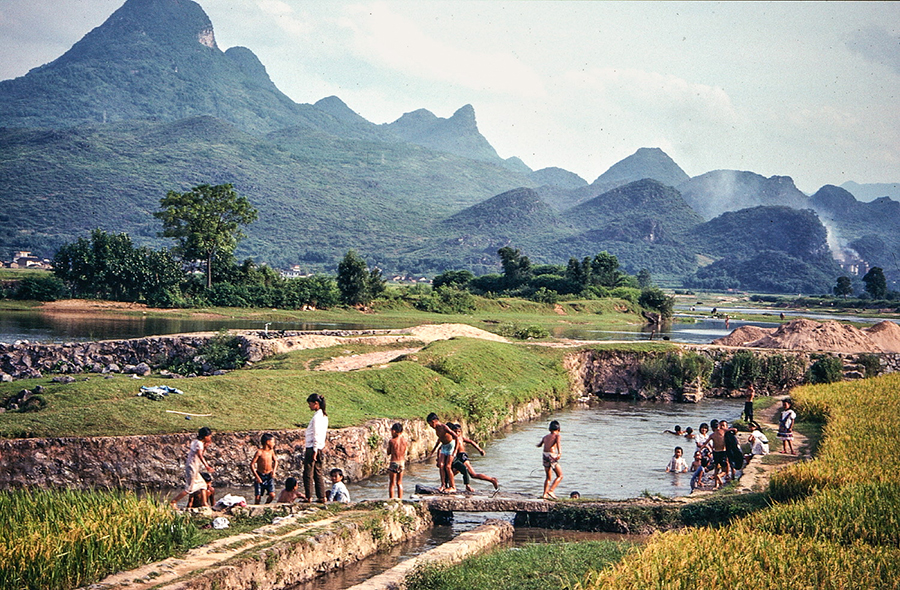
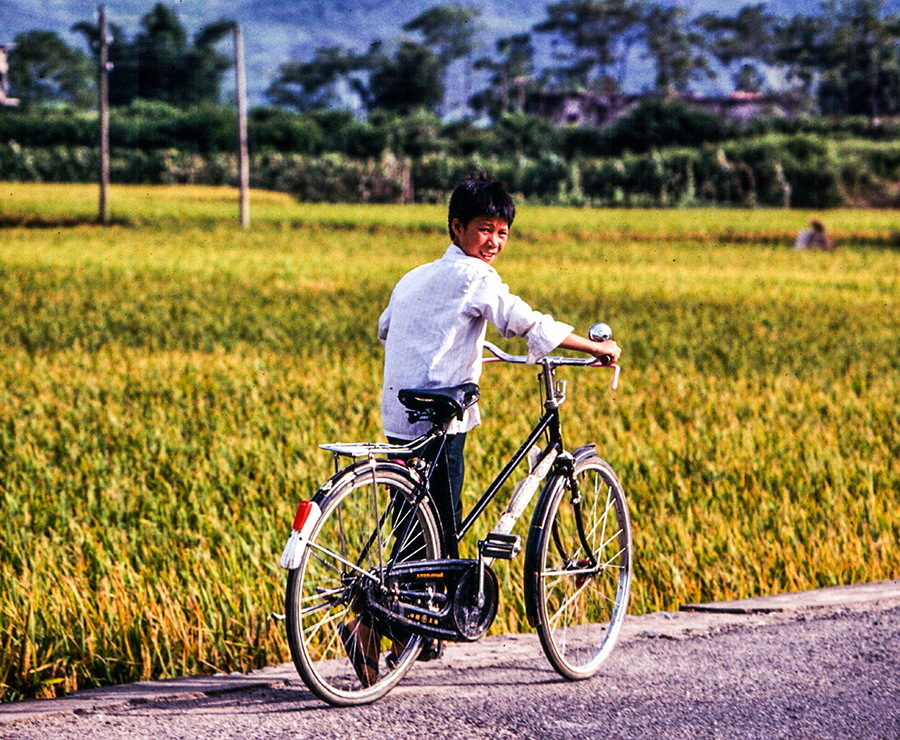
As we walked down between the fields I felt reluctant to leave. Indeed back in the car speeding towards Lianxian, thinking I may never pass this way again, I cried "Stop please" and to universal amazement got out and started along the riverside road. Scenery so breathtaking I almost ran out of film! Rivers emerged from caves below limestone pinnacles. Passing through villages, progressing past maturing rice fields, people cycled or pushed bicycles, stopping in surprise at seeing me. Ducks paddled beside bamboo-walled restaurants overlooking the waters. Gravel paths led to remoter villages tucked onto the sides of jagged hills. Men in low boats scooped up river alluvium to spread onto fields while children escaping summer's heat played in irrigation canals Some shyly said "Hello" before running away! Deviating from the road to follow riverbank paths sometimes I had to wade through the shallows passing men casually fishing. A tractor pulled up, the driver offering me a lift back to town, to his surprise I declined! I would rather walk behind farmers herding buffaloes along the virtually traffic-free highway. Weather was glorious, cooler and less humid than Guangzhou. The jagged mountainous backdrop was bathed increasingly in late afternoonsoft sunlight. With the area so incredibly photogenic, stopping repeatedly, it seemingly took hours to reach Lianxian.

I had not been the first to be captured by the sheer natural beauty. It was noted by poets such as Liu Yuxi and intellectuals including Han You who wrote about the area's landscape in 'Yanxiting Ji'. Qu Dajun in late Ming Dynasty explored the gorges of the Lingnan area described in 'Guangdong Xinyu'.
Exploration can also below ground. From a small countryside car park a rickety chain bridge led to the entrance of a massive cave system. The 1500 metres long Lianzhou Underground River, known as 'The First Underground River in Guangdong Province', actually flows through four mountains . A walkway lit by many coloured fluorescent lights led down to a boat dock. While navigating a wooden rowing vessel our guide, to a background of crashing water, pointed out curious stalactites and stalagmites, their names and legends. For me, a fascinating experience as in an earlier life as a geographer, teaching about karst or limestone topography was a passion. Narrow passageways connected three large caverns. At one point the guide lay on his back, propelling the boat by his feet along the tunnel roof! Emerging from the caves by a long series of steps there were again stunning views of peaks, rivers, farming, villages. Heading back to Lianxian I was totally transfixed by this rural landscape, its human interactions and of course wanted to walk!
A joy was to be invited home for dinner with a local family - an experience I really appreciated during those early days in China. It is certainly true that I owe gratitude to the friendship and help given to me by many Chinese people introducing many aspects of their country. Something I could never have discovered by myself, particularly Lianxian.
It was delightful that my final evening should be on a floating bamboo restaurant on the Lianjiang, having local noodles and drinks with the music of Priscilla Chan playing in the background. Utter tranquility, it could have been a real pleasure to stay longer in Lianxian but another long mountainous drive to Shaoguan lay ahead.