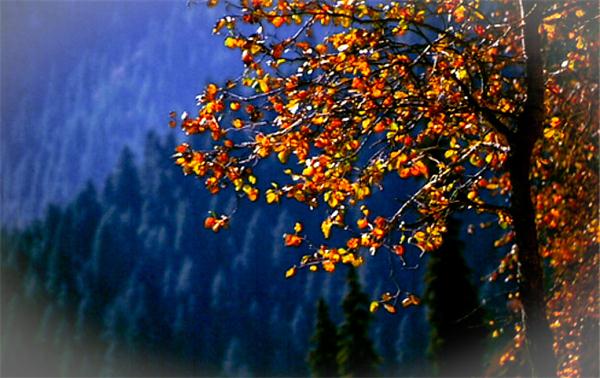
(Source: China Daily)
Journey to the Lake of Heaven
By Bruce Connolly | chinadaily.com.cn | Updated: 2017-10-11 07:39
In 1987 my China experience amounted to a corridor of land north to south along a railway via Beijing to Hong Kong. That year I also had come upon a photo of a lake surrounded by glacial mountains. The caption indicated Northwest China but to me it more resembled Switzerland or western Canada. It was the 'Lake of Heaven' (Tianchi) in Xinjiang and it was instantly added to my 'must visit' list, an achievement not fulfilled until Oct 1, 1997.
An early assumption had been that far western China was desert, such as the Taklamakan. Much of Xinjiang is indeed an extreme, often waterless environment with settlement generally restricted to oases and irrigated areas. However part of the region lies within a major geologically active zone. Plate tectonics, where the Earth's structural plates collide, have pushed up extensive fold mountain ranges across much of Central Asia, including Northwest China. Such high altitudes have colder temperatures, encouraging condensation of atmospheric moisture to fall as snow, accumulating into ice fields from which glaciers emerge. Meltwater flows from the ice to surrounding semi-arid lowlands, allowing intensive farming, such as on the slopes of Tianshan, the Mountains of Heaven. Xinjiang is famed for its fruits, including grapes. Its melons are renowned.

The Lake of Heaven occupies much of a high valley nestling below ice-covered, 5,445 meters high Bogda Feng - part of the eastern extension of Tianshan. Near the lake, within a broad pass through the mountain ranges, sits Urumqi, capital of Xinjiang Uyghur autonomous region.
In late September 1997 I was on a train traveling along the Hexi Corridor from Lanzhou in Gansu to Urumqi - a route roughly following the fabled Northern Silk Road and today a major element within China's Belt and Road Initiative. As we rolled northwest I was increasingly struck by the sheer harshness of the landscape: the dryness, the lack of green and practically no settlement except around large oasis towns, such as Hami. Roughly, only 10% of Xinjiang can support human habitation. Oases were at the heart of the early trade routes. Places such as Turpan, which I would later visit, create fascinating travel experiences.
It was still dark at 6:45 am when the train pulled into Urumqi. It's a place that is farther from the sea than any other world city and right at the heart of the Eurasian continental mass. Like everywhere in China it follows Beijing time and being so far west, results in dark mornings but beautiful long sunny summer evenings. Urumqi effectively is a higher altitude oasis fed from the waters of the Tianshan, its name implying "beautiful pasture". Earlier a Silk Road staging post, today it is a gateway to the Lake of Heaven roughly two hours away. Most travelers pass through Urumqi, either heading straight to the lake or to fabled oasis settlements. I ended up spending a week in the city in 1997, finding it one of the most fascinating I had been to in China.
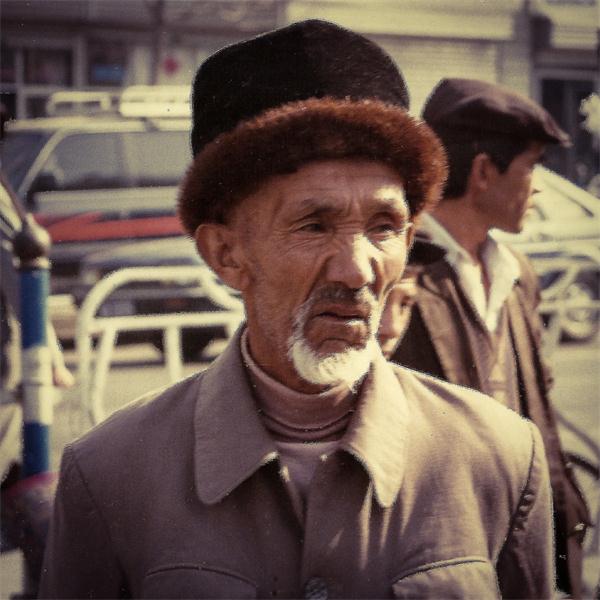
Despite considerable suburban industrialization, downtown was transforming into a modern, high-rise commercial center reflecting its geographically important trading connections. However, it was not the contemporary city that kept me fascinated but more the fact that Urumqi and its vicinity is home to 49 different ethnic groups, again reflecting its location at a crossroads between China and Central Asia. While the Uyghur are the largest of such nationalities, there are significant populations of Hui and Kazakhs, along with smaller groups of Kyrgyz, Uzbek and more.
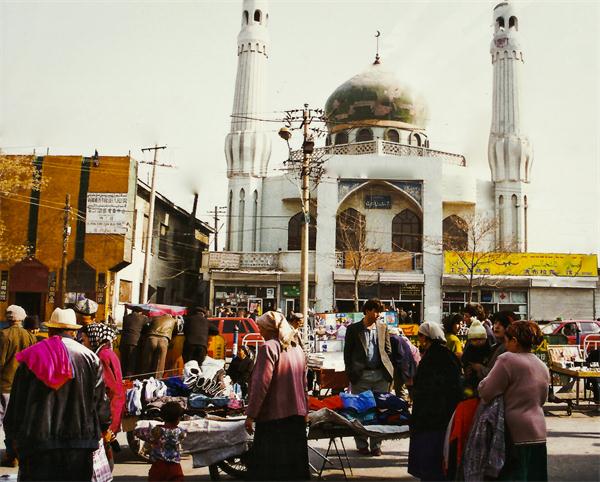
South of downtown lies Erdaoqiao Bazaar, or market. With a history stretching over 130 years, it started as a transit hub for goods brought by camel or packhorse from across Xinjiang and neighboring countries. In 1982 it was remodeled into a single-storey commercial hall with over 600 stores selling an incredible range of local products - providing an opportunity to experience some of the ethnic culture and traditions of Xinjiang. Erdaoqiao for the traveler, the photographer and the writer offered colors, aromas, sights, sounds and music, all with the buzz of a vibrant bazaar. A major outlet for silk fabrics, carpets and dried fruits, along with craft specialties such as Hoton jade, distinctive jewel-encrusted knives, teapots, leather jackets and long black boots. Countless food stalls, stacked with large nan breads, were places to sit and have some snacks or drinks while watching the scene. People with a bewildering mix of languages or dialects wearing bright costumes and distinctive hats or headgear would walk past, some stopping to offer greetings, occasionally in English. I had many happy, indeed unforgettable, moments there. Amusingly there was an advert, :Drink Xinjiang Beer and make friends with the world"! That worked for me at Erdaoqiao! Although it continues to operate, in 2003 a vast International Bazaar, aimed more at tourists, opened nearby.
When not visiting the market, parks in autumn colors provided quiet relaxation. A walk up Hongshan (Red Hill) with its pagoda gave views across the city. Museums showed the relationship to the Silk Road, along with some mummified archaeological discoveries. Evening street food stalls offered a range of delicious food, from Sichuan to Dongbei and of course, Xinjiang specialties, including traditional spicy barbecued lamb on sticks!! There was no chance to go hungry!
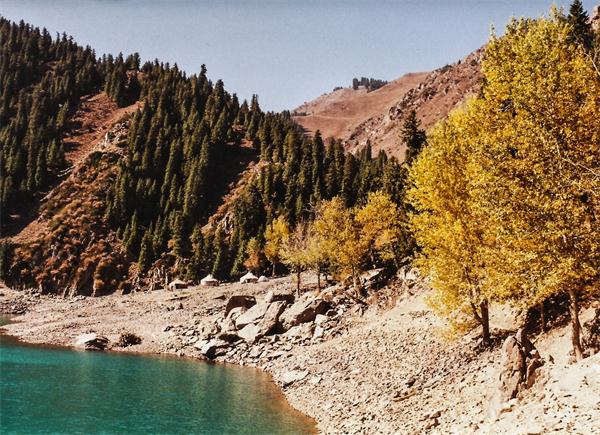
It was National Day 1997 - but not the mass public holiday seen today. From the gates of Renmin Park buses headed to the Lake of Heaven. initially going through industrial and irrigated farmland to Fukang, before turning south and heading uphill. Very quickly the land changed from gravelly, semi-desert to green pastures and increasingly upland forest, through which streams and rivers descended. The road climbed steeply through a rocky gorge, although the lake could not be seen until walking beyond the coach park. Heading through the forest a breathtaking scene started to extend before me. Glimmering in the sunshine and enclosed by steep forested slopes, Tianchi stretched towards the foot of Bogda Feng.
Initially I walked to where the waters cascaded from the lake over rocks before plunging down through the trees - a beautiful scene coupled with the aroma of pine forest. Crossing a nearby grassland, Kazakh horsemen rode up to greet me as I moved towards an outdoor restaurant. It was an hour's pleasure looking across the lake while consuming bowls of spicy noodles while literally in heaven!
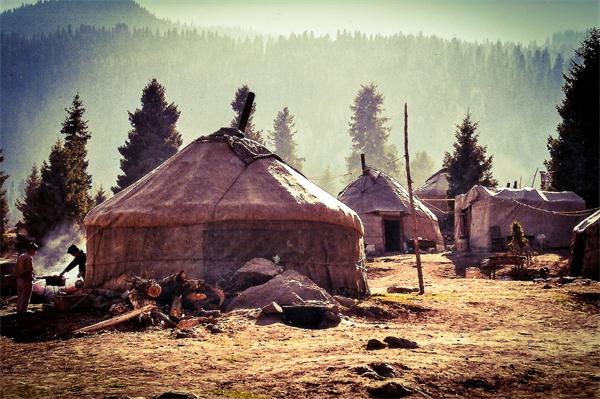
Slopes led up to encampments of circular tents. Originally campgrounds for herders who moved their sheep up to these high summer pastures, some were now for visitors to overnight beside the lake while enjoying locally prepared dinners.
Horsemen continually rode around as I returned to the bus while looking back towards the head of the lake with so much beauty remaining to be explored.
Two days later I was back! Setting off again from the bus park, I kept looking along the lake and thinking of its similarity to others I had experienced back in Scotland, my homeland. During historically colder periods glaciers would have descended from Bogda Feng and surrounding peaks, gouging out a deep trench that today is water filled.
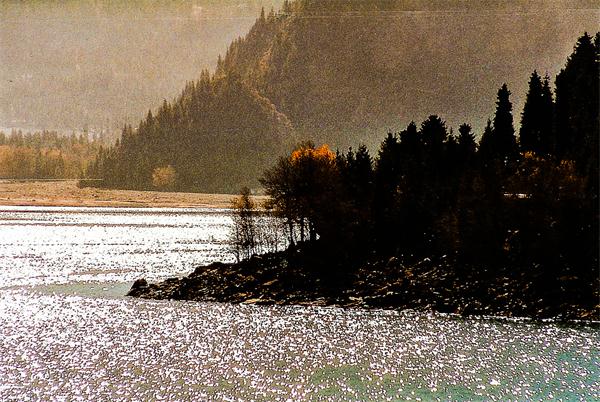
Walking beyond a hotel construction, 20 years ago tourism was still in its infancy; I was alone, with no map. In physically beautiful areas I appreciate solitude. A path along the water's edge turned out not to be the main trail for I was soon scrambling up steep rock faces and along narrow ledges with drops down to the lake. There were no people on my path but looking up there were occasionally some following a higher route through the forest.
Where there were bays, there were more circular tents, with smoke rising from wood fired stoves. Under a beautiful blue sky I eventually reached the head of the lake while looking up to shimmering ice fields on Bogda Feng. It was a textbook glacial scene with a meltwater river braiding into many shallow channels before depositing gravel and sediment into the calm, blue waters.

It was a surreal feeling being alone, beside this lake in a stunning alpine setting and knowing the desert to be so close. This was something I later appreciated flying across Xinjiang heading back to Europe from Hong Kong, passing just north of the mountains and the lake.
But it was time to head back along the safer horse trail to the bus park for Urumqi. In the evening, sitting at an outdoor cafe, writing up my diary, an ambition had been fulfilled - the "Journey to the Lake of Heaven" - but a new adventure was waiting, to one of the world's lowest-lying towns south of the Heavenly Mountains.