(Source: China Daily)
Hainan – China's tropical island destination
By Bruce Connolly | chinadaily.com.cn | Updated: 2017-09-28 07:14
Over the upcoming 'Golden Week' Hainan will attract many holidaymakers. Twenty-four years ago, it was a very different island, with tourism in its infancy.
Train Z201 departs Beijing daily at 5:54 pm, heading south towards western Guangdong before being transported by a dedicated ferry across the Qiongzhou Straight to Hainan Island. Thirty hours after departure, hopefully with the sun rising over the South China Sea, it rolls into Sanya, a tropical city located on the island's southern tip. In January 1993 that option was not available! While living in Guangzhou, Hainan often came up in conversation. It had been administered by Guangdong until 1988 with a close relationship persisting through family and commercial connections. Fascinated, I decided to give it a try, but getting there?
It was possible to fly to Haikou, the provincial capital, but for the adventurous traveler there was another option – boat! A mixed cargo/passenger vessel followed the busy Pearl River for several hours before emerging onto the extensive, wide estuary between Hong Kong and Macao. Overnight the ship skirted Guangdong's southern coast, berthing mid-morning at Haikou's port. In the bay many vessels lay at anchor waiting to enter this gateway to an island intriguingly referred to then as 'China's Hawaii'. Today Haikou continues expanding its port functions with container handling, playing a significant role in China's contemporary Belt and Road Initiative.
Haikou, literally, 'Mouth of the Sea', was a key staging point along the Maritime Silk Road from Europe, the Middle East and on through southeastern Asia to a string of ports, including Fujian's Quanzhou, even influencing Zhejiang and beyond. Maritime commerce led to cultural interaction resulting in a fusion of architecture, food, lifestyles and language.

Haikou's original harbour partly developed along sheltered Haidian River, a branch of the Nandu between Haidian Island to the north and present day Longhua and Meilan districts. In 1993 it was like stepping back in time. From moored wooden sailing vessels great clay pots of pickled vegetables were unloaded. Boatyards still maintained and even constructed such ships which for centuries had been the mainstay of coastal maritime commerce.
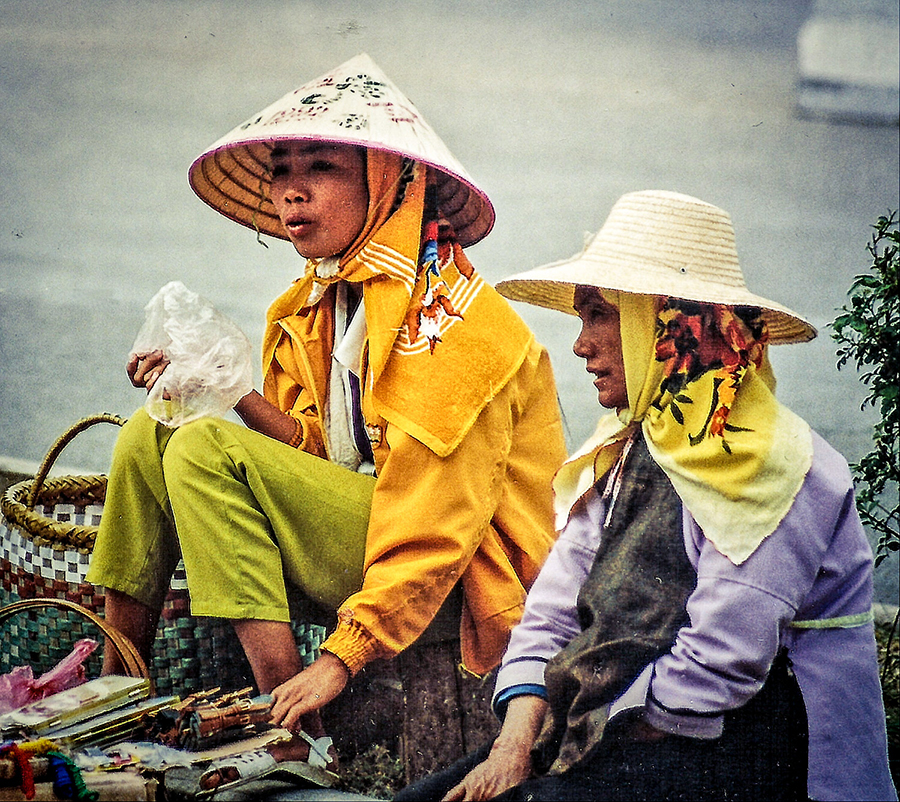
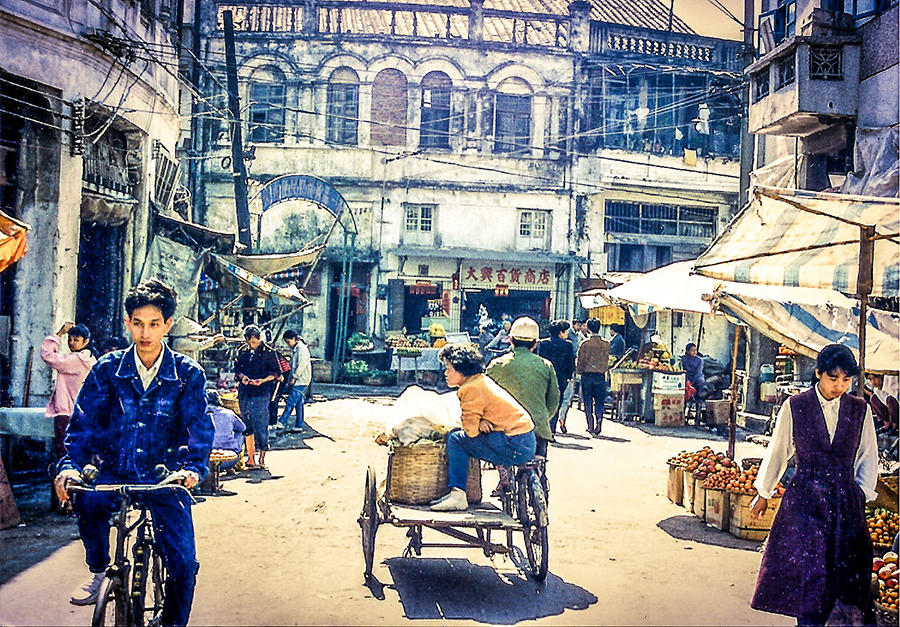
South of the waterway I felt I was walking through the older streets of Malaysia's Penang! This was no mere coincidence. During the Ming and Qing dynasties many Chinese headed to European-colonised ports around the Strait of Malacca. Prospering, some returned to Hainan with wealth to erect distinctive architectural styles referred to as 'Sino-Portuguese' combining Chinese with Arabic and Portuguese characteristics. Most of the older buildings were whitish in -color while supporting ornate window design. Recessed pavements were protected from the weather by overhanging buildings. The sidewalks bustled with maritime-related walk-in shops, buying and selling equipment for the boats. The aroma of spices and traditional medicines along with cooking smells and sizzling sounds from pavement 'fast food' stalls filled the air. Men speaking incomprehensible dialects sat on bamboo stools playing cards or unfamiliar board games while Cantonese cassette music drifted out from scratchy speakers. Women wearing circular bamboo hats navigated bicycle carts loaded with everything from bundles of brushes or fishing nets to baskets of live chickens – surprisingly, Hainan's famed dish is chicken despite these colourful, noisy streets being home to fresh food markets with their large tanks of fish. In earlier days the district was divided into separate zones selling different products. By 1993 it had merged into one great trading area, which I felt was possibly the finest market area I had then come upon in China.

With fascination increasing I wandered through what felt like a significant part of maritime history seemingly frozen in time. Traders competed to show me what they were selling, but there was also a curiosity as to why I was so interested in what to them was just another old area! How could I start to explain what this discovery meant to me?
I could also see modern Haikou starting to rise with financial buildings, hotels and shopping centres. When I was last in Haikou, unfortunately a while ago, the city had transformed into a seemingly vibrant metropolis with sweeping coastal boulevards lined with coconut-palms; sea-fringing parks; beach related tourism while surviving older areas appeared somewhat pedestrian-friendly and at the heart of a history remembering the Maritime Silk Road era.
Reluctantly it was time to leave Haikou, but new discoveries awaited at the very south of the island, for Sanya, now one of China's leading holiday destination, sits close to an area known throughout history as 'The edge of the sky, the rim of the sea' (Tianya Haijiao).
From Haikou East Railway Station, 250 km/hr trains connect with Sanya in 1 hour 22 minutes but in 1993 it was a six-hour bus journey. Following the island's eastern coastline the route quickly lost the capital's semblance of modernity, instead increasingly penetrating tropical forests with a scattering of rice farming and fishing villages fronting a vista of wide, undeveloped sandy beaches.

Arriving in Sanya, the bus station was right in the heart of the old port, close to its major fishing harbour – the neighboring sea abundant with fish and other marine products. The old town occupied a narrow spit of land parallel to the ocean, creating a natural port on a mostly unsheltered coastline.
Tourism was in its infancy but construction underway suggested there were plans to develop the area into a major resort that would someday rival popular South East Asian destinations. Sanya has now become a leading winter location when often perfect weather attracts many visitors around the time of the Chinese Spring Festival. In 1993 the fledgling tourist area was centred around Dadonghai ('Big East Sea'), a short distance from downtown Sanya. Yalong Bay and other high-end hotel locations were still deserted sandy coves overlooked by small fishing villages.
Getting to Dadonghai was by something resembling a ride in a wartime motorcycle and side car. There were only a few domestic hotels – thankfully I had documents allowing me to stay domestically - although closer to the beach the first resort-style complexes were appearing. Foreign visitors who had discovered the area's charms were mostly teachers from Guangdong and a few expats wintering from colder northern cities. It was a landscape of beautiful beaches lined by coconut palms with a backdrop of the partly forested hills. The sea looked both clear and clean, indeed it has become an area for snorkelling and diving around offshore coral reefs. It seemed incredible that Hainan was a dreaded place of exile during the Ming and Qing periods – an area of fearsome tribes and malarial swamps – today a 'must get to' destination!

To appreciate the area's geography I followed a path up Luhuitou ('Deer Turning Backwards') Hill where a café sat amidst colourful surroundings of purple, pink and red flowering bushes. Looking out over a scene of many bays enclosed by green, verdant hills with shimmering blue seas I was reminded of the Mediterranean. It really did have that feel and below amongst the coconut groves of Luhuitou I could see areas being prepared for development. Some of China's top resort hotels are today located there. But in 1993 I descended to small villages reached by gravel roads where local shops sold coconut juice and cold drinks for a couple of yuan. This was a location I returned to many times, particularly in the late afternoon to enjoy the sun setting over offshore, hilly islands, just as fishing boats headed back to the harbor.
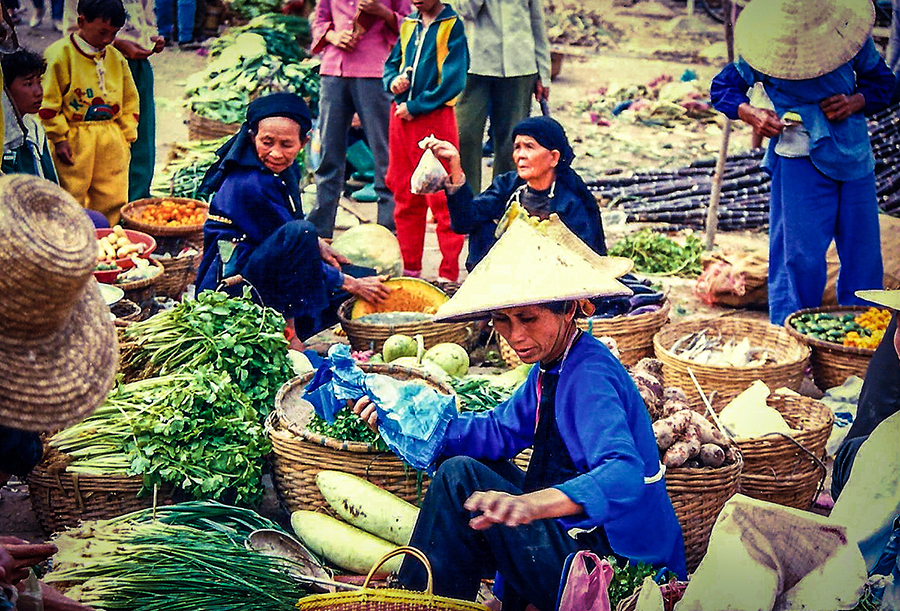
Sanya was also a port on the Maritime Silk Road and like Haikou, its older areas were a joy to explore. Little wooden vessels serving as cross-harbour ferries allowed for close-up views of boats and local life tied up with maritime commerce, trade and of course, fishing. But it was also the major town for much of southern Hainan. The central market was a photographer's dream with colourful displays of exotic fruits, vegetables and circular bamboo stockades teaming with chickens and geese. For me it was also a first experience to come close to some of China's ethnic groups – while the Li and Miao inhabited nearby forested, hilly areas, close to Sanya there were Moslem communities with women wearing bright coloured head scarves. Legend suggests they were descendants of Asian seafarers from a trading vessel that shipwrecked several hundred years previously.
To be continued...