(Source: China Daily)
Concrete moves needed for denuclearization: China Daily editorial
chinadaily.com.cn | Updated: 2018-10-07 21:14
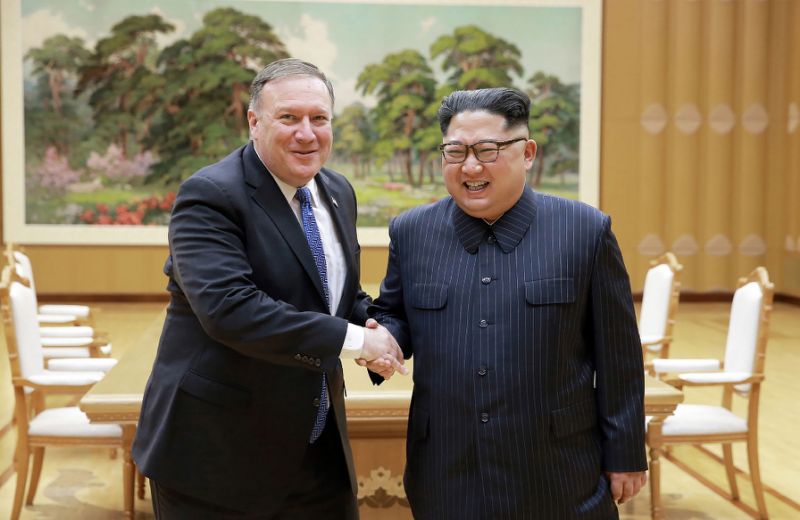
Absent the widely anticipated agreement on a second summit meeting between the leaders of the United States and the Democratic People's Republic of Korea, US Secretary of State Mike Pompeo's fourth trip to Pyongyang did not produce the widely expected outcome.
Yet let's not call the visit fruitless.
Considering the top US diplomat did not even meet with Kim Jong-un on his last visit, and he and Kim talked for two hours this time, with the latter promising to continue working toward denuclearization, it was as said "better than last time".
Both Pyongyang and Washington have expressed dissatisfaction with the lack of progress made since US President Donald Trump and Kim met in Singapore in June, and they have both questioned the other's sincerity. While Washington has insisted Pyongyang has not done enough to denuclearize, the latter has argued it needed to see the former reciprocate.
Pyongyang having dismantled a nuclear test site and then missile facilities, agreeing to a peace treaty to end the 1950-53 war, which concluded with armistice, would have cost nearly nothing on Washington's part and been a reciprocal sign of good faith, especially given Pyongyang had earlier offered to dismantle another nuclear site.
With a peace treaty seemingly not yet forthcoming, that Pyongyang and Washington have reaffirmed their shared willingness to sustain their detente is in itself surely something worth celebrating. With all that has happened, or not happened, a common resolve to keep things moving forward toward amicable relations and denuclearization of the peninsula is surely precious.

The short trajectory of the latest US-DPRK detente has already shown that as long as both parties demonstrate sincerity, previously unimaginable things may happen. Just months back, who would anticipate Pyongyang being so enthusiastic about ending animosity, even willing to negotiate over nuclear weapons, which it had long held as non-negotiable?
It certainly would have been better had Pompeo left Pyongyang with an agreement on a second summit meeting. But once the two leaders do meet again, no matter where, no matter when, they will have to have in place something concrete to deliver. The two parties obviously need more time for that.
The bargaining will be tougher going forward — as one official on Pompeo's team observed, it is likely to be a long haul.
But the detente, and denuclearization, will surely not be materialized with the United Nations sanctions now in place. Pyongyang has just reiterated denuclearization will not happen unilaterally, the ball is in Washington's court.
Two systems still in place despite claims to contrary: China Daily editorial
Ungrounded accusations from some foreign governments over the decision by the Immigration Department of the Hong Kong Special Administrative Region not to renew the work visa of a foreign correspondent in the SAR are the latest attempt to undermine the principle of "one country, two systems" and attack the central and SAR governments.
Although the Hong Kong immigration authority has not given any specific reasons for not renewing the work visa of Victor Mallet, Asia news editor at the Financial Times, it is a usual practice of immigration authorities worldwide not to comment on individual cases, and visa renewal is a sovereign right that no other governments are allowed to interfere in.
Foreign governments demanding an explanation know this. What they really want is not an answer but to create the illusion that freedom of speech and the press in Hong Kong is dwindling.

The fact is, Hong Kong's Immigration Department rejects countless visa renewal applications for various reasons every year, and dwelling on the visa problem of one foreign journalist in the city is nothing but making a mountain out of a molehill. The news media in Hong Kong, local or foreign, is operating as freely as before and nobody's voice, as long as it remains within the boundaries of the law, is stifled. Hong Kong certainly imposes much less immigration restraints than the United States does on the grounds of national security.
There is also the allegation that the central government is trying to "mainlandize" the SAR. In fact, should "mainlandization" mean the SAR further integrates into the country's overall development strategy, it is something good and what the SAR should continue to do. However, the accusers' real intention is to smear the way "one country, two systems" is being practiced.
President Xi Jinping has repeatedly pointed out: "one country, two systems" is to be implemented without any distortion. Thus the commissioner of the Ministry of Foreign Affairs in Hong Kong has resolutely voiced his support to the SAR authorities for duly exercising their power over immigration affairs vested in them by the Basic Law.
Contrary to the picture foreign politicians and activists have painted, the SAR is maintaining its unique system as enshrined in the Basic Law while moving forward together with the country in various aspects.